- Fungi Including Lichens
- ›Basidiomycete Fungi
- ›Higher Basidiomycetes
- ›Mushrooms, Bracket Fungi, Puffballs, and Allies
- ›Russulales
- ›Bondarzewiaceae
- ›Heterobasidion
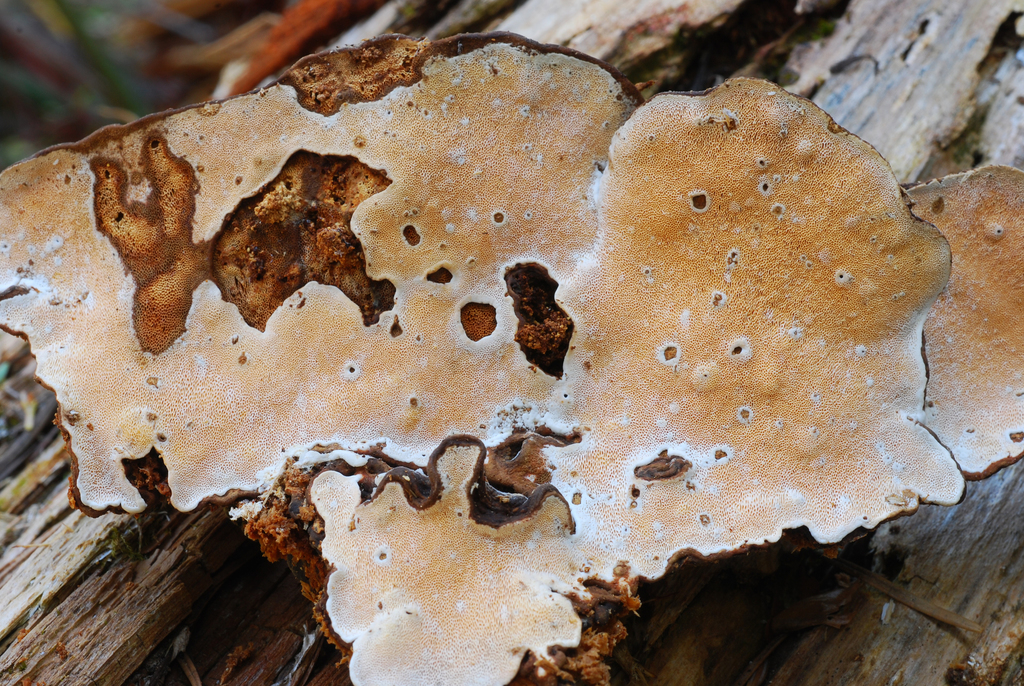
Heterobasidion occidentale
Heterobasidion occidentale is a tree root-rotting pathogenic fungus in the family Bondarzewiaceae. It is endemic in western North America west of the Rocky Mountains from Alaska to southern Mexico. While a natural agent of forest turnover, H. occidentale has become of increased concern due to forest management processes such as pre-commercial thinning, altered site density and species composition, and carbon sequestration. H. occidentale is part of the S-type intersterility group differing from the other North American species H. irregulare.
From the article Heterobasidion occidentale on Wikipedia (CC BY-SA), quoted section by section
Description
The cap is usually wider (and commonly taller) than its depth from the wood. It is 2–15 centimetres (1–6 in) wide, sometimes fuzzy when young and knobby when old. The upper surface of the small shelf or "conk" is dark brown to black, and the margin has an irregular edge. The larger base is covered with white spore tubes. The flesh is whitish and displays annual tube layers. Identification in affected wood, known as white pocket rot, includes symptoms in the form of dark discolouration around the heartwood near the base. Heavily diseased wood will be soft, stringy, and fibrous that may contain black specks parallel to the grain. Quick identification of affected wood can be done by wrapping suspect wood in damp paper towels and left for 5–6 days for the tell-tale formation of the conidial anamorph, Spiniger meineckellus. The basidiospores are spherical to ellipsoid, distinctive of the family Bondarzewiaceae.
Similar species. Distinction from H. irregulare is difficult as both share similar morphologies, distribution, and host range. In stands were both species are endemic, differentiation by hosts is unreliable due to shared host species and the potential spread from root contacts from other host species. Identification using genetic methods is the most accurate method for differentiation. …
Range & habitat
H. occidentale is found in Western North America from Alaska to Southern Mexico. It is found as far inland as Colorado and Montana, but has not been observed east of the Rocky Mountains. The incidence is of highest importance in stands of intensive silviculture, such as Christmas tree plantations. It is also of high importance to the Abies religiosa forests in Central Mexico that are the winter home for the monarch butterfly (Danaus plexipus). The perennial basidiocarps tend to form near the forest floor of affected trees, either on the base or roots of living or dead specimens, and thus may be hidden in the forest duff.
Wikipedia: “Distribution and habitat”
What it does
H. occidentale affects several species of trees including major hosts including Douglas-fir (Pseudotsuga menziesii), western hemlock (Tsuga heterophylla), and various fir (Abies) species. Other notable hosts include sitka spruce (Picea sitchensis) as well as numerous deciduous trees such as red alder (Alnus rubra), bigleaf maple (Acer macrophyllum) and pacific madrone (Arbutus menziesii). Ornamental and landscape trees are seldom affected. This contrasts the Eurasian S-type species, H. parviporum, which has a fairly strict host range of spruce, fir, and larch. Heterobasidion can be spread through conidia, basidiospores, and mycelia. H. occidentale can not grow freely in soil and relies on aerial infection for distribution. Basidiospores can travel from the basidiocarps through the air infecting exposed sapwood from injured trees. Spores are present year-round, due to the perennial fruiting bodies, with the greatest quantity detected during spring and autumn in the Pacific Northwest. Forest distress such as pre-commercial thinning may increase spore release in affected forests. Conidia can travel through air, water, or soil and can survive up to 10 months in some soil types. Disease symptoms are worse on well-drained soil with little organic litter. …
Wikipedia: “Ecology”
Where it lives
Recorded sightings
—
geo-referenced records in GBIF, from museums, herbaria and field observers.
Drag the globe to turn it. Dots are where records exist, not a range map; darker means more records.
In the stacks
Searching the stacks…
Every page naming Heterobasidion occidentale in the Biodiversity Heritage Library →
This page is assembled live from iNaturalist, GBIF, Wikipedia, the Source Library and the Internet Archive. It is not yet part of the hand-edited codex. iNaturalist taxon 367290.