- Fungi Including Lichens
- ›Basidiomycete Fungi
- ›Higher Basidiomycetes
- ›Mushrooms, Bracket Fungi, Puffballs, and Allies
- ›Agaricomycetidae
- ›boletes and allies
- ›Suillineae
- ›Suillaceae
- ›Suillus
- ›Suillus
- ›Diversipedes
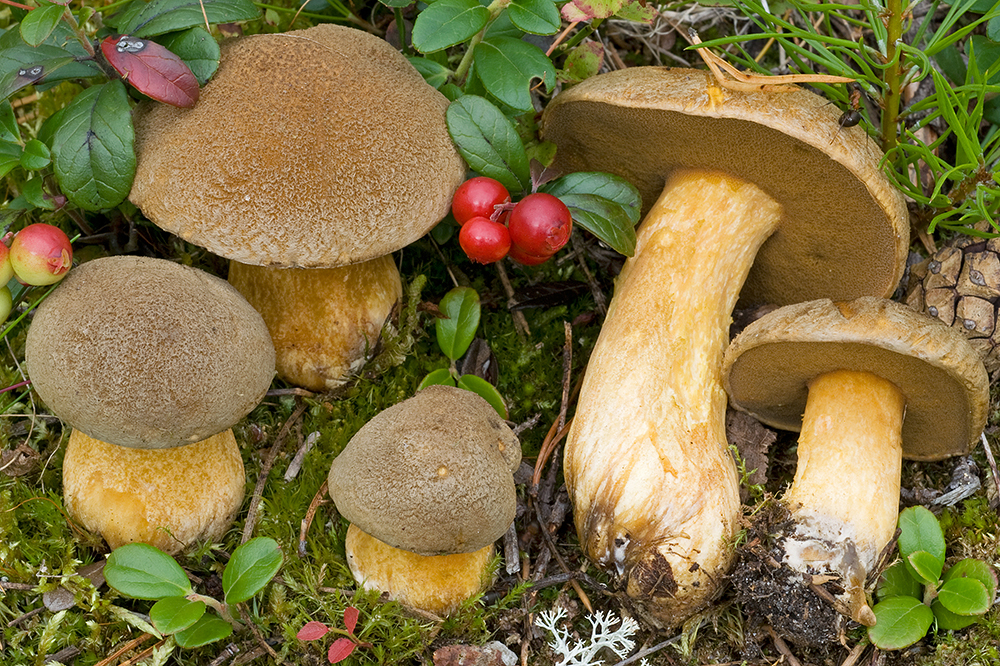
Velvet Bolete
Suillus variegatus
Suillus variegatus, commonly called the velvet bolete or variegated bolete, is a species of edible mushroom in the genus Suillus. Like all bolete-like species it has tubes, and pores, instead of gills under its cap. The mushroom forms a mycorrhizal relationship with pine and occurs in North America and Eurasia.
From the article Suillus variegatus on Wikipedia (CC BY-SA), quoted section by section
Description
The cap is 6 – 13 cm in diameter. It is rusty to tawny, or ochraceous, and has a velvety or downy feel when young. As it matures the surface becomes smoother, even greasy, and tacky in wet periods. The stem is ochre, more yellow towards the top, and may be flushed with rust at the base. It is sometimes slightly bulbous. The flesh is pale lemon, and may turn very slightly blue on cutting. The pores are ochre, becoming more cinnamon later, and the spore print is walnut brown. Said to smell like an 'Earth ball' fungus (Scleroderma). The variegatic acid is an orange pigment first isolated from Suillus variegatus. It has strong antioxidant properties, and a nonspecific inhibitory effect on cytochrome P450 enzymes. When mushroom tissue containing variegatic acid is exposed to air, the chemical is enzymatically oxidized to blue quinone methide anions.
Range & habitat
Suillus variegatus appears frequently with, and is mycorrhizal with two needle pine trees in late summer. It is often found with heathers, and other acid loving plants, on sandy soils. It is widespread in Europe, nearer parts of Asia, and North America.
Wikipedia: “Distribution and habitat”
At the table
Suillus variegatus is edible, but is said to smell unpleasant, with a somewhat metallic taste. It was one of the most productive edible wild mushroom species in Finland in the 1970s.
Wikipedia: “Edibility”
Where it lives
Recorded sightings
—
geo-referenced records in GBIF, from museums, herbaria and field observers.
Drag the globe to turn it. Dots are where records exist, not a range map; darker means more records.
In the stacks
Searching the stacks…
Every page naming Suillus variegatus in the Biodiversity Heritage Library →
This page is assembled live from iNaturalist, GBIF, Wikipedia, the Source Library and the Internet Archive. It is not yet part of the hand-edited codex. iNaturalist taxon 363593.