- Fungi Including Lichens
- ›Basidiomycete Fungi
- ›Higher Basidiomycetes
- ›Mushrooms, Bracket Fungi, Puffballs, and Allies
- ›Agaricomycetidae
- ›Common Gilled Mushrooms and Allies
- ›Marasmiineae
- ›Physalacriaceae
- ›Armillaria
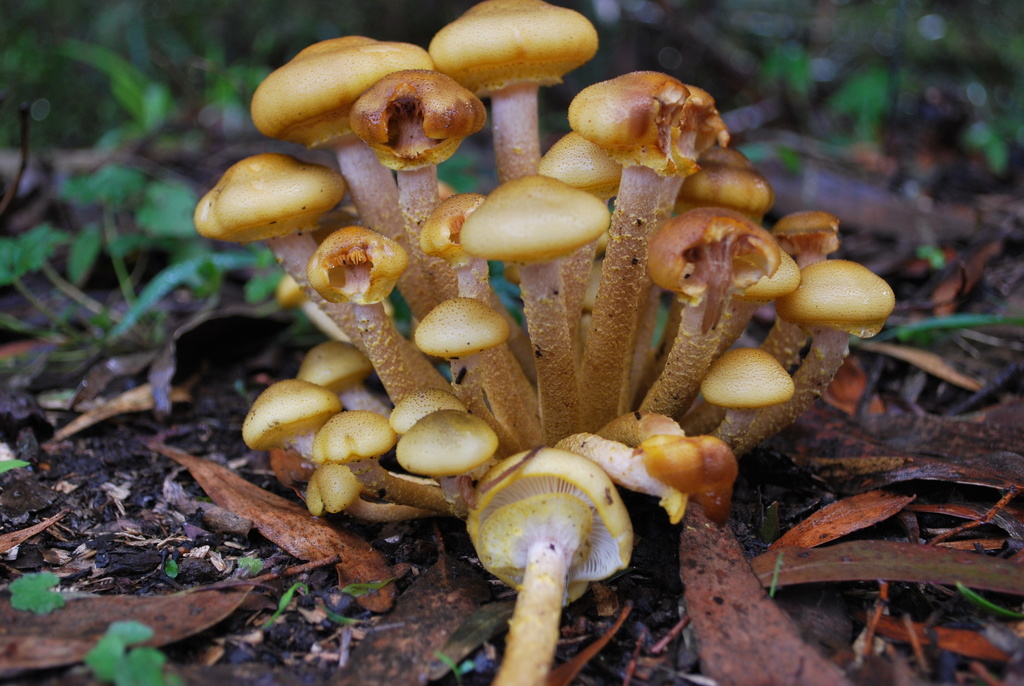
Australian honey fungus
Armillaria luteobubalina
Armillaria luteobubalina, commonly known as the Australian honey fungus, is a species of root rot fungus in the family Physalacriaceae.
It was first described in 1978, after having been discovered several years earlier growing in a Eucalyptus plantation in southeastern Australia. It distinguished itself from other known Australian Armillaria species by its aggressive pathogenicity. It may take years for infected trees to show signs of disease, leading to an underestimation of disease prevalence. Studies show that the spread of disease in eucalypt forests is associated with infected stumps left following logging operations. Although several methods have been suggested to control the spread of disease, they are largely economically or environmentally unfeasible. Phylogenetic analyses have determined that A. luteobubalina is closely related to A. montagnei and that both of these species are in turn closely related to the Brazilian species A. paulensis. The distribution of A. luteobubalina suggests that it is an ancient species that originated before the separation of the precursor supercontinent Gondwana.
From the article Armillaria luteobubalina on Wikipedia (CC BY-SA), quoted section by section
Description
Up to 10 cm (4 in) in diameter, the cap is convex to flattened in shape with a central umbo (a rounded elevation) and is various shades of cream, yellow and tan. The cap surface is covered with darker scales and feels rough to the touch. The cap edge, or margin, is rolled inward in young specimens. The crowded gills are sinuate and white to cream in colour initially, brownish-cream or pinkish brown in maturity, and sometimes with yellow or rust-coloured marks close to the margins. The stem is central (that is, it joins the cap in the centre) and is up to 20 cm (8 in) long by 1.5 cm (1 in) thick. It is slightly thicker at its base than its apex, sometimes almost bulb-like. The stem surface is streaked with fibrils that run up and down its length. It has a floppy yellow wool-like ring which may develop irregular, jagged edges with time. The flesh is white, and in the stem has a woolly or stringy consistency.
Microscopic characteristics. The spore print is white when fresh, but becomes more cream-coloured when dry. The smooth spores are oval to ellipsoid, hyaline (translucent), non-amyloid (meaning they do not absorb iodine from Melzer's reagent), and typically measure 6.5–7.5 by 4.5–5.5 μm. The basidia (spore-bearing cells) are thin-walled, hyaline, and lack clamp connections at their bases. …
Range & habitat
Armillaria luteobubalina has been recorded in southeastern Australia, from the southeastern corner of Queensland through eastern New South Wales and across Victoria into southeastern South Australia. It also occurs in Tasmania and southwestern Western Australia. Those of the karri forests (consisting largely of the species E. diversicolor) of the southwest have paler and yellower caps than those in the jarrah forests (which contain predominantly Eucalyptus marginata) further north. The fruit bodies arise on wood, especially on stumps or around the base of trees, and often in huge numbers. They usually appear between April and July, although most production occurs in the second half of May. Abundant in woodlands, it can invade gardens and orchards, where it can attack many woody plants. The honey fungus infected and killed many plants near tuart trees (Eucalyptus gomphocephala) which had been cut down near Kings Park in suburban Perth. Armillaria luteobubalina is commonly found in eucalyptus forests in Australia, and is thought to be the most pathogenic and most widespread Armillaria species in the major western Australian forest types. The mushroom has also been reported from southern South America, in Argentina and Chile. A 2003 study of the molecular phylogenetics and pattern of its distribution in South America and Australia indicate that A. …
Wikipedia: “Habitat and distribution”
At the table
Although it has a hot-bitter taste, the species is edible, and cooking removes the bitterness.
Wikipedia: “Uses”
Where it lives
Recorded sightings
—
geo-referenced records in GBIF, from museums, herbaria and field observers.
Drag the globe to turn it. Dots are where records exist, not a range map; darker means more records.
In the stacks
Searching the stacks…
Every page naming Armillaria luteobubalina in the Biodiversity Heritage Library →
This page is assembled live from iNaturalist, GBIF, Wikipedia, the Source Library and the Internet Archive. It is not yet part of the hand-edited codex. iNaturalist taxon 355923.