- Fungi Including Lichens
- ›Basidiomycete Fungi
- ›Higher Basidiomycetes
- ›Mushrooms, Bracket Fungi, Puffballs, and Allies
- ›Agaricomycetidae
- ›Common Gilled Mushrooms and Allies
- ›Agaricineae
- ›Field Mushrooms and Allies
- ›Macrolepioteae
- ›Macrolepiota
- ›Macrolepiota
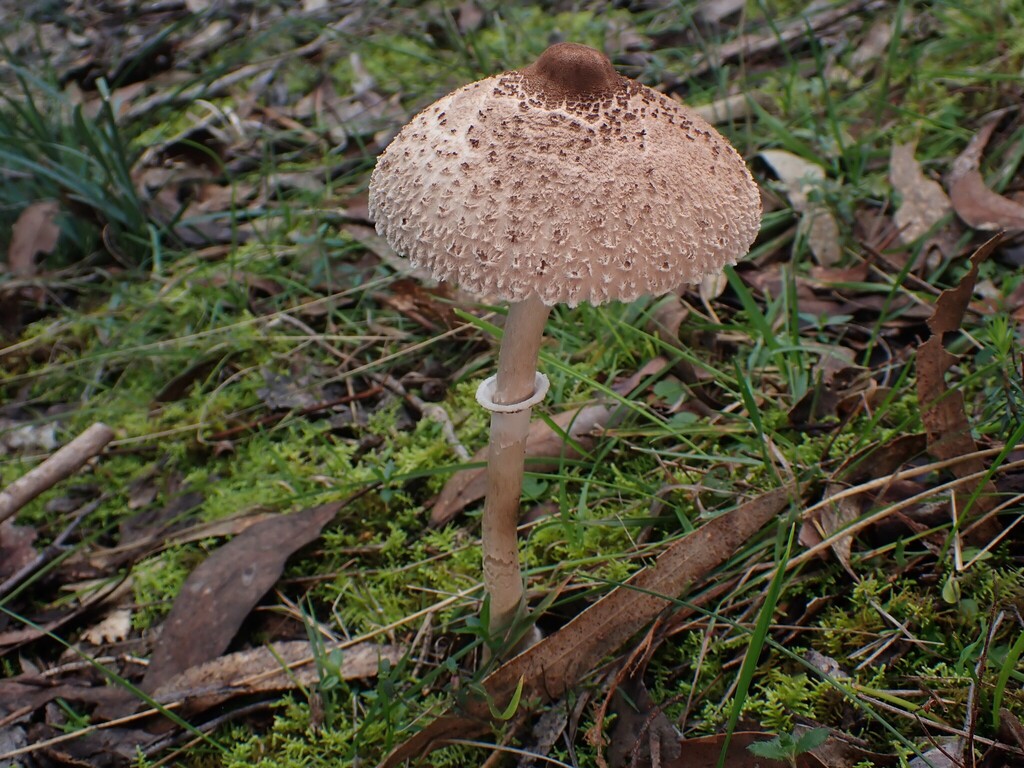
Graceful Parasol
Macrolepiota clelandii
Macrolepiota clelandii, commonly known as the slender parasol or graceful parasol, is a species of mushroom-forming fungus in the family Agaricaceae. The species is found in Australia and New Zealand, where it fruits singly or in small groups on the ground in eucalypt woodlands, parks, and roadsides. It is a tall mushroom up to roughly 20 cm (8 in), with a broad cap covered with distinctive rings of dark brown scales. The whitish gills on the cap underside are closely spaced and free from attachment to the slender stipe, which has a loose ring on its upper half, and a bulbous base. The edibility of the mushroom is not known with certainty, but closely related parasol mushrooms are edible and some are very sought after.
The fungus, first documented by naturalist John Burton Cleland in the early 20th century, was initially assumed to be the close relative Macrolepiota procera, a European species now known to be absent from Australia. Australian mycologist Cheryl Grgurinovic recognized Cleland's collections as a distinct species, officially describing it in 1997. The fungus has been referred to by several names: M. konradii, M. gracilenta, and M. mastoidea. Else Vellinga showed using molecular phylogenetic analysis that these names refer to European species and were misapplied by Australian authors.
From the article Macrolepiota clelandii on Wikipedia (CC BY-SA), quoted section by section
Description
The fruitbody of Macrolepiota clelandii has a cap that is initially egg-shaped, later becoming convex and then flattened in maturity, reaching diameters of 7.6–12.5 cm (3.0–4.9 in). It has a dark brown umbo and small dark brown scales that show the whitish flesh underneath. These scales are arranged in concentric rings that become increasingly crowded until the umbo, which is completely covered in scales. Small fragments of the partial veil may be left hanging on the cap margin.
The white gills are free from attachment to the stipe and closely spaced. The slender, hollow stipe measures up to 18.7 cm (7.4 in) long, and has a somewhat bulbous base. It has a pale brown colour, and features a ring on its upper half that often detaches to become freely movable up and down the stipe. The mushrooms have no distinctive odour. Its tall stature means the gills are usually clean, having avoided rain splash from the forest floor. According to Peter Roberts and Shelley Evans, all "parasol" species (i.e., M. procera and its close relatives, including M. clelandii) are edible. Anthony M. Young notes the similarity of M. clelandii to the edible European species M. konradii, but warns "the toxicity of the Australian species is unknown." Macrolepiota clelandii produces a white spore print. …
Range & habitat
Macrolepiota clelandii fruits singly or in small groups on the ground in grass or among leaf litter. It is typically found in eucalypt forest and subtropical rainforests. It has been recorded from Queensland, New South Wales, Victoria, South Australia, and Western Australia. In southwest Australia it is found in jarrah (Eucalyptus marginata) and karri (Eucalyptus diversicolor) forests, where fruiting usually occurs in late autumn and early winter. The fungus appears to prefer disturbed ground, as it is often found at roadsides by forests, on lawns, grassy areas of parks, and among the slash of thinned karri regrowth forests. It is common in river red gum (Eucalyptus camaldulensis) woodlands. M. clelandii also occurs in New Zealand, where it is found in mixed mānuka (Leptospermum scoparium), kānuka (Kunzea ericoides), and kauri (Agathis) forest, and in conifer plantations. It is the smallest and most slender of the Macrolepiota species that occur there.
== References ==
Wikipedia: “Habitat and distribution”
Where it lives
Recorded sightings
—
geo-referenced records in GBIF, from museums, herbaria and field observers.
Drag the globe to turn it. Dots are where records exist, not a range map; darker means more records.
In the stacks
Searching the stacks…
Every page naming Macrolepiota clelandii in the Biodiversity Heritage Library →
This page is assembled live from iNaturalist, GBIF, Wikipedia, the Source Library and the Internet Archive. It is not yet part of the hand-edited codex. iNaturalist taxon 354649.