- Fungi Including Lichens
- ›Basidiomycete Fungi
- ›Pucciniomycotina
- ›Pucciniomycetes
- ›rust fungi
- ›Uredinineae
- ›Pucciniaceae
- ›Puccinia
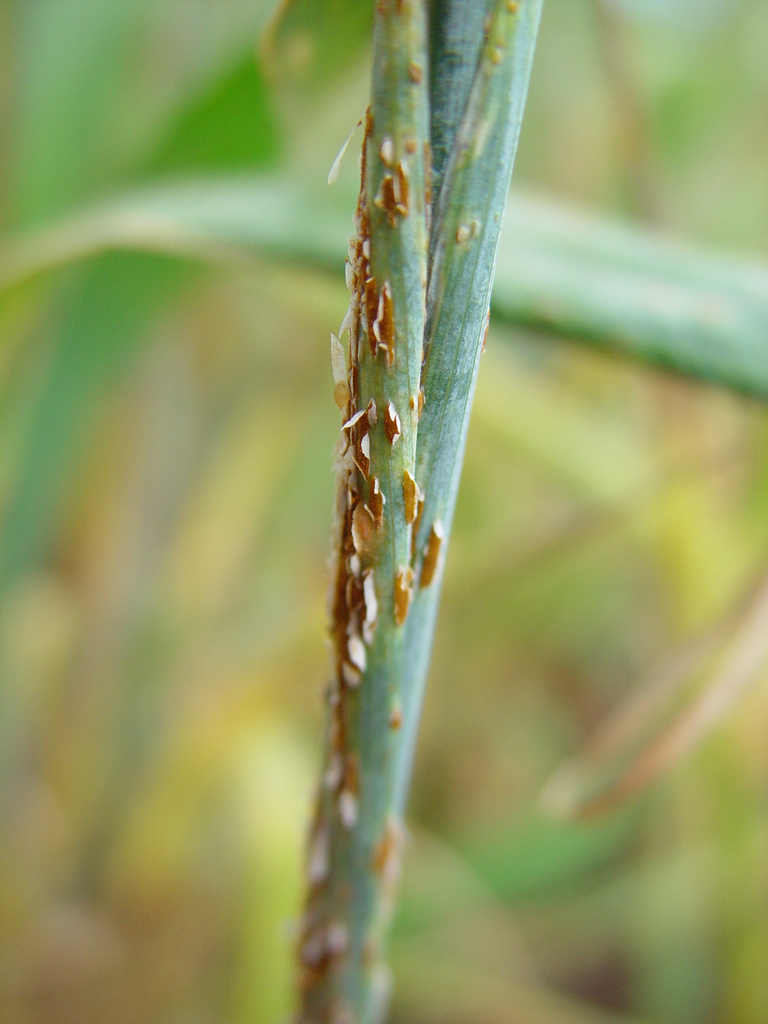
cereal rusts
Puccinia graminis
Stem rust, also known as cereal rust, black rust, red rust or red dust, is caused by the fungus Puccinia graminis, which causes significant disease in cereal crops. Crop species that are affected by the disease include bread wheat, durum wheat, barley and triticale. These diseases have affected cereal farming throughout history. The annual recurrence of stem rust of wheat in North Indian plains was discovered by K. C. Mehta. Since the 1950s, wheat strains bred to be resistant to stem rust have become available. Fungicides effective against stem rust are available as well.
In 1999 a new, more virulent race of stem rust was identified against which most current wheat strains show no resistance. The race was named TTKSK (e.g. isolate Ug99). An epidemic of stem rust on wheat caused by race TTKSK spread across Africa, Asia and the Middle East, causing major concern due to the large numbers of people dependent on wheat for sustenance, thus threatening global food security.
From the article Stem rust on Wikipedia (CC BY-SA), quoted section by section
What it does
Like other Puccinia species, P. graminis is an obligate biotroph (it colonizes living plant cells) and has a complex life cycle featuring alternation of generations. The fungus is heteroecious, requiring two hosts to complete its life cycle – the cereal host and the alternate host. There are many species in Berberis and Mahonia (and their hybrid genus x Mahoberberis) that are susceptible to stem rust, but the common barberry (B. vulgaris) is considered to be the most important alternate host. P. graminis is macrocyclic (exhibits all five of the spore types that are known for rust fungi). P. graminis can complete its life cycle either with or without barberry (the alternate host). P. g. tritici's obligately biotrophic lifestyle involves the dramatic up-regulation of particular gene transcriptions, constituting its biotrophy genomic features. These genomic regions have parallels in other eukaryotic plant pathogens. These parallels – between these independently evolved and unrelated sets of genes – show a strong and broad pattern of convergent evolution around the plant pathogenic lifestyle.
Life cycle on barberry. Due to its cyclical nature, there is no true 'start point' for this process. …
Wikipedia: “Life cycle”
In human culture
The fungal ancestors of stem rust have infected grasses for millions of years and wheat crops for as long as they have been grown. According to Jim Peterson, professor of wheat breeding and genetics at Oregon State University, "Stem rust destroyed more than 20% of U.S. wheat crops several times between 1917 and 1935, and losses reached 9% twice in the 1950s," with the last U.S. outbreak in 1962 destroying 5.2% of the crop. Stem rust has been an ongoing problem dating back to Aristotle's time (384–322 BC). An early ancient practice by the Romans was one where they would sacrifice red animals, such as foxes, dogs, and cows, to Robigus (fem. Robigo), the rust god. They would perform this ritual in the spring during a festival known as the Robigalia in hopes of the wheat crop being spared from the destruction caused by the rust. Weather records from that time have been reexamined and it has been speculated that the fall of the Roman Empire was due to a string of rainy seasons in which the rust would have been more harsh, resulting in reduced wheat harvests. Laws banning barberry were established in 1660 in Rouen, France. This was due to the fact that European farmers noticed a correlation between barberry and stem rust epidemics in wheat. …
Wikipedia: “History”
Where it lives
Recorded sightings
—
geo-referenced records in GBIF, from museums, herbaria and field observers.
Drag the globe to turn it. Dots are where records exist, not a range map; darker means more records.
In the stacks
Searching the stacks…
Every page naming Puccinia graminis in the Biodiversity Heritage Library →
This page is assembled live from iNaturalist, GBIF, Wikipedia, the Source Library and the Internet Archive. It is not yet part of the hand-edited codex. iNaturalist taxon 352070.