- Fungi Including Lichens
- ›Ascomycete Fungi
- ›Sac Fungi and Lichens
- ›Operculate Ascomycetes
- ›Pezizales
- ›Sarcosomataceae
- ›Pseudoplectania
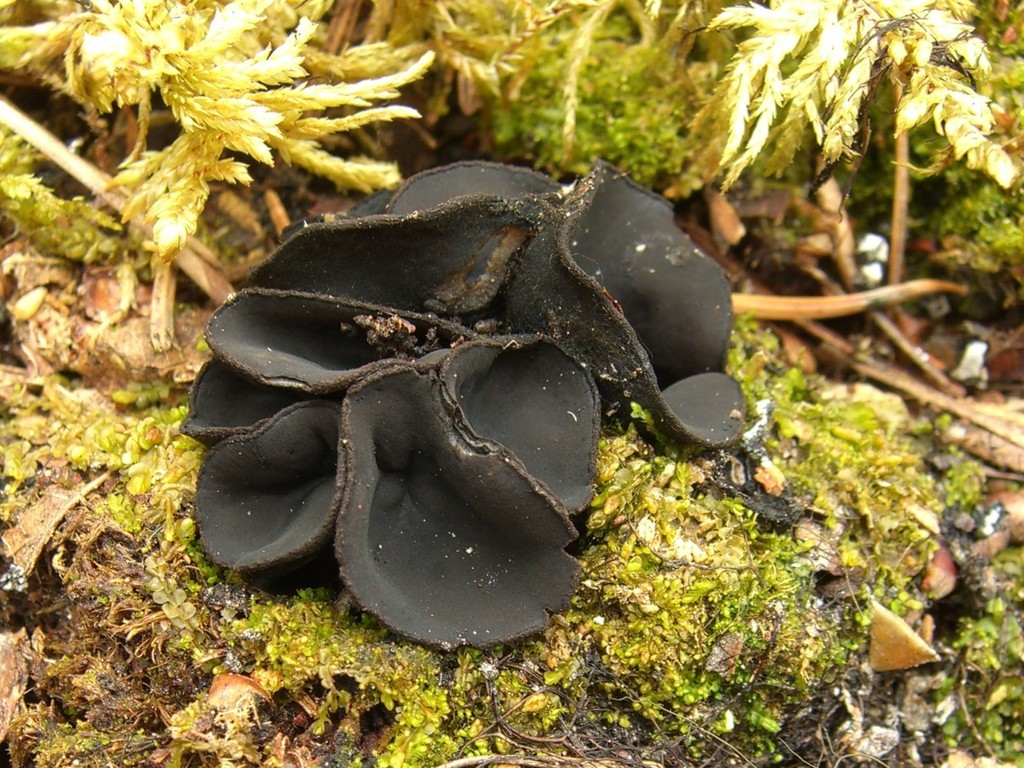
ebony cup
Pseudoplectania nigrella
Pseudoplectania nigrella, commonly known as the ebony cup, the black false plectania, or the hairy black cup, is a species of fungus in the family Sarcosomataceae. The fruit bodies of this saprobic fungus are small blackish cups, typically up to 2 cm (3⁄4 in) broad.
P. nigrella has a worldwide distribution, and has been found in North America, the Caribbean, Eurasia, Madagascar, and New Zealand. It grows in groups on soil or mossy rotting wood, often amongst pine needles. The fungus produces a unique chemical compound, plectasin, that has attracted research interest for its ability to inhibit the growth of the common human pathogenic bacterium Streptococcus pneumoniae.
From the article Pseudoplectania nigrella on Wikipedia (CC BY-SA), quoted section by section
Description
The fruit bodies (technically called apothecia) typically grow in groups, or sometimes crowded closely together, with small stems or missing them entirely. Initially, the fruit bodies are closed and roughly spherical, but as they develop they expand to become cup-shaped, or almost flat. The inner surface of the cups bear the reproductive spore-bearing layer, or hymenium; it is brownish-black, with an edge that is often wavy and curved slightly inwards, and covered with fine hairs. The cups may reach up to 2 cm (3⁄4 in) in diameter. The hairs are long but usually closely coiled and twisted, which gives the cap's exterior a slightly tomentose appearance of nearly uniform thickness. They are pale brown and 4–6 μm in diameter. The fungus has no distinctive taste or odor and is considered inedible.
The asci are roughly cylindrical with a long stem-like base; the entire ascus is often as long as 300–325 μm and about 15 μm in diameter at the thickest point. The spores are round, smooth, translucent (hyaline), and have diameters of about 12–14 μm. They are filled with many small oil droplets. The paraphyses (sterile filamentous hyphae in the hymenium) are enlarged at their tips and filled with brown colored matter, about 4 μm thick.
Similar species. Pseudoplectania sphagnophila resembles P. …
Range & habitat
P. nigrella has a worldwide distribution, and has been found in North America, the Caribbean, Europe, India, Madagascar, New Zealand, Israel, and Japan. This species is saprobic, and is found growing in groups on the ground or on moss-covered decaying wood, especially amongst fallen pine needles. In North America, fruit bodies appear in the spring and summer, and are fairly common; in Britain, the fungus fruits from winter to spring, and is rare. Its small size and dark color makes it easy to overlook.
Wikipedia: “Distribution and habitat”
Where it lives
Recorded sightings
—
geo-referenced records in GBIF, from museums, herbaria and field observers.
Drag the globe to turn it. Dots are where records exist, not a range map; darker means more records.
In the stacks
Searching the stacks…
Every page naming Pseudoplectania nigrella in the Biodiversity Heritage Library →
This page is assembled live from iNaturalist, GBIF, Wikipedia, the Source Library and the Internet Archive. It is not yet part of the hand-edited codex. iNaturalist taxon 351979.