- Fungi Including Lichens
- ›Basidiomycete Fungi
- ›Higher Basidiomycetes
- ›Mushrooms, Bracket Fungi, Puffballs, and Allies
- ›Agaricomycetidae
- ›Common Gilled Mushrooms and Allies
- ›Agaricineae
- ›Brittlestems and Allies
- ›Psathyrella
- ›Spadiceogriseae
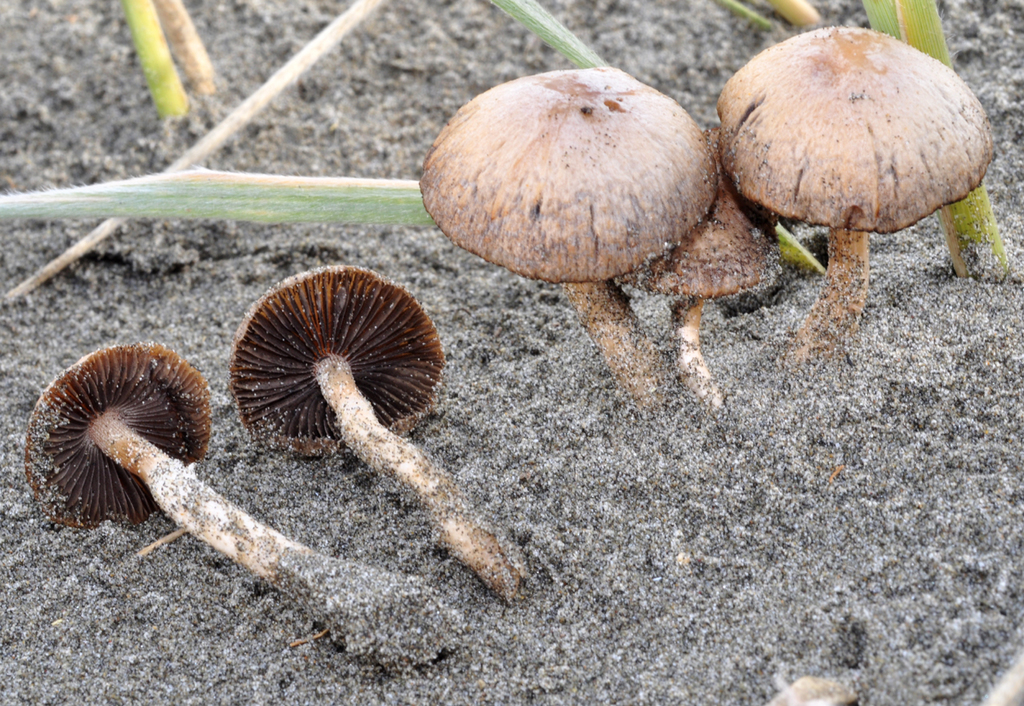
Beach Brittlestem
Psathyrella ammophila
Psathyrella ammophila is a species of fungus in the family Psathyrellaceae and is found throughout Europe. Commonly known as the dune brittlestem, this agaric primarily grows on sand dunes near marram grass, feeding saprotrophically on the decaying roots. In the Northern hemisphere, the season of growth is generally May to November.
P. ammophila is variable in appearance, changing colour and shape during its lifespan. Initially bell-shaped and tan or pale brown, the cap gradually flattens and darkens, becoming dark brown with a depressed shape as it ages.
From the article Psathyrella ammophila on Wikipedia (CC BY-SA), quoted section by section
Description
Typically small- to medium-sized, P. ammophila is found growing terrestrial or in small clumps near marram grass. The cap is a light clay-brown or tan when younger and about 1 to 4 centimetres (0.4 to 1.6 in) in diameter. Although the cap is generally smooth, it possesses microscopically tiny hairs and is often coated with sand particles. The tissue is not hygrophanous and therefore does not change colour with moisture loss and absorption, but the mushrooms do darken to a dark brown as they age. Cap shape begins as campanulate or convex, gradually flattening and possibly becoming depressed in shape. The gills of P. ammophila are crowded and attached to the stem usually broadly (adnate) but occasionally narrowly (adnexed). At a very young age they may be a pallid brown, but for most of the lifespan are dark brown, sometimes turning black. The stipe/stem is light grey to pale brown and centrally attached to the cap. The surface is smooth, sometimes with small vertical ridges. It is deeply rooted in the substrate for feeding on the roots of marram grass and for stability in its sand dune habitat. Above ground, its height is typically 3 to 7 cm (1.2 to 2.8 in) tall and its diameter is slender, about 2 to 5 mm (0.08 to 0.20 in). There is no ring. The basidia bear four spores. The spores are dark brown and smooth, ellipsoid in shape, and 10 to 11 μm × 6 to 7 μm. …
Range & habitat
Psathyrella ammophila has a wide but sparse distribution throughout the European continent and in limited coastal locations outside Europe, with records of collection in Algeria, New Zealand, and Canada. It can sometimes be found near the shoreline, inside the littoral zone, but is most often encountered in more stable and established sand dunes and dune slacks inland. The presence of marram grass nearby is a key aspect of its habitat, as it has a symbiotic (specifically, commensal) relationship with the plants, using their decaying roots as food. The mushrooms grow singly or in clumps and are, to some degree, sympatric with the fly Delia albula. The fungivorous larvae of the fly develops in P. ammophila parasitically, though will also attack other fungi.
Wikipedia: “Distribution and habitat”
Where it lives
Recorded sightings
—
geo-referenced records in GBIF, from museums, herbaria and field observers.
Drag the globe to turn it. Dots are where records exist, not a range map; darker means more records.
In the stacks
Searching the stacks…
Every page naming Psathyrella ammophila in the Biodiversity Heritage Library →
This page is assembled live from iNaturalist, GBIF, Wikipedia, the Source Library and the Internet Archive. It is not yet part of the hand-edited codex. iNaturalist taxon 351954.