- Fungi Including Lichens
- ›Basidiomycete Fungi
- ›Higher Basidiomycetes
- ›Mushrooms, Bracket Fungi, Puffballs, and Allies
- ›Agaricomycetidae
- ›Common Gilled Mushrooms and Allies
- ›Agaricineae
- ›Hymenogastraceae
- ›Phaeocollybia
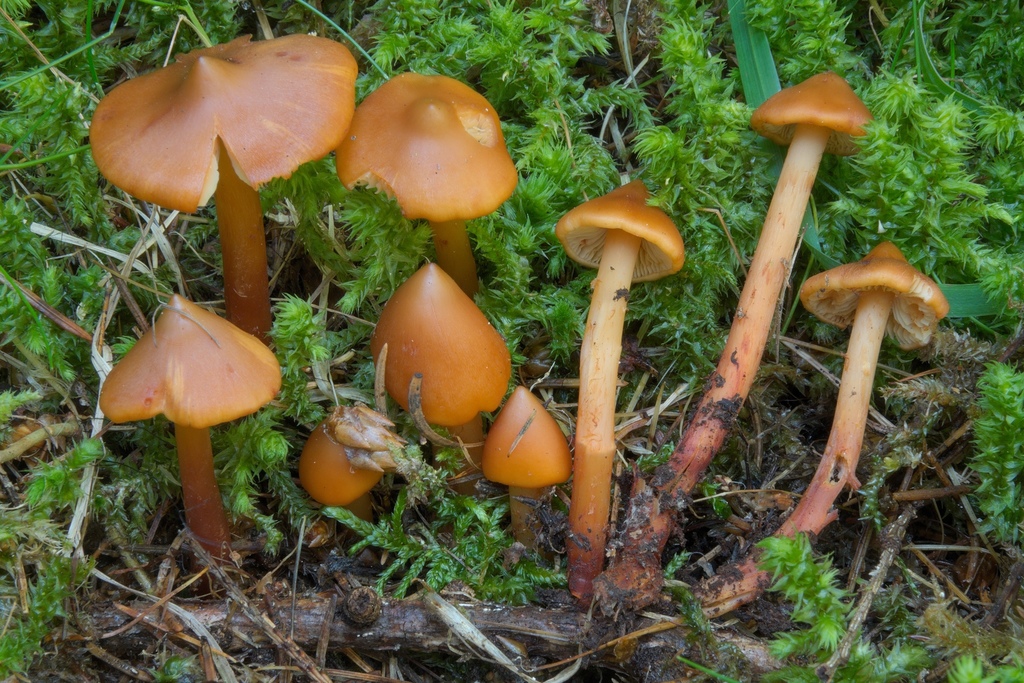
Christina's rootshank
Phaeocollybia christinae
Phaeocollybia christinae, commonly known as Christina's rootshank, is a species of fungus in the family Cortinariaceae. Found in the woodlands of Europe and eastern North America, it typically grows in sandy soil near conifer trees, especially spruce. The fruit bodies are characterized by a brownish cap with a pointed umbo, and a long stem that extends deeply into the soil.
From the article Phaeocollybia christinae on Wikipedia (CC BY-SA), quoted section by section
Description
The cap is initially conical before expanding to become broadly conical with a pointed umbo; it reaches a diameter of 2–5 cm (0.8–2.0 in). The cap surface is smooth, and marked by a variable number of raised radial grooves extending from the center of the cap to the margin. Depending on the age of the fruit body and the levels of moisture in the environment, the cap may be sticky or moist. When hydrated, the cap color is orange-red to yellow-brown; the color fades to reddish yellow, gold-colored, or tawny when dry. The cap flesh is the same color as the cap surface. The gills are slightly adnexed and seceding, and crowded closely together. They are initially pallid before becoming fulvous to deep reddish-yellow, slightly spotted, and shining. The stem is 6–8 cm (2.4–3.1 in) long by 0.4–0.6 cm (0.16–0.24 in) thick, and roughly equal in width throughout its length. The stem surface is smooth, and the stem flesh has a cartilage-like consistency. The base of the stem is radicating, that is, it extends deep into the substrate. Its color is dark red, lightening to pale reddish-yellow near the top. The mushrooms have an odor and taste comparable to radishes or almonds. The mushroom is inedible. The spore print is colored cinnamon to rusty brown. …
Range & habitat
Fruit bodies of Phaeocollybia christinae grow scattered or in groups, deeply rooted in moss or leaf litter. Suspected to be mycorrhizal, they usually appear under conifer trees, particularly spruce. The fungus is found in Europe and eastern North America.
Wikipedia: “Habitat and distribution”
Where it lives
Recorded sightings
—
geo-referenced records in GBIF, from museums, herbaria and field observers.
Drag the globe to turn it. Dots are where records exist, not a range map; darker means more records.
In the stacks
Searching the stacks…
Every page naming Phaeocollybia christinae in the Biodiversity Heritage Library →
This page is assembled live from iNaturalist, GBIF, Wikipedia, the Source Library and the Internet Archive. It is not yet part of the hand-edited codex. iNaturalist taxon 351752.