- Fungi Including Lichens
- ›Basidiomycete Fungi
- ›Higher Basidiomycetes
- ›Mushrooms, Bracket Fungi, Puffballs, and Allies
- ›Agaricomycetidae
- ›Common Gilled Mushrooms and Allies
- ›Marasmiineae
- ›Mycenaceae
- ›Panellus
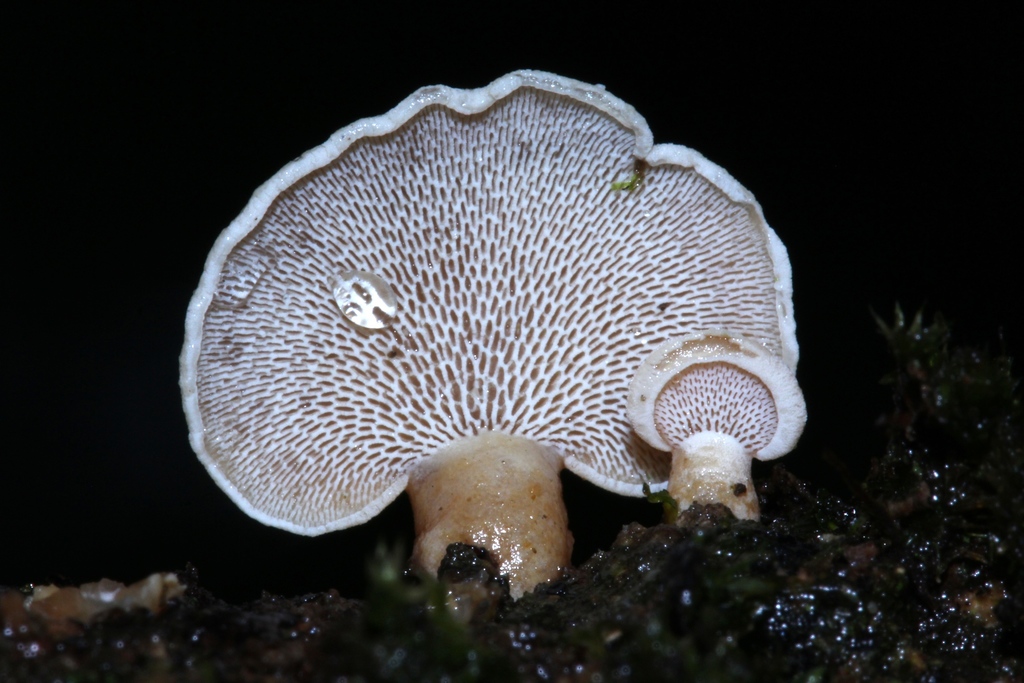
Panellus pusillus
Panellus pusillus is a species of fungus in the family Mycenaceae. A widely distributed species, it has been recorded in Australia, Asia, Europe, North America, and South America. The fungus was first given its current name in 1975, but has been known by many names since French physician and mycologist Joseph-Henri Léveillé first described it as Gloeoporus pusillus in 1844. A recent molecular phylogenetic study explored the diversity and phylogeny of Panellus, and used species like P. pusillus to identify five new poroid species from China in the genus.
The mushroom develops into flat and broadly round fan- or kidney-shaped caps that measure up to 16 mm broad. The caps go from white to buffish color, and attached to decaying by short stubby stalks that are connected off-center, giving the mushroom it's fan look. Its luminosity has been known for more than half a century and is observable in the fruiting body as well as mycelia both in the wild and in laboratory cultures. The glow is rather weak and requires time to adjust to the dark to be able to notice it, and it isn't often photographed.
From the article Panellus pusillus on Wikipedia (CC BY-SA), quoted section by section
Description
The mushroom is quite small and easy to miss in the daytime, with the widest cap reaching 16 mm. Supporting the cap is a stipe that is up to 6 mm long, 1–2 mm thick, with the base enlarged downward or nearly equal, finely pubescent, and is colored like the cap. The stipe can be eccentric or laterally attached to the cap. The cap itself is convex, semicircular to kidney- or fan-shaped (looks like a pong paddle, hence the name). The upper surface is white to whitish when young, soon becoming pinkish buff to pale salmon. It can be moist or dry, glabrous or finely pubescent, smooth or finely wrinkled, and sometimes with one or two very shallow concentric furrows. The fertile surface goes from whitish to pale pinkish buff. The margin is incurved, sometimes sulcate or splitting. The pores are angular, somewhat radially aligned, about 2-5 per mm of the fertile surface, and the tubes can run up to 1 mm deep. The flesh is up to 2 mm thick, firm and white, with a nondistinctive odor and taste. Panellus pusillus is reported as toxic in North Mexico according to a book, though there hasn't been many studies done on its potential toxicity.
Similar species. The relatives within Panellus genus such as P. stipticus appear very similar. Both have white spore prints and similar cap morphology, except P. stipticus has gills instead of pores and has a stronger bioluminescent glow. …
Wikipedia: “Morphology”
What it does
P. pusillus has been on almost every continent except Africa and Antarctica. It is distributed mostly in Florida where it receives a lot of humidity, often growing in dense groups and overlapping clusters on decaying broadleaves in the shade. In other words, it prefers to grow in the tropics and subtropics. (Wassink 1979) It tends to favor hardwoods, but it has been reported growing on rotten culm of bamboo, eucalyptus, and even pine. P. pusillus is a saprobic species and causes a white rot. This is a form of wood decay in which the wood assumes a bleached appearance and where lignin as well as cellulose and hemicellulose is broken down by enzymes secreted by the fungus.
Wikipedia: “Ecology”
In human culture
There is a lot of folklore in Japan surrounding bioluminescent fungi (including P. pusillus). Some examples are Kitsune-bi, meaning 'fox's fire', and Mino-bi, meaning 'raincoat fire'. Both Kitsune-bi and Mino-bi are partly considered to be responsible for the luminous mycelia growing on rotten wood or the straw of Mino, and were sometimes believed to be the work of foxes. Of note, Sakyo Kanda (1874–1939), the author of the book "Shiranui, Hitodama, and Kitsune-bi", which sheds light on the mysterious luminescence, was a biologist of luminous organisms, and he considered the major cause of the Japanese foxfire to be a misinterpretation of people's lanterns. Japanologist Katsumi Masuda theorized that P. pusillus is the one responsible for the glowing bamboo in The Tale of the Bamboo Cutter, with historian Michihisa Hotate agreeing with this hypothesis. The distribution records of P. pusillus were mainly in the southern part of Japan: Bonin Isls., Matsuyama (Ehime Prefecture), and Hachijo Isl., but also in central Japan. Shidei reported the growth of P. pusillus on bamboo in Kyoto. …
Wikipedia: “Japanese Folklore”
Where it lives
Recorded sightings
—
geo-referenced records in GBIF, from museums, herbaria and field observers.
Drag the globe to turn it. Dots are where records exist, not a range map; darker means more records.
In the stacks
Searching the stacks…
Every page naming Panellus pusillus in the Biodiversity Heritage Library →
This page is assembled live from iNaturalist, GBIF, Wikipedia, the Source Library and the Internet Archive. It is not yet part of the hand-edited codex. iNaturalist taxon 351677.