- Fungi Including Lichens
- ›Basidiomycete Fungi
- ›Higher Basidiomycetes
- ›Mushrooms, Bracket Fungi, Puffballs, and Allies
- ›Agaricomycetidae
- ›Common Gilled Mushrooms and Allies
- ›Agaricineae
- ›Verrucosporaceae
- ›Lepiota
- ›Lepiota
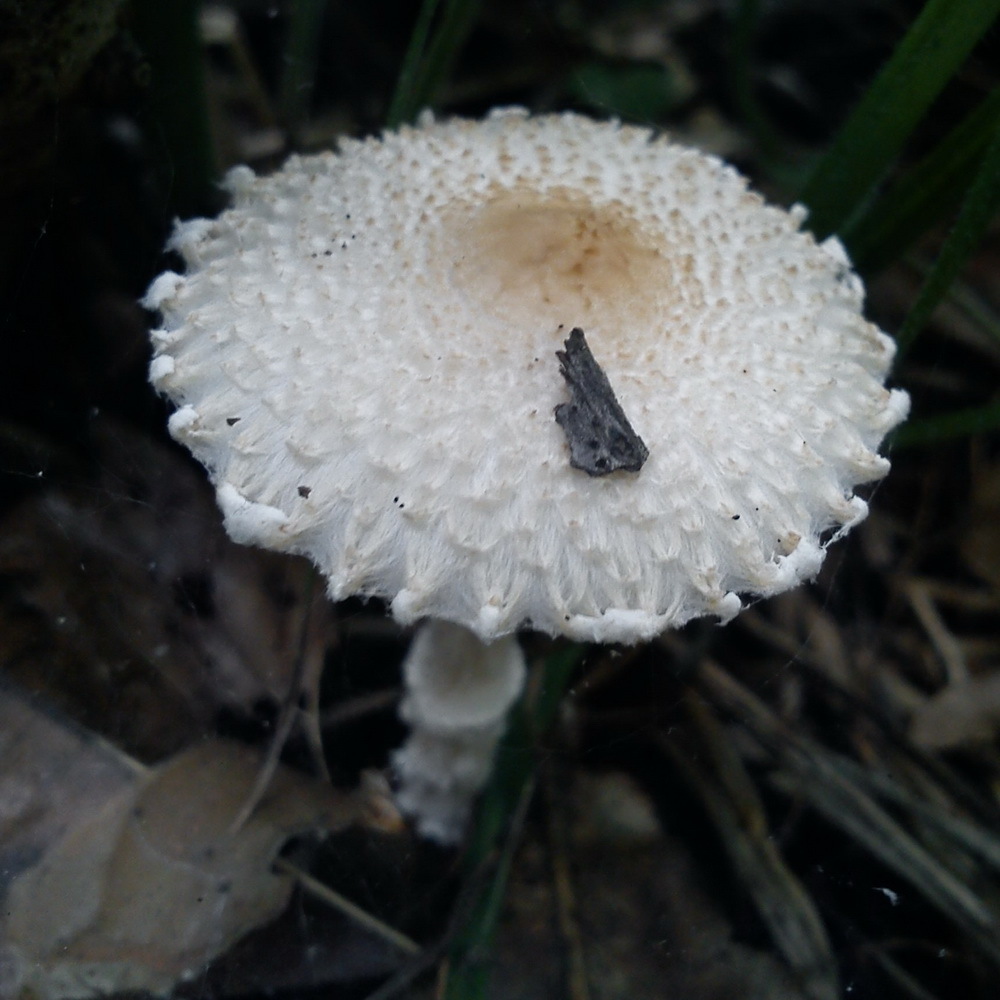
Shield Dapperling
Lepiota clypeolaria
Lepiota clypeolaria, commonly known as the shield dapperling or the shaggy-stalked Lepiota, is a common species of mushroom in the genus Lepiota. The fruit bodies have a brownish cap, a shaggy stipe with a collapsed, sheathing ring or ring zone, and spindle-shaped spores.
It is widely distributed in northern temperate zones, where it grows in deciduous and coniferous forests.
From the article Lepiota clypeolaria on Wikipedia (CC BY-SA), quoted section by section
Description
The cap is egg-shaped when young, soon broadly bell-shaped and has pale straw- or orange-brown scales on a pale background. The central umbo is covered with a well-delimited uniform disk of the same colour as the scales. It grows to a diameter of 4–7 cm (1.6–2.8 in). The gills are white, crowded, free from attachment to the stipe. The white stem has an indistinct ring, below which it is coarsely woolly, giving an appearance which is sometimes described as "booted". The stipe, which measures 5–12 cm (2.0–4.7 in) long by 0.3–1 cm (0.12–0.39 in) thick, is hollow and slender, expanding slightly at the base into a club shape. The flesh is white and has an unpleasant smell. The spore print is white. The spores are fuse-shaped (fusiform), meaning that they are tapered at both ends. They have dimensions of 12–16 by 5–6 μm. Cystidia on the gill edge (cheilocystidia) are club-shaped to cylindrical, and measure 20–40 by 5–15 μm.
Similar species. Lepiota ochraceosulfurescens may be distinguished as having a less defined dark area in the cap centre, a smell of rubber or melted butter, and yellow flesh in the stipe base, but Species Fungorum and Funga Nordica regard this name as a synonym. Lepiota magnispora is similar in appearance but has brighter colours with a more intensely coloured cap center and longer spores.
Range & habitat
The fruit bodies grow singly or in small groups on the ground in deciduous and coniferous forests. A common species, it is widespread in temperate regions of the Northern Hemisphere, and has been reported from Asia, Europe, North America, and South America. Fruiting occurs in autumn. In China, it is known from the provinces of Heilongjiang, Jilin, Liaoning, Jiangsu, Guangdong, and Yunnan.
Wikipedia: “Habitat and distribution”
Toxicity
L. clypeolaria is considered poisonous, but more importantly, it resembles some of the more deadly species of its genus.
Where it lives
Recorded sightings
—
geo-referenced records in GBIF, from museums, herbaria and field observers.
Drag the globe to turn it. Dots are where records exist, not a range map; darker means more records.
In the stacks
Searching the stacks…
Every page naming Lepiota clypeolaria in the Biodiversity Heritage Library →
This page is assembled live from iNaturalist, GBIF, Wikipedia, the Source Library and the Internet Archive. It is not yet part of the hand-edited codex. iNaturalist taxon 351371.