- Fungi Including Lichens
- ›Basidiomycete Fungi
- ›Higher Basidiomycetes
- ›Mushrooms, Bracket Fungi, Puffballs, and Allies
- ›Cantharellales
- ›Hydnaceae
- ›Craterellus
- ›Lamelles
Yellowfoot
Craterellus tubaeformis
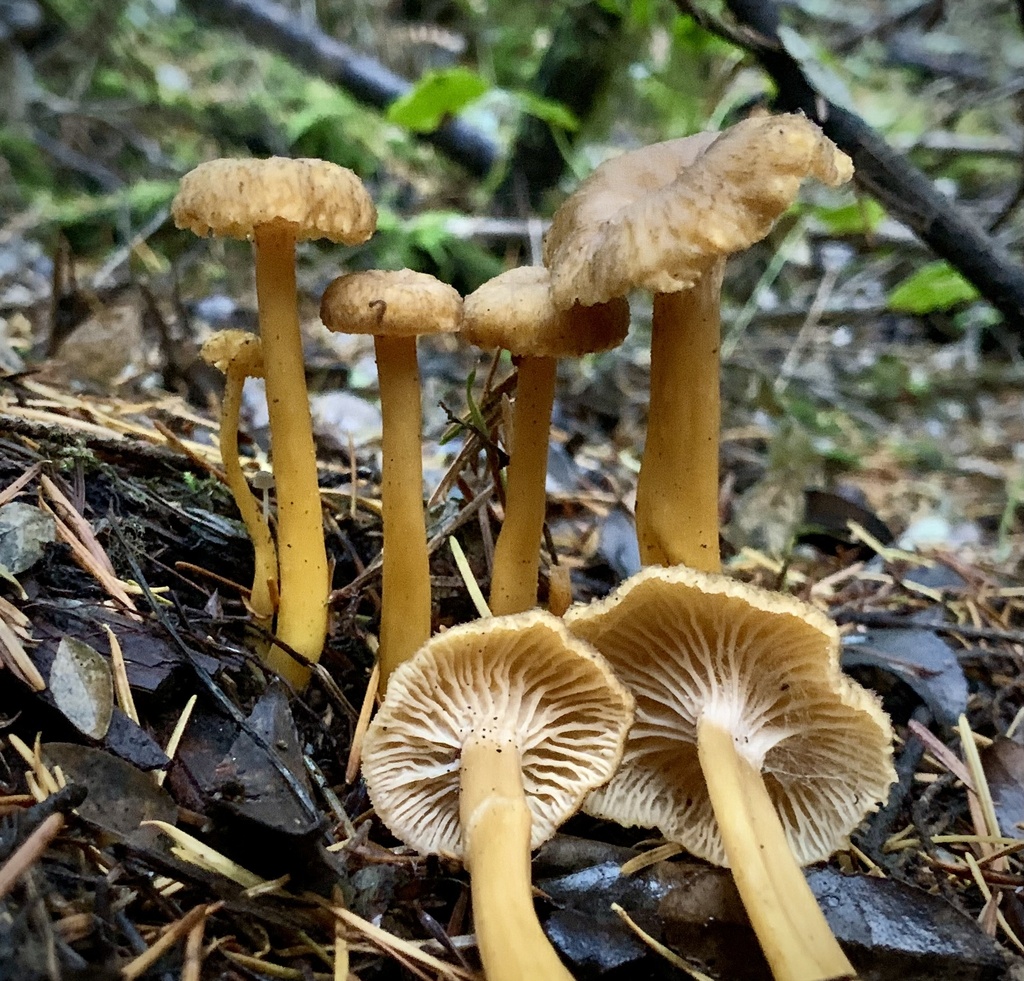
Craterellus tubaeformis (formerly Cantharellus tubaeformis) is a species of fungus, also known as the winter chanterelle, yellowfoot, winter mushroom, or funnel chanterelle. It was reclassified from Cantharellus, which has been supported by molecular phylogenetics.
C. tubaeformis is a yellowish-brown and trumpet-shaped mushroom found in great numbers late in the mushroom season, thus earning the common name winter mushroom. The cap is convex and sometimes hollow down the middle. The gills are widely separated and of lighter color than the cap.
From the article Craterellus tubaeformis on Wikipedia (CC BY-SA), quoted section by section
Description
The mushroom is mostly yellow with a grayish-brown cap. The cap is 1–4 centimetres (1⁄2–1+1⁄2 inches) wide, generally flat with a depressed center, funnel-shaped, waxy, with a wavy margin, and mild odor and taste. The gills are shallow, decurrent, forked, and pale. The hollow stalk is 2–12 cm (1–4+1⁄2 in) tall and 1 cm or less wide. It has a very distinctive smokey, peppery taste when raw. The spores are whitish, elliptical, and smooth. The spore print is light orangish-pink. It usually fruits later than other mushrooms, sometimes near Hydnum repandum. It usually grows in large groups.
Similar species. Cantharellus cibarius (the golden chanterelle) is larger, yellow, and funnel-shaped. It has a weaker but more fruity taste than C. tubaeformis.
The edible Craterellus lutescens has wrinkled hymenium without gills, differs slightly in colour and is found only in very wet places. Craterellus odoratus is bright yellow with a seamless cap and stem. Also similar are Cantharellus californicus and Cantharellus formosus (Pacific golden chanterelle).
Range & habitat
It grows in temperate and cold parts of North America (near both coasts) and Europe, including Scandinavia, Finland, Russia, and the British Isles, as well as in the Himalayas in Asia, including Assam, in the central parts of the Indian subcontinent, and in Thailand. Growing in large groups, it is most common in forests with a large amount of well-rotted coarse woody debris, growing on moss or rotten wood, and in North America mostly in conifer bogs. In the Pacific Northwest, it can be found from November to January.
Wikipedia: “Distribution and habitat”
What it does
The species is mycorrhizal (forming symbiotic associations with plants), providing an obstacle to its cultivation. The western North American C. tubaeformis has been shown to make ectomycorrhizal relationships with western hemlock (Tsuga heterophylla) and Douglas-fir (Pseudotsuga menziesii).
Wikipedia: “Ecology”
At the table
Though small, the mushroom is choice. It can be eaten with meat, in soups, pasta, and other dishes.
Wikipedia: “Uses”
Where it lives
Recorded sightings
—
geo-referenced records in GBIF, from museums, herbaria and field observers.
Drag the globe to turn it. Dots are where records exist, not a range map; darker means more records.
In the stacks
Searching the stacks…
Every page naming Craterellus tubaeformis in the Biodiversity Heritage Library →
This page is assembled live from iNaturalist, GBIF, Wikipedia, the Source Library and the Internet Archive. It is not yet part of the hand-edited codex. iNaturalist taxon 350511.