- Fungi Including Lichens
- ›Basidiomycete Fungi
- ›Higher Basidiomycetes
- ›Mushrooms, Bracket Fungi, Puffballs, and Allies
- ›Agaricomycetidae
- ›Common Gilled Mushrooms and Allies
- ›Agaricineae
- ›Hymenogastraceae
- ›Psilocybe
- ›Caerulescentes
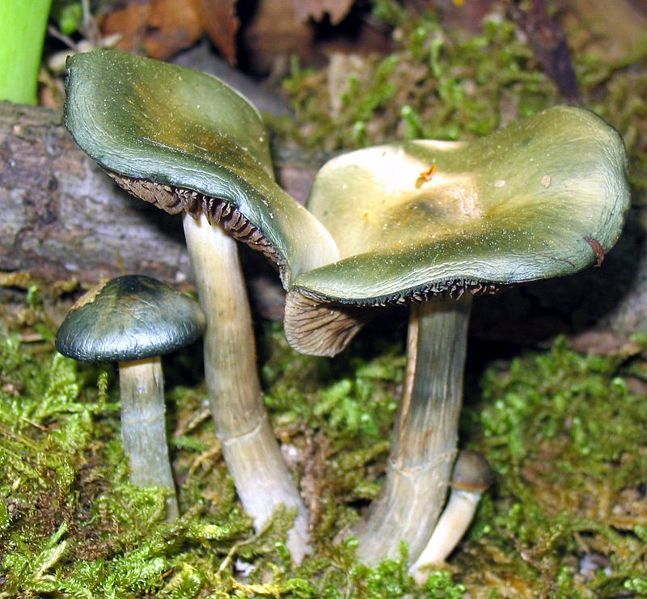
Psychedelic Ovoid Mushroom
Psilocybe ovoideocystidiata
Psilocybe ovoideocystidiata is a psilocybin mushroom in the section Stuntzae, having psilocybin and/or psilocin as main active compounds. It is closely related to P. subaeruginascens from Java, P. septentrionalis from Japan, and P. wayanadensis from India. This mushroom was first documented by Richard V. Gaines in Montgomery County, Pennsylvania in June 2003. Although it is sometimes confused with Psilocybe caerulipes, it can be distinguished by its rhomboid spores, larger stature, earlier fruiting season and membranous annulus.
From the article Psilocybe ovoideocystidiata on Wikipedia (CC BY-SA), quoted section by section
Description
Cap: (1) 1.5 — 5 (8) cm across, convex to subumbonate, chestnut or orangish brown to yellowish brown to pearly cream color, hygrophanous, glabrous, sub-viscid, translucent-striate near the margin, from slightly to highly undulated in maturity. During youth, the cap is usually highly convex and dark brown/black (the stem is white). During maturity, the entire mushroom becomes light-brown (cinnamon-brown when moist and light-beige when dry). Mature specimens often naturally exhibit blue-greenish bruising, and old, dried-out specimens are usually all black. Appearance may vary significantly among individuals, depending on maturity and location. Flesh thick, pliant. Bruises blue and green where injured. Gills: adnate attachment and range from whitish to rusty brown, lavender, or dark purple brown. Spore print: Dark purple brown. Stipe: (1.5) 3 – 9 (13) cm long by (2) 3 – 15 (20) mm wide, equal, somewhat subbulbous, hollow, base sometimes hypogeous, smooth at the top and often having small hairs near the bottom, colored whitish with irregular yellowish, brownish, or bluish tones. The partial veil is variable, ranging from a thin cortina that leaves a barely perceptible annular zone, to a substantial membrane that leaves a fairly persistent annulus. …
Range & habitat
Psilocybe ovoideocystidiata is mainly native to the Eastern United States, where its range stretches from Missouri east to Rhode Island and from Georgia north to Michigan. It is particularly common in the Ohio River valley. It also occurs in Western North America from Southern California north to British Columbia, Canada. As a relatively recently identified species, P. ovoideocystidiata is frequently reported to appear in new areas, leading some to speculate that its range is currently undergoing expansion. This species grows on woody debris and can be found along rivers and streams, usually in overflow areas, and in man-made mulch and wood chips in urban and suburban environments. It is sometimes found alongside Japanese knotweed and also tends to prefer shady areas and avoid direct sunlight. It is typically gregarious, growing in groups of several hundred individuals in one particular area, as well as in multiple small clusters of several mushrooms each, within close proximity of one another. Solitary specimens also occur on occasion. Seasonality varies a great deal depending on what region they are found in, but in the northeastern US, they are most common in the spring, from mid-April to late-June (peaking late-May), especially after periods of steady heavy rain for several consecutive days (a common weather pattern in the eastern US during spring). …
Wikipedia: “Habitat and distribution”
In human culture
The specific epithet refers to the abundant ovoid pleurocystidia and cheilocystidia of this species.
Wikipedia: “Etymology”
Where it lives
Recorded sightings
—
geo-referenced records in GBIF, from museums, herbaria and field observers.
Drag the globe to turn it. Dots are where records exist, not a range map; darker means more records.
In the stacks
Searching the stacks…
Every page naming Psilocybe ovoideocystidiata in the Biodiversity Heritage Library →
This page is assembled live from iNaturalist, GBIF, Wikipedia, the Source Library and the Internet Archive. It is not yet part of the hand-edited codex. iNaturalist taxon 348835.