- Fungi Including Lichens
- ›Basidiomycete Fungi
- ›Higher Basidiomycetes
- ›Mushrooms, Bracket Fungi, Puffballs, and Allies
- ›Agaricomycetidae
- ›Common Gilled Mushrooms and Allies
- ›Agaricineae
- ›Hymenogastraceae
- ›Hebeloma
- ›Sinapizantia
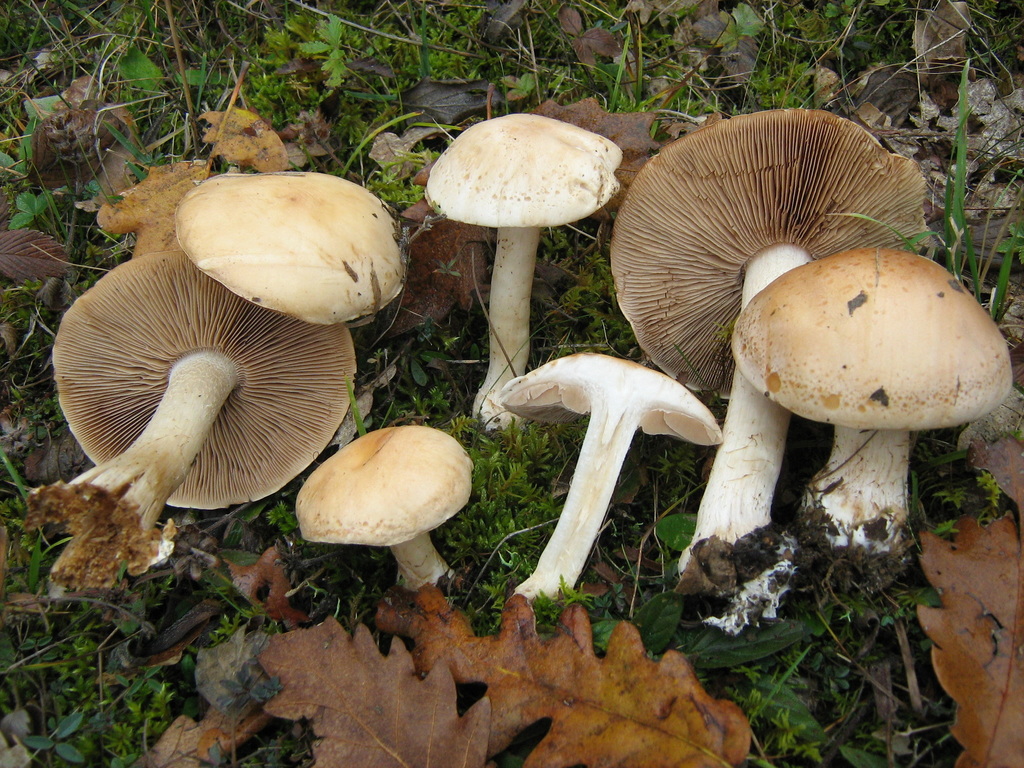
bitter poisonpie
Hebeloma sinapizans
Hebeloma sinapizans, commonly known as the rough-stalked Hebeloma, is a species of mushroom in the family Hymenogastraceae. It has a strong radish-like smell, and a prominent bulbous stem base. It is larger than the similar and more common H. crustuliniforme, a relative that is also poisonous. H. sinapizans is found in Europe and North America.
From the article Hebeloma sinapizans on Wikipedia (CC BY-SA), quoted section by section
Description
The fruit body has a cap that is initially convex before flattening out in age, reaching a diameter of 4–16 centimetres (1+1⁄2–6+1⁄2 inches). The cap may have a shallow umbo. The cap surface is smooth, moist to sticky, and first with an inrolled margin then becoming uplifted. It is tannish, sometimes with pinkish grayish tints. The gills have an adnate attachment to the stipe and have a notch just before the point of attachment; the gill edges have tiny fringes or serrations. They are first whitish before turning pale brown in maturity. The spore print is pale brown. The stipe measures 2–13 cm (1–5 in) long and 1–3 cm (1–3 cm) thick; it is roughly equal in width except for a swollen base. The flesh is whitish, thick, and has a radish-like odor and taste. The spores are elliptical with a rough surface texture and measure 10–14 by 6–8 μm.
Similar species. It is similar to the more common H. crustuliniforme, a smaller relative that is also poisonous.
Range & habitat
As of December 2022, the species has been found in 20 countries across Europe as well as in Asiatic Turkey and Lebanon. The fungus fruits on the ground in groups or fairy rings in deciduous and coniferous forests.
Wikipedia: “Distribution and habitat”
Where it lives
Recorded sightings
—
geo-referenced records in GBIF, from museums, herbaria and field observers.
Drag the globe to turn it. Dots are where records exist, not a range map; darker means more records.
In the old herbals & bestiaries

In the stacks
Searching the stacks…
Every page naming Hebeloma sinapizans in the Biodiversity Heritage Library →
This page is assembled live from iNaturalist, GBIF, Wikipedia, the Source Library and the Internet Archive. It is not yet part of the hand-edited codex. iNaturalist taxon 344561.