- Fungi Including Lichens
- ›Basidiomycete Fungi
- ›Higher Basidiomycetes
- ›Mushrooms, Bracket Fungi, Puffballs, and Allies
- ›Agaricomycetidae
- ›boletes and allies
- ›Sclerodermatineae
- ›Diplocystidaceae
- ›Astraeus
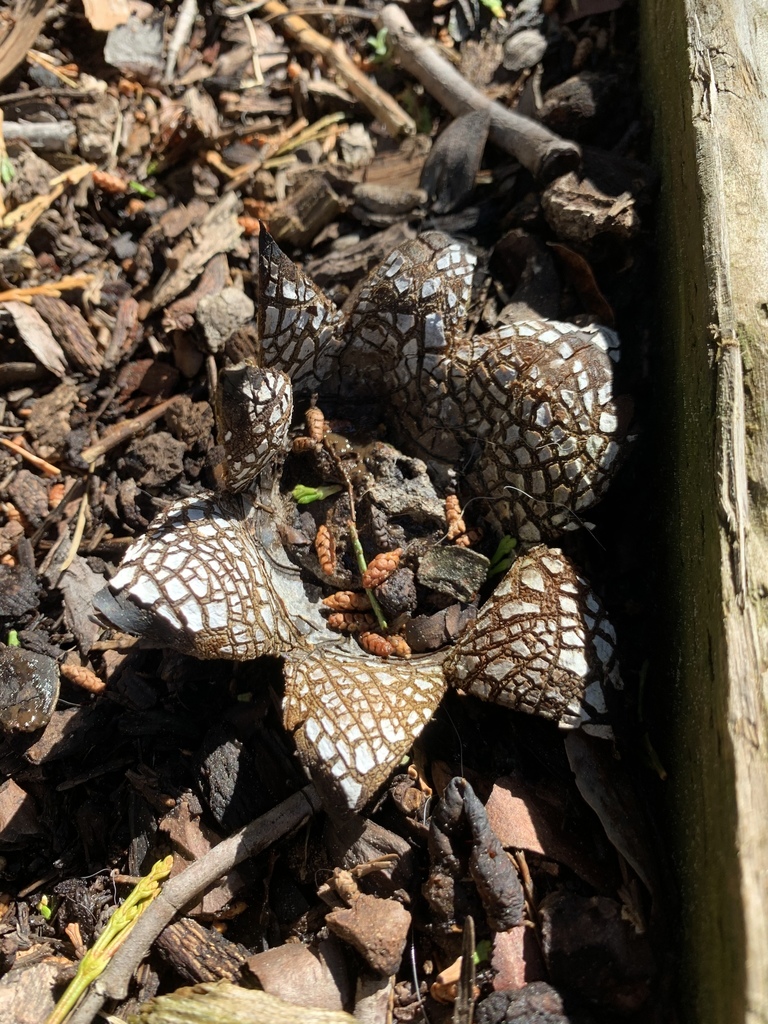
giant hygroscopic earthstar
Astraeus pteridis
Astraeus pteridis is a species of false earthstar in the family Diplocystaceae. It was described by American mycologist Cornelius Lott Shear in 1902 under the name Scleroderma pteridis. Sanford Myron Zeller transferred it to Astraeus in a 1948 publication. It is found in North America.
From the article Astraeus pteridis on Wikipedia (CC BY-SA), quoted section by section
Description
A. pteridis reaches 5 to 15 centimetres (2 to 6 in) or more when expanded, and often has a more pronounced areolate pattern on the inner surface of the rays. Like other Astraeus species, it is hygroscopic, with rays expanding in humid conditions and closing in arid conditions. It is not typically considered edible. It closely resembles the European A. hygrometricus, but is larger. Within Astraeus, A. pteridis is most closely related to A. morganii.
Range & habitat
A molecular phylogenetic study from 2013 resulted in the application of the name A. pteridis to the larger Astraeus found in the Pacific Northwest region of North America. A. pteridis has also been found in the Canary Islands, Madeira, and Argentina, which share historical connections to Lusitania. It may be widely distributed or have been translocated.
Wikipedia: “Distribution”
Where it lives
Recorded sightings
—
geo-referenced records in GBIF, from museums, herbaria and field observers.
Drag the globe to turn it. Dots are where records exist, not a range map; darker means more records.
In the stacks
Searching the stacks…
Every page naming Astraeus pteridis in the Biodiversity Heritage Library →
This page is assembled live from iNaturalist, GBIF, Wikipedia, the Source Library and the Internet Archive. It is not yet part of the hand-edited codex. iNaturalist taxon 344482.