- Fungi Including Lichens
- ›Ascomycete Fungi
- ›Sac Fungi and Lichens
- ›Common Lichens
- ›Shield Lichens, Sunburst Lichens, Rosette Lichens, and Allies
- ›Sunburst Lichens and Allies
- ›sunburst lichens, firedots, and allies
- ›Xanthorioideae
- ›Xanthomendoza
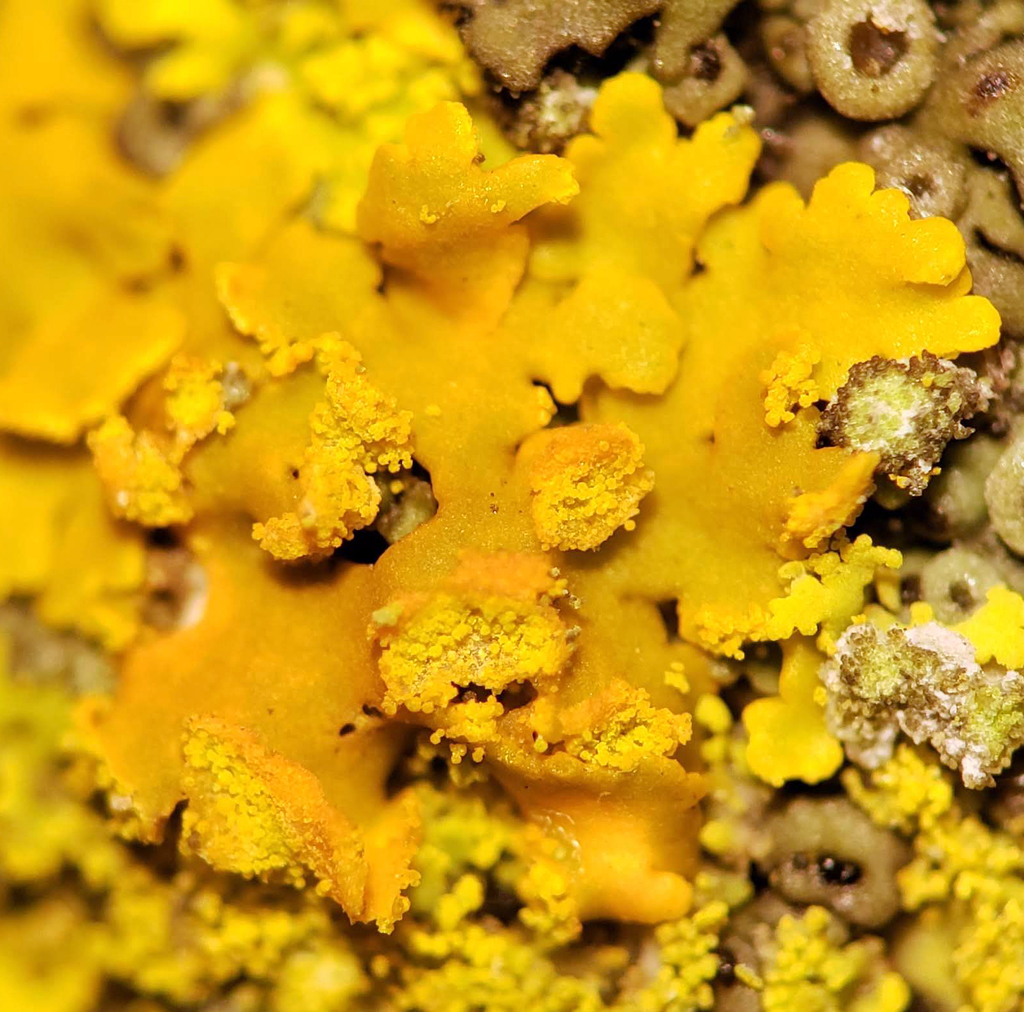
Hooded Sunburst Lichen
Xanthomendoza fallax
Oxneria fallax, also known as the hooded sunburst lichen, is a small yellow-orange to red-orange foliose lichen that grows on bark or rarely on rock or bone. It is found all over the world except very dry areas. In Nepal, O. fallax has been reported from 3,200 to 3,400 m elevation in a compilation of published records.
The non-fruiting body (thallus) grows in rosettes to 3 cm in diameter. The rosettes sometimes coalesce with each other. The lobes may appear divided at the tips. It is sometimes tightly appressed to the substrate (adnate), and sometimes not. The fruiting bodies (apothecia) are lecanorine, meaning that they are disc-like with a ring or rim of tissue around the disc that is made of tissue similar to the thallus. The tips of the lobes form hood shaped soralia that produce powdery greenish yellow soredia. It prefers growing on elm or oak bark, but can also be found on rocks, bone, or other wood types. In Norway, it has been recorded growing on the bark of various sun-exposed broadleaved trees, including Acer, Betula, Fagus, Fraxinus, Populus, Tilia, and Ulmus. Lichen spot tests on the surface are K+ (purple), C−, KC−, and P−.
Where it lives
Recorded sightings
—
geo-referenced records in GBIF, from museums, herbaria and field observers.
Drag the globe to turn it. Dots are where records exist, not a range map; darker means more records.
In the stacks
Searching the stacks…
Every page naming Xanthomendoza fallax in the Biodiversity Heritage Library →
This page is assembled live from iNaturalist, GBIF, Wikipedia, the Source Library and the Internet Archive. It is not yet part of the hand-edited codex. iNaturalist taxon 344442.