- Fungi Including Lichens
- ›Basidiomycete Fungi
- ›Higher Basidiomycetes
- ›Mushrooms, Bracket Fungi, Puffballs, and Allies
- ›Agaricomycetidae
- ›Common Gilled Mushrooms and Allies
- ›Agaricineae
- ›Hymenogastraceae
- ›Agrocybe
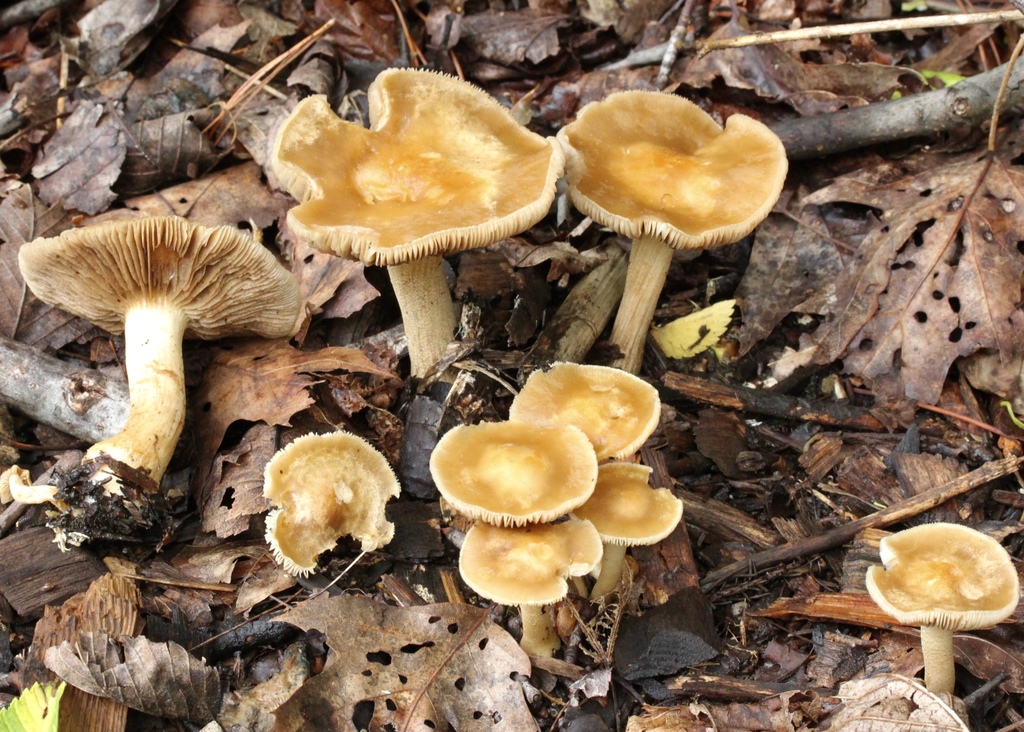
Mulch Fieldcap
Agrocybe putaminum
Agrocybe putaminum, commonly known as the mulch fieldcap, is a species of agaric fungus in the family Strophariaceae in the Agrocybe sororia complex. Described as new to science in 1913, it is found in Asia, Australia, Europe, and western North America, where it grows in parks, gardens, and roadsides in woodchip mulch. Fruitbodies of the fungus have a dull brownish-orange cap with a matte texture, a grooved stipe, and a bitter, mealy taste.
From the article Agrocybe putaminum on Wikipedia (CC BY-SA), quoted section by section
Description
The fruitbodies have a convex cap that later flattens out in maturity, sometimes developing a shallow umbo; the cap attains a diameter of 3–10 cm (1+1⁄4–4 in). Its color is initially dark brown, but fades to pale yellowish tan in age. The cap surface is smooth, matte, and is finely pruinose–as if coated with very fine flour. The gills, which have an adnate attachment to the stipe, are pale clay-brown in color, but later deepen to become dark brown after the spores mature. The gills are moderately crowded together, and are interspersed with lamellulae (short gills that do not extend fully from the cap margin to the stipe). The cylindrical stipe measures 5–8 cm (2–3+1⁄4 in) long by 1–1.5 cm (1⁄2–1⁄2 in) thick, and is thicker at both the apex and the club-shaped base. Initially stuffed with a cottony pith, the stipe eventually becomes hollow. It is the same color as the cap, and has a surface marked by thin raised ridges (particularly near the top); these ridges originate from mycelial cords. The flesh of the mushroom is white, up to 1.5 cm (1⁄2 in) thick, and does not change color when cut or otherwise injured. Its odor is both farinaceous (like freshly ground flour) and fungal, while its taste is bitter, with a cucumber aftertaste. The mushrooms are not edible.
Agrocybe putaminum produces a dark brown spore print. …
Range & habitat
Agrocybe putaminum is a saprobic species. Its fruitbodies grow on the ground in clusters or close groups, usually in woodchips, and so can be found in gardens, parks, and other areas that use this type of mulch. It is known to occur in western North America and Europe. The species used to be considered rare; after the initial report of its 1913 discovery in France, it was infrequently recorded again: in the Netherlands in 1958, Denmark in 1989, western Belgium and Italy in 1998, and India in 2003. The fungus has since become more common, and its range has spread along with the increasing use of woodchip mulch in ornamental flower beds. A 2007 report from central coastal California was the first North American record. It has been reported several times from Southwest Australia.
Wikipedia: “Habitat and distribution”
Where it lives
Recorded sightings
—
geo-referenced records in GBIF, from museums, herbaria and field observers.
Drag the globe to turn it. Dots are where records exist, not a range map; darker means more records.
In the stacks
Searching the stacks…
Every page naming Agrocybe putaminum in the Biodiversity Heritage Library →
This page is assembled live from iNaturalist, GBIF, Wikipedia, the Source Library and the Internet Archive. It is not yet part of the hand-edited codex. iNaturalist taxon 343465.