- Fungi Including Lichens
- ›Basidiomycete Fungi
- ›Higher Basidiomycetes
- ›Mushrooms, Bracket Fungi, Puffballs, and Allies
- ›Agaricomycetidae
- ›Common Gilled Mushrooms and Allies
- ›Tricholomatineae
- ›Pseudoclitocybaceae
- ›Pseudoclitocybe
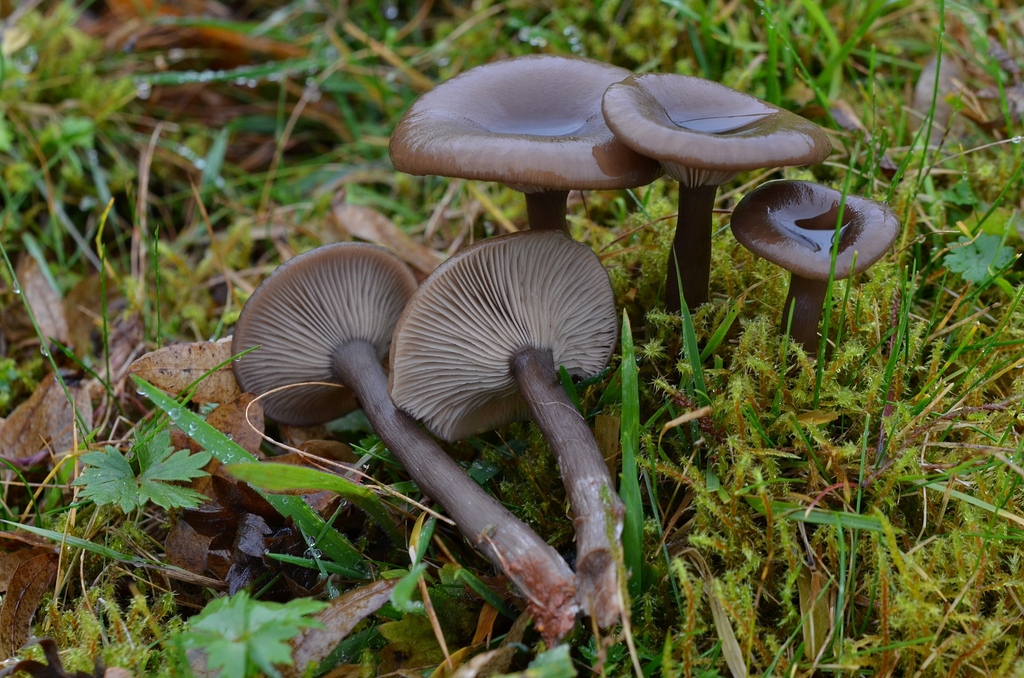
The Goblet
Pseudoclitocybe cyathiformis
Pseudoclitocybe cyathiformis, commonly known as the goblet funnel cap, is a species of fungus in the Tricholomataceae family, and the type species of the genus Pseudoclitocybe. It was first described scientifically as Agaricus cyathiformis by Jean Baptiste François Pierre Bulliard in 1786, and later transferred to the genus Pseudoclitocybe by Rolf Singer in 1956. The fungus is found in North America and Europe.
From the article Pseudoclitocybe cyathiformis on Wikipedia (CC BY-SA), quoted section by section
Description
The cap is up to 8 centimetres (3+1⁄4 in) wide and brown, fading in age. It is initially centrally depressed with an inrolled margin then becomes funnel-shaped. The gills are adnate to decurrent and pale, becoming gray to brown. The stem may be slightly lighter than the cap and is up to 12 cm (4+3⁄4 in) long and 1 cm thick, sometimes larger at the base. The spore print is white.
Range & habitat
The fungus is found in North America and Europe (September to December), in woodland soil or rotting wood.
Wikipedia: “Distribution and habitat”
At the table
The species is reportedly edible and can be dried for preservation, but resembles a number of species of unknown edibility.
Wikipedia: “Uses”
Where it lives
Recorded sightings
—
geo-referenced records in GBIF, from museums, herbaria and field observers.
Drag the globe to turn it. Dots are where records exist, not a range map; darker means more records.
In the stacks
This page is assembled live from iNaturalist, GBIF, Wikipedia, the Source Library and the Internet Archive. It is not yet part of the hand-edited codex. iNaturalist taxon 339415.