- Fungi Including Lichens
- ›Basidiomycete Fungi
- ›Higher Basidiomycetes
- ›Mushrooms, Bracket Fungi, Puffballs, and Allies
- ›Agaricomycetidae
- ›Common Gilled Mushrooms and Allies
- ›Marasmiineae
- ›Mycenaceae
- ›Mycena
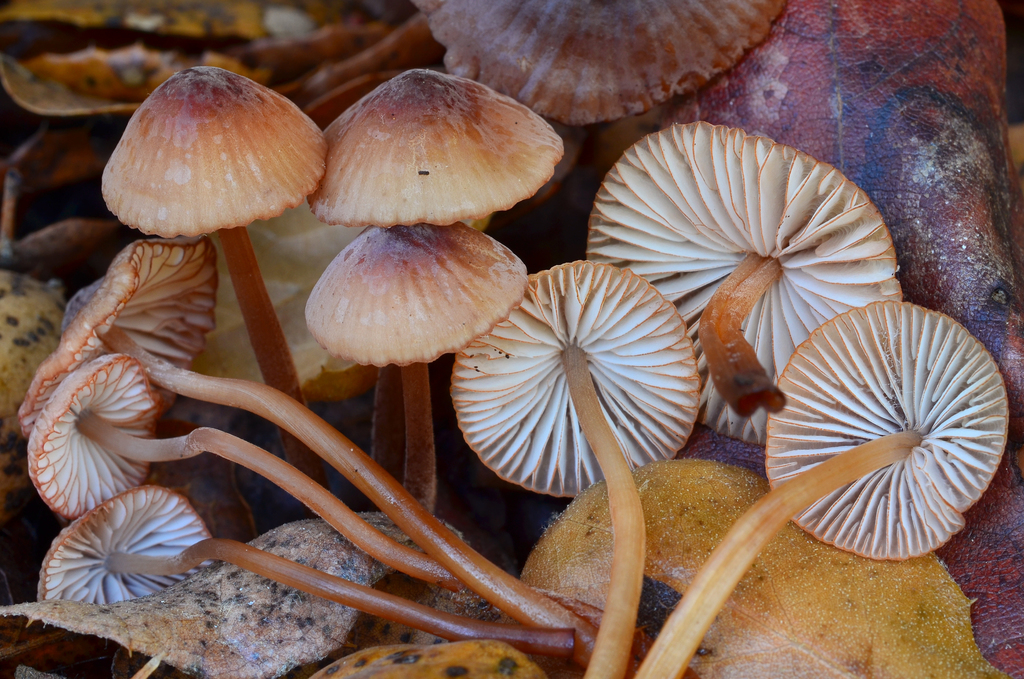
California Mycena
Mycena californiensis
Mycena californiensis is a species of fungus in the family Mycenaceae. It is a common and abundant species in the coastal oak woodlands of California, where it grows saprobically, feeding on the fallen leaves and acorns of various oak species. First described in 1860 by Berkeley and Curtis, the species was collected four years earlier during an exploring and surveying expedition. It was subsequently considered a doubtful species by later Mycena researchers, until a 1999 publication validated the taxon. Mycena elegantula is considered a synonym.
Making their appearance in late autumn to early winter, the small and fragile fruit bodies are characterized by reddish-brown tones in the cap, stem, and the edges of the gills. If cut, the mushroom tissue will "bleed" a deep reddish to orangish latex. As is typical of the genus Mycena, caps of M. californiensis are bluntly conical, becoming bell-shaped to convex, and eventually flatten out when old. They measure up to 2 cm (0.8 in) in diameter, and are attached to thin, hollow stems that are up to 13 cm (5.1 in) long.
From the article Mycena californiensis on Wikipedia (CC BY-SA), quoted section by section
Description
The cap is initially conic or bell-shaped, but flattens out in maturity, and typically reaches dimensions of up to 2 cm (3⁄4 in). The cap margins (edges) are curved inwards when young, but as they age they become wavy or crenate (with rounded scallops), develop striations (radial grooves) and may even split. The surface of the cap is dull and smooth. Its color ranges from reddish brown to brownish orange in young specimens, with the color fading as the mushroom matures; the center of the cap is usually darker than the margins. The flesh is thin, and either the same color as the cap or lighter; it may stain a dark red color when bruised. The gills have an adnate attachment to the stem—broadly attached slightly above the bottom of the gill, with most of the gill fused to the stem. They are not closely spaced together, and there are about 15–20 of them. Some of the gills do not extend the full distance from the edge of the cap to the stem. These short gills, called lamellulae, form one to two groups of roughly equal length. All of the gills have a white to pinkish-buff color, with the gill edges ranging from reddish orange to reddish brown to brownish orange. The hollow stem is 3–13 cm (1+1⁄4–5 in) long and 1–3 mm (1⁄16–1⁄8 in) thick, and roughly the same thickness throughout. …
Range & habitat
The fruit bodies grow in clusters or scattered on the decomposing leaves and acorns of oak trees, such as Coast Live Oak, Valley Oak and Black Oak. It is common in the coastal oak woodlands of California, where it appears from late autumn to early winter.
Wikipedia: “Habitat and distribution”
Where it lives
Recorded sightings
—
geo-referenced records in GBIF, from museums, herbaria and field observers.
Drag the globe to turn it. Dots are where records exist, not a range map; darker means more records.
In the stacks
Searching the stacks…
Every page naming Mycena californiensis in the Biodiversity Heritage Library →
This page is assembled live from iNaturalist, GBIF, Wikipedia, the Source Library and the Internet Archive. It is not yet part of the hand-edited codex. iNaturalist taxon 337490.