- Fungi Including Lichens
- ›Basidiomycete Fungi
- ›Higher Basidiomycetes
- ›Mushrooms, Bracket Fungi, Puffballs, and Allies
- ›Phallomycetidae
- ›Gomphales
- ›Gomphaceae
- ›Ramaria
- ›Laeticolora
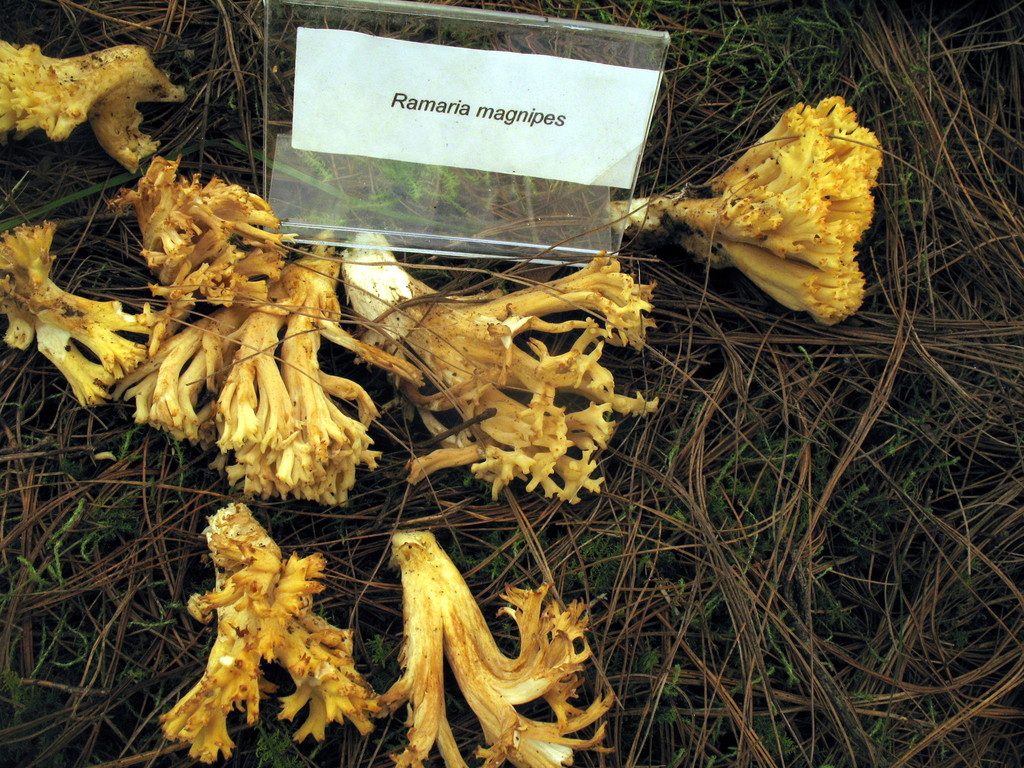
Ramaria magnipes
Ramaria magnipes is a coral fungus in the family Gomphaceae. It is found in western North America, where it fruits on the ground in mixed forests.
From the article Ramaria magnipes on Wikipedia (CC BY-SA), quoted section by section
Description
The coral-shaped fruit bodies are relatively large, with dimensions of 9–25 cm (3+1⁄2–9+7⁄8 in) by 14–24 cm (5+1⁄2–9+1⁄2 in). The large stipe, which roots into the soil, is tapered to conical, measuring 7–14 cm (2+3⁄4–5+1⁄2 in) long by 4–6 cm (1+5⁄8–2+3⁄8 in) thick; it stains brown in age. The color of fresh fruit bodies ranges from light yellow to brownish pale orange (with white flesh), while dried specimens tend to be paler, from pale yellow to grayish orange (with pale yellow flesh); the flesh has a slow and mild amyloid reaction. The branches are compact (giving the fruit body a cauliflower-like appearance), with about six branches from the base. The primary branches are thick, up to 3 cm (1+1⁄8 in) in diameter, while the secondary branches are usually in the range of 0.2–1 cm (1⁄8–3⁄8 in) in diameter. Its flesh has a weakly aromatic or fabaceous (bean-like) odor, and a weakly fabaceous or bitter taste. The dimensions of the spores is in the range of 10–14 by 3–4.5 μm (averaging 11.8–3.7 μm). They are cylindrical, and smooth or with very fine cyanophilous (stainable with blue dyes) warts. The basidia (spore-bearing cells) are club-shaped, two- or four-spored with sterigmata up to 14 μm long, and measure 47–80 by 8–11 μm. The variety albidior differs from the main type by having white to yellowish branches. …
Range & habitat
The fungus fruits on the ground in mixed forests. It has been collected from the US states of Idaho, Washington, and Tennessee. Variety albidior is found in the Sierra Nevada mountains of California, where it fruits in the spring. Ramaria magnipes is a snowbank fungus, meaning it is often found around the edge of melting snowbanks, or shortly after snowmelt.
Wikipedia: “Habitat and distribution”
At the table
The species is edible, best eaten young and cooked, and may have a laxative effect.
== References ==
Wikipedia: “Edibility”
Where it lives
Recorded sightings
—
geo-referenced records in GBIF, from museums, herbaria and field observers.
Drag the globe to turn it. Dots are where records exist, not a range map; darker means more records.
In the stacks
Searching the stacks…
Every page naming Ramaria magnipes in the Biodiversity Heritage Library →
This page is assembled live from iNaturalist, GBIF, Wikipedia, the Source Library and the Internet Archive. It is not yet part of the hand-edited codex. iNaturalist taxon 335952.