- Fungi Including Lichens
- ›Basidiomycete Fungi
- ›Higher Basidiomycetes
- ›Mushrooms, Bracket Fungi, Puffballs, and Allies
- ›Agaricomycetidae
- ›Common Gilled Mushrooms and Allies
- ›Pleurotineae
- ›Pleurotaceae
- ›Pleurotus
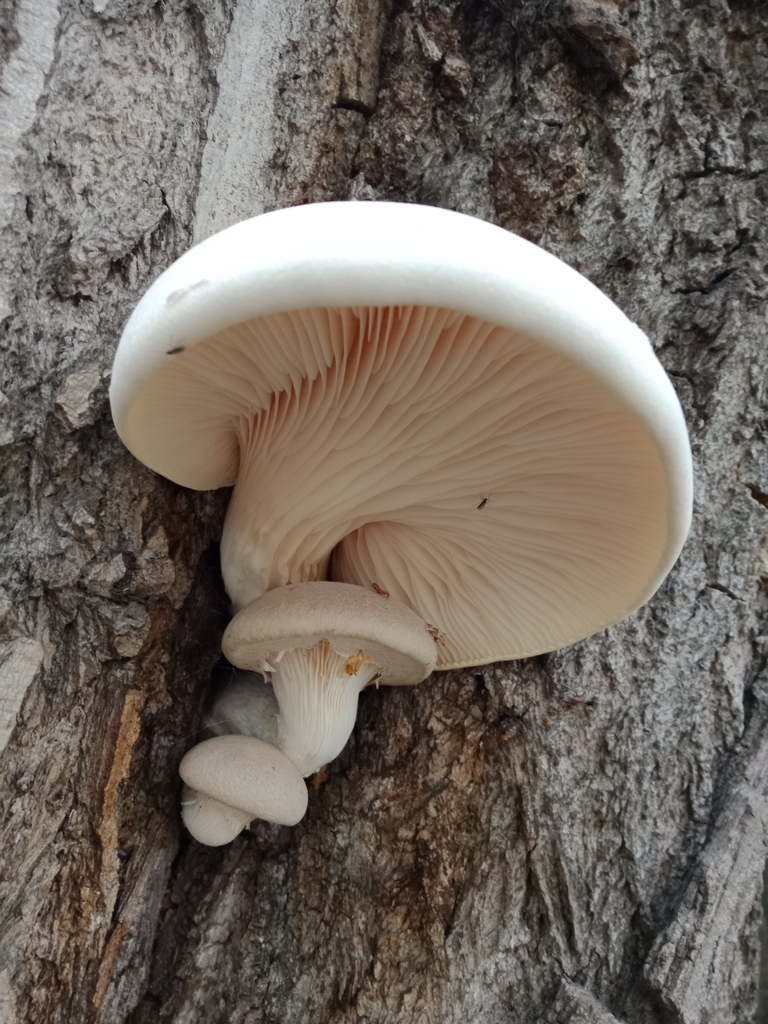
Veiled Oyster
Pleurotus dryinus
Pleurotus dryinus, commonly known as the veiled oyster mushroom, is a species of fungus in the family Pleurotaceae. It grows on dead wood and is a weak pathogen, especially infecting broad-leaved trees.
From the article Pleurotus dryinus on Wikipedia (CC BY-SA), quoted section by section
Description
The cap grows to 20 centimetres (8 in) across. It is pale to beige, but can turn yellowish. Veil remnants may adhere to the edge. At first it is velvety (tomentose) and the tomentum can develop into grey-brown scales; in old specimens the surface becomes bare and may crack. The whitish or pale brownish lateral stem may be very short or up to 10 cm long, generally with a membranous ring. The gills are decurrent well down the stipe and may anastomose (criss-cross) at the lower extreme. They are white, sometimes turning yellowish. The smell is described as "pleasant" or "slightly polypore-like" or "complex, a bit fruity or sourish". The taste is mild.
Microscopic characteristics. As with ordinary fragile mushrooms, the flesh may be monomitic but may be dimitic, having extra thick-walled hyphae which give the flesh a tough consistency. There are no cystidia. The spores are elongated in the form of a rounded cylinder and around 9–15 μm by 3–5 μm.
Range & habitat
Appearing from summer to autumn, it is distributed throughout Europe, where it varies locally between common and rare. It is also found in North America. This mushroom is saprobic on dead wood and can also be a weak parasite of trees (as a "white rot"). It occurs especially on oak (from which it derives its name), but also on beech, other broad-leaved trees, and occasionally on conifers. It is often solitary or may grow in small groups.
Wikipedia: “Distribution and habitat”
At the table
This mushroom is edible, though it is tough when older and inferior to the better-known members of Pleurotus. Like some other Pleurotus species, P. dryinus attacks nematodes and may provide a control method for these parasites when they infect cats and dogs.
Wikipedia: “Uses”
In human culture
The species name is a Latinised version of the Greek word "dryinos" (δρύῐνος), meaning "related to oak", referring to one of its main hosts.
Wikipedia: “Etymology”
Where it lives
Recorded sightings
—
geo-referenced records in GBIF, from museums, herbaria and field observers.
Drag the globe to turn it. Dots are where records exist, not a range map; darker means more records.
In the stacks
Searching the stacks…
Every page naming Pleurotus dryinus in the Biodiversity Heritage Library →
This page is assembled live from iNaturalist, GBIF, Wikipedia, the Source Library and the Internet Archive. It is not yet part of the hand-edited codex. iNaturalist taxon 334340.