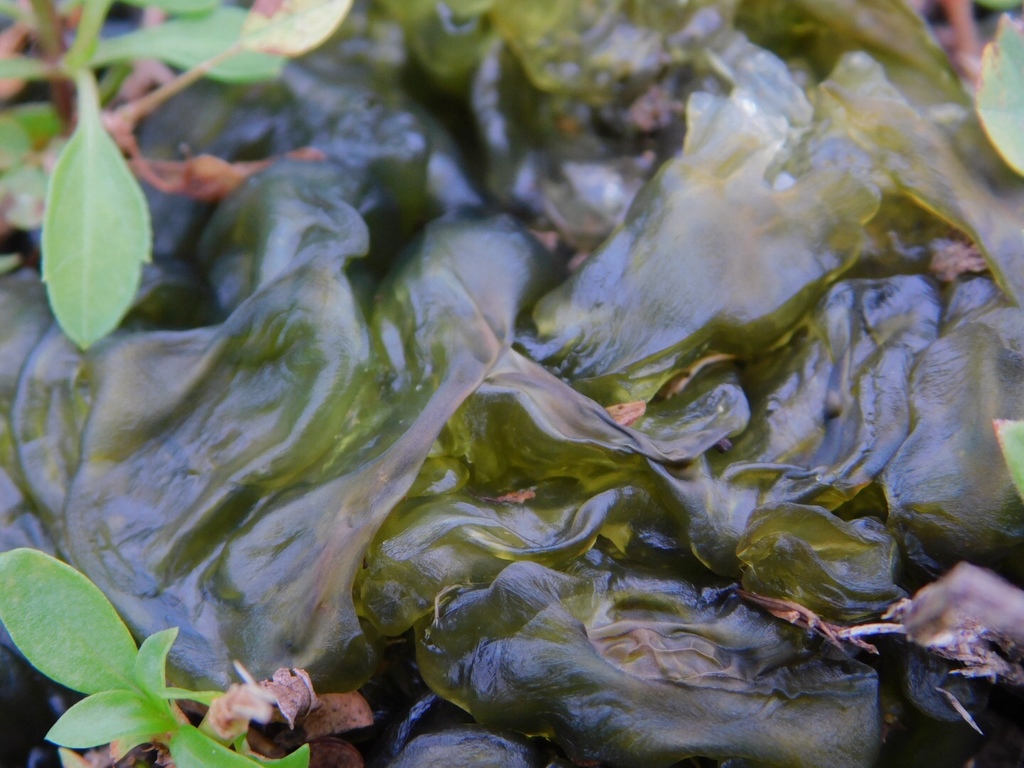
Star Jelly
Nostoc commune
Nostoc commune is a species of cyanobacterium in the family Nostocaceae. Common names include star jelly, witch's butter, mare's eggs, fah-tsai and facai. It is the type species of the genus Nostoc and is cosmopolitan in distribution.
From the article Nostoc commune on Wikipedia (CC BY-SA), quoted section by section
Description
Nostoc commune is a colonial species of cyanobacterium. It initially forms a small, hollow gelatinous globule which grows and becomes leathery, flattened and convoluted, forming a gelatinous mass with other colonies growing nearby. Inside the thin sheath are numerous unbranched hair-like structures called trichomes formed of short cells in a string. The cells are bacteria and thus have no nucleus nor internal membrane system. To multiply, they form two new cells when they divide by binary fission. Along the trichomes, larger specialist nitrogen-fixing cells called heterocysts occur between the ordinary cells. When wet, Nostoc commune is bluish-green, olive green or brown but in dry conditions it becomes an inconspicuous, crisp brownish mat.
Range & habitat
Nostoc commune is found in many countries around the world. It is able to survive in extreme conditions in polar regions and arid areas. It is a terrestrial or freshwater species and forms loose clumps on soil, gravel and paved surfaces, among mosses and between cobbles. In Singapore, Nostoc commune is found growing on alkaline soils, in brackish water, in paddy fields, on cliffs and on wet rocks.
Wikipedia: “Distribution and habitat”
At the table
Nostoc commune is eaten as a salad in the Philippines and is also eaten in Indonesia, Japan and China. In Taiwan, it is nicknamed 雨來菇 yǔ lái gū (meaning "post-rain mushroom"). Research indicates that consumption of Nostoc commune var. sphaeroides, in addition to consumption of other cyanobacteria, may be beneficial by means of an anti-inflammatory mechanism. The related Nostoc flagelliforme, sometimes named as a variety of this species, is known as 发菜 fàcài in China. It forms part of the food traditionally served at the Lunar New Year.
== References ==
Wikipedia: “Uses”
Where it lives
Recorded sightings
—
geo-referenced records in GBIF, from museums, herbaria and field observers.
Drag the globe to turn it. Dots are where records exist, not a range map; darker means more records.
In the stacks
Searching the stacks…
Every page naming Nostoc commune in the Biodiversity Heritage Library →
This page is assembled live from iNaturalist, GBIF, Wikipedia, the Source Library and the Internet Archive. It is not yet part of the hand-edited codex. iNaturalist taxon 319815.