- Fungi Including Lichens
- ›Ascomycete Fungi
- ›Sac Fungi and Lichens
- ›Common Lichens
- ›rocktripes, bloodspot lichens, and allies
- ›rocktripes, bloodspot lichens, and allies
- ›Rocktripes, Toadskin Lichens, and allies
- ›Umbilicaria
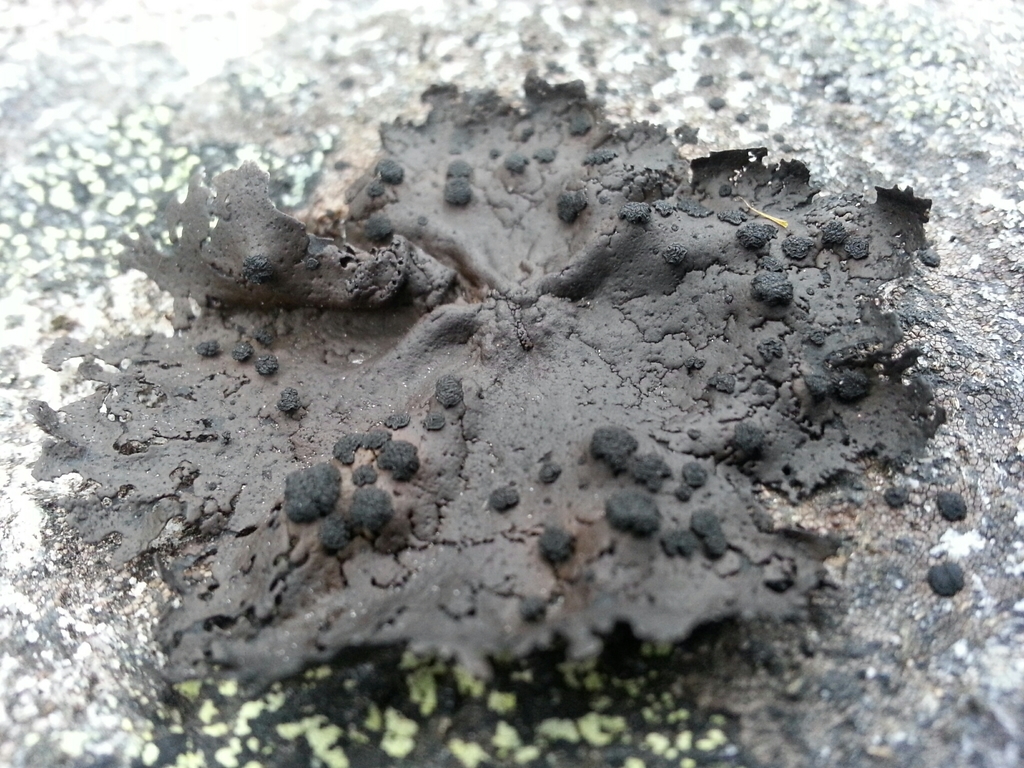
Punctured Rocktripe Lichen
Umbilicaria torrefacta
Umbilicaria torrefacta is a species of saxicolous (rock-dwelling), foliose lichen in the family Umbilicariaceae. It is an arctic-alpine species with a circumpolar distribution and is widely distributed within the Holarctic realm, specifically within the Palearctic and Neoarctic biogeographical regions. Characteristic features of Umbilicaria torrefacta include the lace-like fringe in its lobes and the plates on the underside of the thallus. One common name, punctured rock-tripe, refers to the distinctive sieve-like perforations on the thallus margins.
The species was scientifically described in 1777 by John Lightfoot and later classified under the genus Umbilicaria by Heinrich Schrader in 1794. Because of its somewhat variable morphology, this species has often been misidentified historically and described under different names, resulting in an extensive synonymy. In 2017, a lectotype specimen was designated for the species, clarifying its taxonomic status. Molecular phylogenetics studies have revealed complex relationships within the family Umbilicariaceae, resulting in the revision of the genus Umbilicaria. U. torrefacta is a member of Gyrophora, a subgenus characterised by species with circular ridges on the discs of their apothecia; rigid, non-pustulate thalli; and specific secondary metabolites, such as gyrophoric acid and stictic acid.
From the article Umbilicaria torrefacta on Wikipedia (CC BY-SA), quoted section by section
Description
Umbilicaria torrefacta is a lichen with a thallus that ranges from 2 to 6 cm (3⁄4 to 2+3⁄8 in) in diameter and consists of a single lobe. The thalli are typically monophyllous—connected to the substrate at a single point of attachment called an umbilicus. The thallus is often crumpled, with the edges finely dissected and perforated by small holes, giving it a lace-like appearance. These perforations may occasionally appear towards the centre. The upper surface colour ranges from brown to dark brown, and can be either smooth or have a cracked, wart-like texture. McCune and Geiser liken the surface cracks to "sutures in a skull" and treat them as characteristic. The lower surface varies from pale brown to black and features irregular, thin, somewhat flattened layers resembling plates (trabeculae) that are often torn or perforated. Although rhizines (root-like structures) are absent in this species, torn fringes of trabeculae may be mistaken for rhizines. Nineteenth-century authors noted a tea-like odour on rewetting. Apothecia (fruiting bodies) are common and measure 0.5 to 2 mm in diameter. They are slightly immersed in depressions on the thallus and have a twisted, gyrose appearance with black discs. The paraphyses (sterile filaments among the spores) are unbranched with brown tips. …
Range & habitat
Umbilicaria torrefacta is occurs in rocky, alpine environments within the Holarctic region, covering both the Palearctic and Nearctic biogeographical areas. It grows on rock outcrops, both open and sheltered. According to Llano's 1950 monograph on Umbilicaria, in North America, it has not been recorded south of the White Mountains of California and has not been found in South America. It grows in the splash zone of coastal ecosystems, particularly along the White Sea in Russia. This lichen species prefers a range of coastal habitats, growing on vertical rock faces and in boulder fields. It is occasionally exposed to sea spray, although it tends to favour more sheltered, less frequently wetted environments compared to its relative Umbilicaria deusta. In the Nuuk region of southern Greenland, U. torrefacta is typically found on somewhat moist siliceous rocks, and often in the company of a community of lichens that includes Aspicilia berntii, Bellemerea subsorediza, Lecidea lapicida, Miriquidica atrofulva, Miriquidica leucophaea, Miriquidica nigroleprosa, Montanelia disjuncta, Orphniospora moriopsis, and Pseudephebe minuscula.
Wikipedia: “Habitat and distribution”
What it does
Umbilicaria torrefacta has a pattern of growth characterised by rapid initial expansion followed by a gradual slowdown as it approaches its maximum size. A study conducted over a 240-year chronosequence in the foreland of the Hellstugubreen glacier in Jotunheimen National Park, Norway, found that the initial growth rate of U. torrefacta is relatively slow compared to other Umbilicaria species, averaging 0.9 mm per year. The maximum observed thallus diameter was 47 mm, with the growth period extending to approximately 107 years. This growth pattern reflects a common trend among alpine lichens, where rapid early growth is followed by a stabilisation phase as the lichen matures. Reproduction in U. torrefacta is closely related to thallus size. Apothecium production increases with the size of the thallus, with the first fertile individuals appearing at around 8 to 12 mm in diameter. However, U. torrefacta tends to start reproducing later than some of its relatives, such as U. hyperborea, which begins to reproduce at smaller sizes. The reproductive output continues to grow with thallus size, but the trend is more linear compared to the exponential reproductive increase seen in U. hyperborea. This suggests a more steady reproductive strategy, likely influenced by the harsh alpine conditions in which U. torrefacta grows.
Wikipedia: “Growth and reproduction”
At the table
Umbilicaria torrefacta holds historical significance as a natural dye in the Scottish Highlands. This lichen, commonly referred to as one of the "crotal" lichens, was traditionally used for dyeing wool and fabric. The dye produced from U. torrefacta yields a range of colours, including purplish-red and greyish-magenta hues, depending on the dyeing process and mordants used. The fermentation method involves soaking the lichen in an ammonia solution for several weeks to produce rich red and purple dyes. These colours were highly valued and often used in traditional Scottish tartans and textiles. The dyeing process using U. torrefacta and similar lichens was integral to the textile traditions of the Scottish Highlands. Lichen dyes were known for their vibrant and long-lasting colours, essential for creating the vivid hues seen in Highland dress.
== References ==
Wikipedia: “Uses”
Where it lives
Recorded sightings
—
geo-referenced records in GBIF, from museums, herbaria and field observers.
Drag the globe to turn it. Dots are where records exist, not a range map; darker means more records.
In the stacks
Searching the stacks…
Every page naming Umbilicaria torrefacta in the Biodiversity Heritage Library →
This page is assembled live from iNaturalist, GBIF, Wikipedia, the Source Library and the Internet Archive. It is not yet part of the hand-edited codex. iNaturalist taxon 233255.