- Fungi Including Lichens
- ›Ascomycete Fungi
- ›Sac Fungi and Lichens
- ›Common Lichens
- ›Shield Lichens, Sunburst Lichens, Rosette Lichens, and Allies
- ›Peltigerales
- ›Peltigeraceae
- ›Peltigera
- ›Peltigera
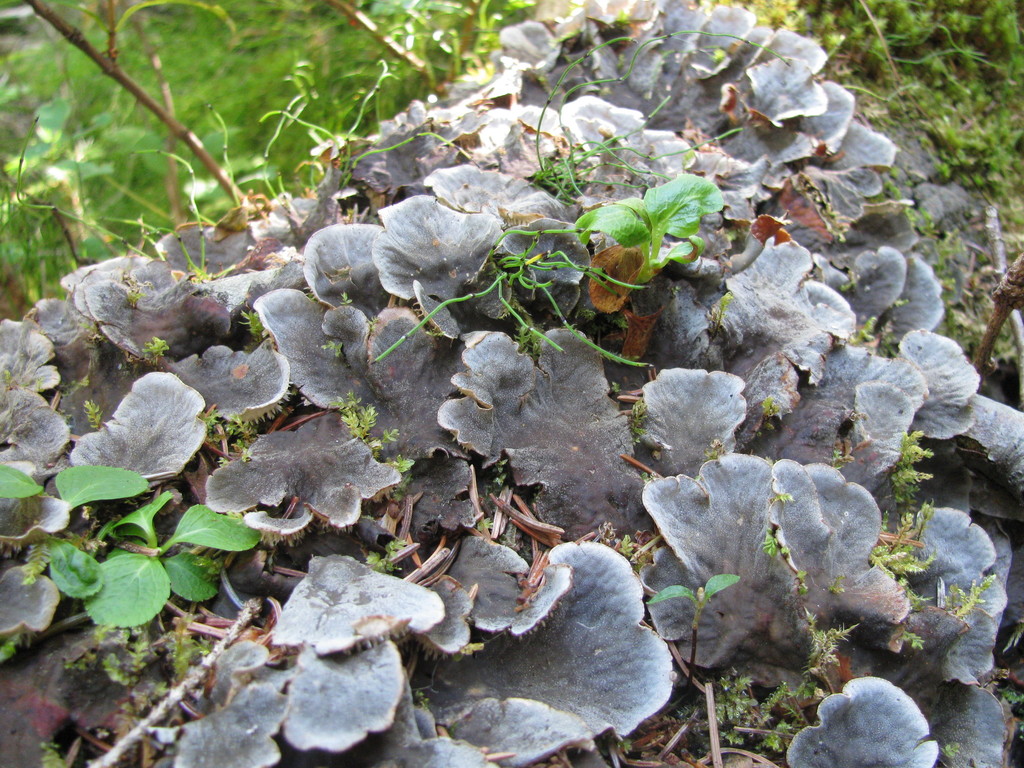
Peltigera cinnamomea
Peltigera cinnamomea, commonly known as the cinnamon-pelt lichen, is a muscicolous (moss-dwelling), leafy lichen in the family Peltigeraceae. The Canadian lichenologist Trevor Goward formally described the species in 1995. The lichen is found in northwestern North America's forested regions, particularly in the unique montane and subalpine forest communities of the northern Rocky Mountains. Peltigera cinnamomea grows under prolonged snow cover, surviving well into spring. This trait distinguishes it from many other Peltigera species in similar North American forest ecosystems.
Peltigera cinnamomea forms a specialised symbiotic relationship with specific strains of the cyanobacterium Nostoc, enabling it to fix atmospheric nitrogen, crucial for survival in nutrient-poor environments. This lichen is part of the broadly defined species complex centred around the widely distributed Peltigera canina. Within this complex, P. cinnamomea falls under the CICADE group, indicating a preference for moist, woodland habitats.
From the article Peltigera cinnamomea on Wikipedia (CC BY-SA), quoted section by section
Description
Peltigera cinnamomea is characterised by its foliose, loosely attached thallus, which typically spans 10–30 cm (4–12 in) in diameter. The structure of the thallus facilitates various ecological functions. The lobes of this lichen are somewhat leathery and stiff, measuring approximately 1 to 3 cm (0.4 to 1.2 in) in width, elongating and loosely overlapping with irregular branches. The tips of the lobes are rounded and may either lie flat or curve downwards, with generally smooth margins. The upper surface varies in colour from pale bluish-grey to pale brownish-grey, and may be tinged with shades of cinnamon brown. This surface is dull, often billowed broadly, and covered with a tomentum—a short, soft, dense growth of hairs—that tends to fade near the thallus centre. The lichen lacks soredia (granular reproductive structures) and isidia (outgrowths containing both the algae and the fungus of the lichen), indicative of its specific reproductive and structural characteristics. The margins are devoid of lobules (small lobes). The lower surface features pale tan veins that darken to rusty brown or cinnamon brown towards the centre. These veins are narrow, occasionally raised, and smooth (glabrous), while the areas between them (interstices) are whitish and moderately deep. …
Range & habitat
Peltigera cinnamomea inhabits various forested areas across western North America. It predominantly grows on moss, moss-covered rocks, and logs, in open and somewhat sheltered inland forests at various elevations. This species adapts well to mesophytic to hygrophytic conditions and is particularly prevalent in areas with prolonged snow cover, often surviving under snow until late spring or early summer (May or June). This resilience makes it one of the most snow-tolerant Peltigera species that occur in the local lichen funga. Peltigera cinnamomea is extensively documented and is locally widespread in suitable forested habitats. It is most abundant in the Rocky Mountains. In Canada, collections have been made in Alberta at Swan Hills and in British Columbia at multiple locations, including the Clearwater River Basin, Skeena River Basin, Skagit River Basin, Fraser River Basin, and Nechako River Basin. In the United States, it has been identified in Montana at Lake Country and in Pend Oreille County, Washington. It also occurs in Oregon. In Alaska, most records of the lichen are from the southeast region of the state. P. cinnamomea is one of 29 Peltigera species in the Pacific Northwest region of North America.
Wikipedia: “Habitat and distribution”
What it does
Peltigera cinnamomea grows in specific ecological communities within montane and subalpine forests in the northern Rocky Mountains, particularly in the northern Whitefish Range, Montana, USA. These communities are classified in a unique forest order called Calamagrostio-Pseudotsugetalia glaucae, characterised by its dominant plant species and unique environmental conditions. Though termed an "order", this classification groups ecosystems with similar species and interactions, typical of valley bottoms and lower slopes across northwestern North America. These forests are distinct from the coastal forests of the Vaccinio-Piceetea class, filling niches similar to those of broad-leaved forests in other temperate regions. Influenced by Pacific air masses, these areas benefit from moist conditions and extensive snow cover, providing a stable environment for the growth of species like P. cinnamomea.
Wikipedia: “Ecology”
Where it lives
Recorded sightings
—
geo-referenced records in GBIF, from museums, herbaria and field observers.
Drag the globe to turn it. Dots are where records exist, not a range map; darker means more records.
In the stacks
Searching the stacks…
Every page naming Peltigera cinnamomea in the Biodiversity Heritage Library →
This page is assembled live from iNaturalist, GBIF, Wikipedia, the Source Library and the Internet Archive. It is not yet part of the hand-edited codex. iNaturalist taxon 227385.