- Fungi Including Lichens
- ›Ascomycete Fungi
- ›Sac Fungi and Lichens
- ›Common Lichens
- ›Shield Lichens, Sunburst Lichens, Rosette Lichens, and Allies
- ›shield lichens, rim lichens, and allies
- ›shield lichens and allies
- ›typical shield lichens
- ›Parmelia
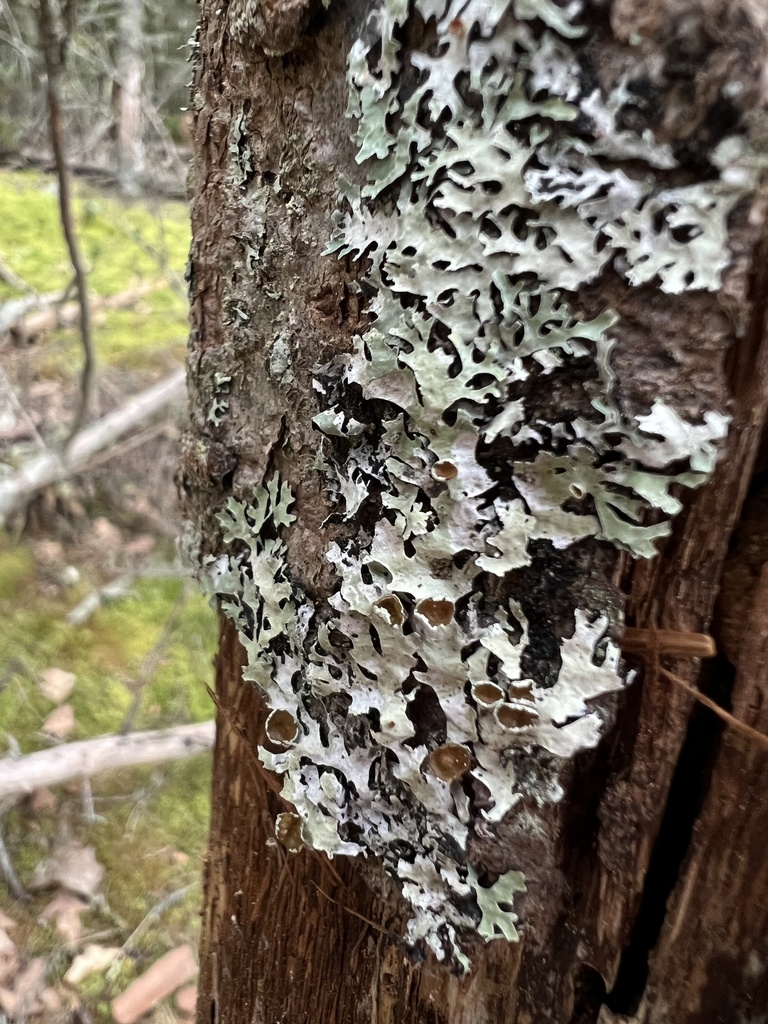
Parmelia fertilis
Parmelia fertilis is a species of corticolous (bark-dwelling) foliose lichen in the family Parmeliaceae. Originally described from Siberian collections in 1887, this lichen has a broad temperate distribution across the Northern Hemisphere, occurring in Asia from the Himalayas to Japan and Taiwan, in Siberia, and in maritime regions of eastern Canada. In North America it was recognised only late in the 20th century and has since been confirmed from Maine, where it was first reported for the United States. The species forms pale greenish to whitish-grey rosette-shaped growths 6–12 cm across on tree bark, characterized by lobes with conspicuous pale pores that sometimes merge into a white network near the tips. It is closely related to Parmelia sulcata but can be distinguished by its smaller asexual spores and denser root-like structures on the undersurface, and it readily produces fruiting bodies.
From the article Parmelia fertilis on Wikipedia (CC BY-SA), quoted section by section
Description
The thallus of Parmelia fertilis grows closely attached to bark and forms pale greenish to whitish-grey rosettes 6–12 cm across. The lobes are fairly long and overlapping, 1.5–5 mm wide, and more adnate and compact in Canadian specimens than in Asian ones. The upper surface is smooth to slightly wrinkled, becoming cracked with age, and bears conspicuous pale pores (pseudocyphellae) that are 0.5–1 mm long, elongate, and mostly marginal and laminal; they sometimes fuse to form a discontinuous white network near the lobe tips. The undersurface is black and densely covered with root-like rhizines that are simple to densely branched and 0.5–2 mm long. Asexual reproduction is common: pycnidia are frequent and produce cylindrical to weakly spindle-shaped conidia 5.5–6.5 micrometres (μm) long. Apothecia are also common, usually somewhat sessile, and 2–7 mm in diameter; the discs are dark brown with a finely reticulate-pseudocyphellate thalline margin. The hymenium is 55–60 μm tall, and the ascospores are 6–8 × 12–14 μm, with a thin outer wall about 1 μm thick. Chemically, the species produces atranorin and salazinic acid, with consalazinic acid also recorded in some material. Specimens from eastern North America (New Brunswick and Nova Scotia) are morphologically identical to Asian material, though typically more compact, with similarly dense rhizines and comparable spore dimensions. …
Range & habitat
Parmelia fertilis occurs across a broad temperate range in the Northern Hemisphere, with records from Asia, North America, and eastern Russia. It is widespread in Japan, Taiwan, and Korea, and extends northwards into Siberia and westwards to the Himalayas. In North America, the species has been confirmed from New Brunswick and Nova Scotia, where it is rare and restricted to oceanic habitats. The lichen typically grows on the bark of trees in humid, cool-temperate forests, often in well-ventilated or coastal areas that experience regular moisture. The species was acknowledged as part of the North American lichen flora only recently; subsequent fieldwork documented the first United States record from Maine. Material from Asia, particularly from Japan and Taiwan, tends to form larger and more open rosettes than that from eastern Canada, which is more compact and tightly adnate. Despite these regional differences, populations share the same key features.
== References ==
Wikipedia: “Habitat and distribution”
Where it lives
Recorded sightings
—
geo-referenced records in GBIF, from museums, herbaria and field observers.
Drag the globe to turn it. Dots are where records exist, not a range map; darker means more records.
In the stacks
Searching the stacks…
Every page naming Parmelia fertilis in the Biodiversity Heritage Library →
This page is assembled live from iNaturalist, GBIF, Wikipedia, the Source Library and the Internet Archive. It is not yet part of the hand-edited codex. iNaturalist taxon 227215.