- Fungi Including Lichens
- ›Basidiomycete Fungi
- ›Higher Basidiomycetes
- ›Mushrooms, Bracket Fungi, Puffballs, and Allies
- ›Agaricomycetidae
- ›Common Gilled Mushrooms and Allies
- ›Hygrophorineae
- ›Waxcaps and Allies
- ›Hygrophoroideae
- ›Hygrophoreae
- ›Hygrophorus
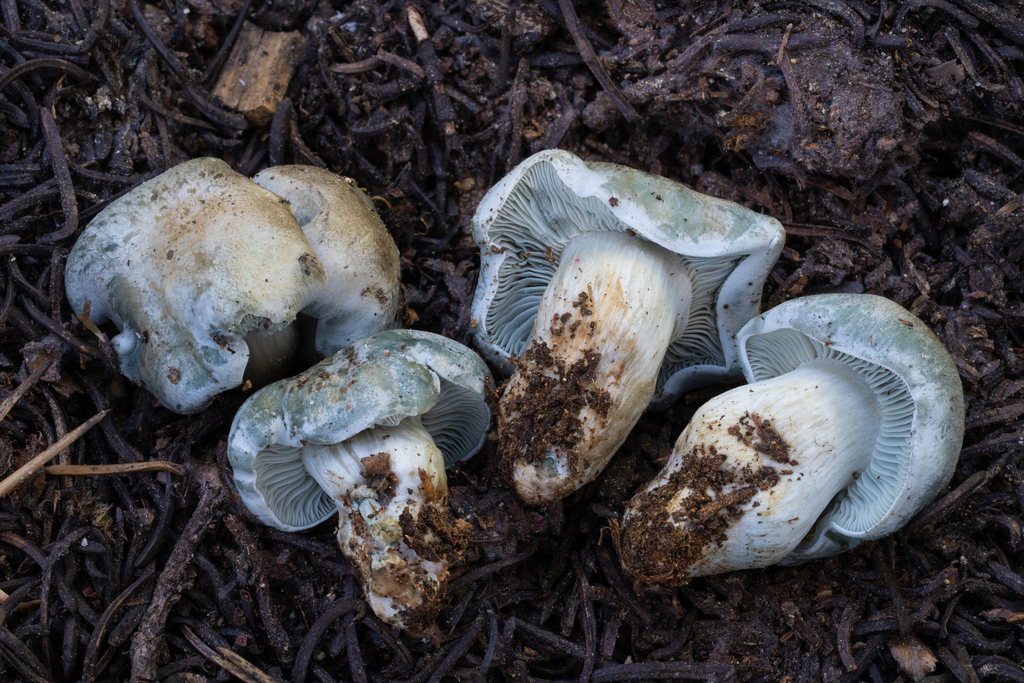
Hygrophorus caeruleus
Hygrophorus caeruleus is a rare species of agaric fungus in the family Hygrophoraceae. Found in the western United States, the mushroom is characterized by its stout fruit body including blue-tinted cap margin and stipe, blue-grey to bluish green gills, and odor of rancid meal.
From the article Hygrophorus caeruleus on Wikipedia (CC BY-SA), quoted section by section
Description
Fruit bodies of Hygrophorus caeruleus have broadly convex caps that are 5–9 cm (2.0–3.5 in) in diameter. They are cream in color, with a blue tint, especially around the margin. The cap surface is felt-like and moist, and covered with a coarse network of cracks and small crevices. The gills, colored bluish-green to gray, have a close to somewhat distant spacing and an adnate to slightly decurrent attachment to the stipe. There are two tiers of lamellulae (short gills) interspersed between the gills. Like most Hygrophorus species, crushed gills have a waxy feel. The stipe measures 2.5–5 cm (1.0–2.0 in) long by 1.5–2.5 cm (0.6–1.0 in) thick and tapers abruptly at the base. Usually somewhat twisted, its surface comprises longitudinally arranged flattened fibrils. Its color is bluish-green to cream at the base. Near the top, it is somewhat pruinose (as in covered with a dusting of fine white powder), while at the base, it is attached to fine white rhizomorphs. The dingy cream flesh bruises a fading bluish-gray to blue-green when injured, and smells strongly of rancid meal. The spore print is white, while spores are elliptical, thin-walled, hyaline, and measure 2.5–5 μm. The basidia (spore-bearing cells) are four-spored and measure 35–45 by 7–8 μm.
Range & habitat
The fruit bodies of Hygrophorus caeruleus grow in scattered groups under Douglas fir, Grand Fir, and Engelmann spruce, typically partially buried in the forest floor. A rare species, it has been reported from the states of Idaho, Oregon, and Washington.
Wikipedia: “Habitat and distribution”
Where it lives
Recorded sightings
—
geo-referenced records in GBIF, from museums, herbaria and field observers.
Drag the globe to turn it. Dots are where records exist, not a range map; darker means more records.
In the stacks
Searching the stacks…
Every page naming Hygrophorus caeruleus in the Biodiversity Heritage Library →
This page is assembled live from iNaturalist, GBIF, Wikipedia, the Source Library and the Internet Archive. It is not yet part of the hand-edited codex. iNaturalist taxon 221879.