- Fungi Including Lichens
- ›Basidiomycete Fungi
- ›Higher Basidiomycetes
- ›Mushrooms, Bracket Fungi, Puffballs, and Allies
- ›Agaricomycetidae
- ›Common Gilled Mushrooms and Allies
- ›Agaricineae
- ›Hymenogastraceae
- ›Psilocybe
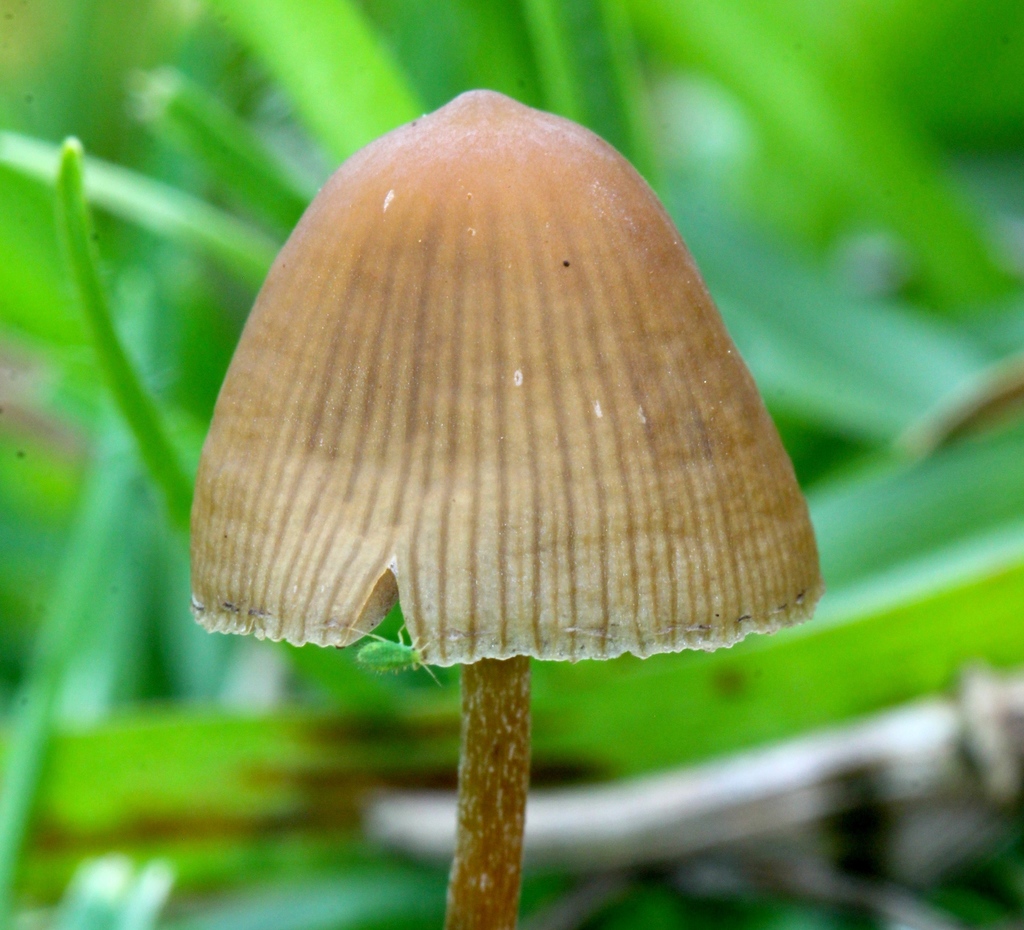
Psilocybe mexicana
Psilocybe mexicana is a psychedelic mushroom. Its first known usage was by the natives of North and Central America over 2,000 years ago. Known to the Aztecs as teonanácatl, from the Nahuatl teotl ("god") + nanácatl ("fungus"). This species was categorized by French botanist Roger Heim.
It was from this species that Dr. Albert Hofmann, working with specimens grown in his Sandoz laboratory, first isolated and named the active psychedelic compounds psilocybin and psilocin. Uncertain of whether or not the artificially cultivated mushrooms would retain their natural psychoactive properties, Dr. Hofmann consumed 32 specimens. The following is his account of the experience, published in his classic text, The Botany and Chemistry of Hallucinogens:
From the article Psilocybe mexicana on Wikipedia (CC BY-SA), quoted section by section
Description
Cap: (0.5)1 — 2(3) cm in diameter, conic to campanulate or subumbonate and often with a slight papilla, hygrophanous or glabrescent, even to striate at the margin, ocherous to brown or beige to straw color in age, sometimes with blueish or greenish tones, easily turning blue when injured. Gills: Adnate or adnexed, gray to purple-brown with whitish edges. Spore Print: Dark purple-brown Stipe: 4 — 10(12.5) cm tall x 1 — 2(3) mm thick, equal, hollow, straw color to brownish or reddish-brown, becoming darker where injured, annulus absent. Odor: Farinaceous Taste: Farinaceous Microscopic features: Spores 8 — 12 x 5 — 8 μm. Ovoid and smooth. Cheilocystidia 13–34 μm, fusoid-ampullaceous to sublageniform, sometimes with a forked neck. Pleurocystidia sublageniform or absent. Psilocybe mexicana may form sclerotia, a dormant form of the organism, which affords it some protection from wildfires and other natural disasters.
Range & habitat
Psilocybe mexicana grows alone or in small groups among moss along roadsides and trails, humid meadows or cornfields, in particular in the grassy areas bordering deciduous forests. Common at elevations between 300–550 metres (980–1,800 ft), rare in lower elevations, known only from Mexico, Costa Rica, El Salvador and Guatemala. Fruiting takes place from May to October.
Wikipedia: “Distribution and habitat”
How it is grown
Like several other psilocybin mushrooms in the genus, Psilocybe mexicana has been consumed by indigenous North American peoples for its entheogenic effects. In the Western world, sclerotia of Psilocybe mexicana are sometimes cultivated for entheogenic use. The sclerotia have a lower content of active substances than the actual mushrooms themselves.
Wikipedia: “Consumption and cultivation”
Where it lives
Recorded sightings
—
geo-referenced records in GBIF, from museums, herbaria and field observers.
Drag the globe to turn it. Dots are where records exist, not a range map; darker means more records.
In the stacks
Searching the stacks…
Every page naming Psilocybe mexicana in the Biodiversity Heritage Library →
This page is assembled live from iNaturalist, GBIF, Wikipedia, the Source Library and the Internet Archive. It is not yet part of the hand-edited codex. iNaturalist taxon 206138.