- Fungi Including Lichens
- ›Ascomycete Fungi
- ›Sac Fungi and Lichens
- ›Lichinomycetes
- ›Candelariales
- ›Candelariaceae
- ›Candelaria
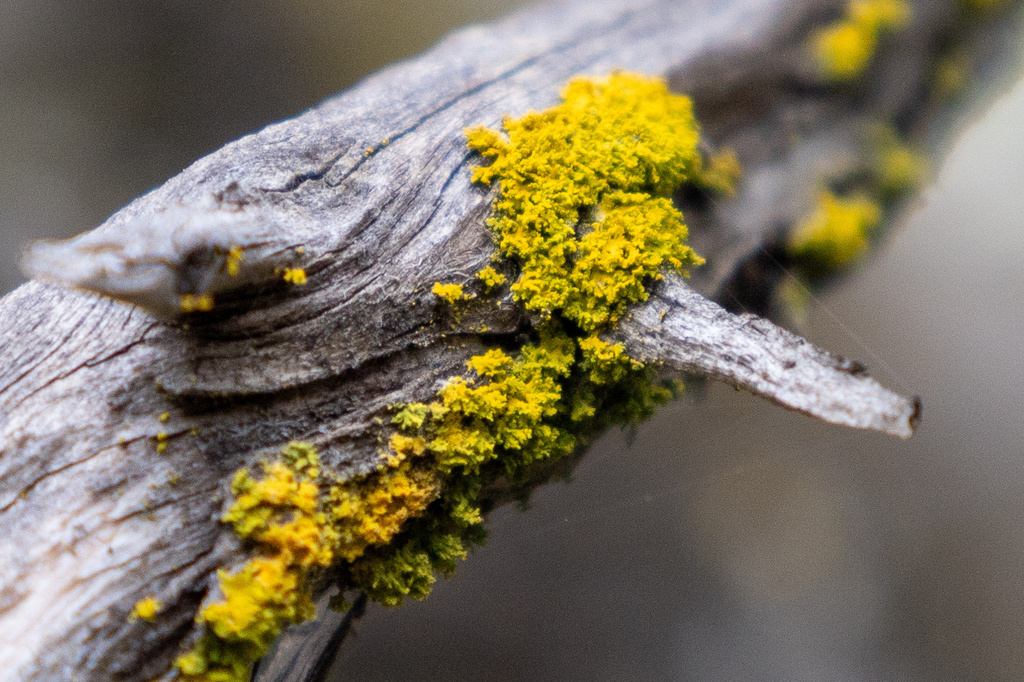
Pacific Candleflame Lichen
Candelaria pacifica
Candelaria pacifica is a widely distributed corticolous (bark-dwelling), leprose lichen. It was formally described as a species in 2011. It is a very small, yellow, bark-dwelling lichen that is often confused with the similar Candelaria concolor but differs in having eight-spored asci, lacking a lower cortex, and producing fewer rhizines. The species is widespread in western North America and has become increasingly recognized across Europe, where herbarium revisions have shown that many specimens previously identified as C. concolor belong to this species. It grows mainly on nutrient-rich bark of deciduous trees in open or semi-open settings.
From the article Candelaria pacifica on Wikipedia (CC BY-SA), quoted section by section
Description
Candelaria pacifica is a very small, yellow, foliose lichen whose individual thalli are usually up to about 5 mm wide, although neighbouring thalli may merge into much larger patches on bark. The thallus is typically squamulose rather than neatly rosette-forming, with narrow lobes 0.1–0.6 mm wide that give it a somewhat shrubby appearance; many specimens consist largely of minute blastidia with only a few weakly developed lobes. The upper surface is yellow (with shades of lemon, orange, or green), smooth, with a cortex up to 45 μm thick. The inner tissue (medulla) is white and thin, and the underside is whitish to greenish, lacking a true lower cortex and therefore appearing pale and cobwebby under magnification. Attachment structures are few and delicate, not the long, conspicuous rhizines typical of C. concolor. Soredia form on the lobe tips and margins, including on the lower side, and the thallus margins commonly produce abundant blastidia.
Apothecia are common in some populations but appear uncommon in European material; they reach up to 1 mm in diameter. The asci are club-shaped (clavate) and eight-spored — a key distinction from C. concolor, which has many-spored asci. The ascospores are colorless and ellipsoid, containing lipid droplets. Pycnidia appear on the surface as orange warts, producing ellipsoid conidia. …
Range & habitat
Candelaria pacifica was described from California, and it is now known to be widespread in western North America, from the Sonoran Desert north to Washington and Idaho and into British Columbia. It has also been reported from South America. In Europe, the species has been recorded from Scandinavia, France, Belgium, Luxembourg, the Netherlands, Germany, Austria, Switzerland, Poland, Estonia, Russia, and Turkey. It has also been found in Iran. The lichen grows mainly on the nutrient-rich bark of deciduous trees in open or semi-open habitats such as roadside plantings, cemeteries, and park-like settings, often on free-standing trees or at forest edges; it occasionally occurs on conifers and can also colonise dead bark and detached wood. Recorded host trees include lime, oak, ash, hornbeam, elm, horse chestnut, maple, birch, pear, poplar, walnut, and other broadleaved species. The algal partner is a green alga housed within the thallus. Field studies in Germany found it common and apparently not threatened in the north-west German lowlands, especially on old lime trees in settled areas, though in the Aachen region it remained less frequent than C. concolor. In Upper Austria, revisions of herbarium collections showed that many specimens previously filed under C. concolor actually belonged to C. …
Wikipedia: “Habitat and distribution”
Where it lives
Recorded sightings
—
geo-referenced records in GBIF, from museums, herbaria and field observers.
Drag the globe to turn it. Dots are where records exist, not a range map; darker means more records.
In the stacks
Searching the stacks…
Every page naming Candelaria pacifica in the Biodiversity Heritage Library →
This page is assembled live from iNaturalist, GBIF, Wikipedia, the Source Library and the Internet Archive. It is not yet part of the hand-edited codex. iNaturalist taxon 203098.