- Fungi Including Lichens
- ›Basidiomycete Fungi
- ›Higher Basidiomycetes
- ›Mushrooms, Bracket Fungi, Puffballs, and Allies
- ›Russulales
- ›Bondarzewiaceae
- ›Heterobasidion
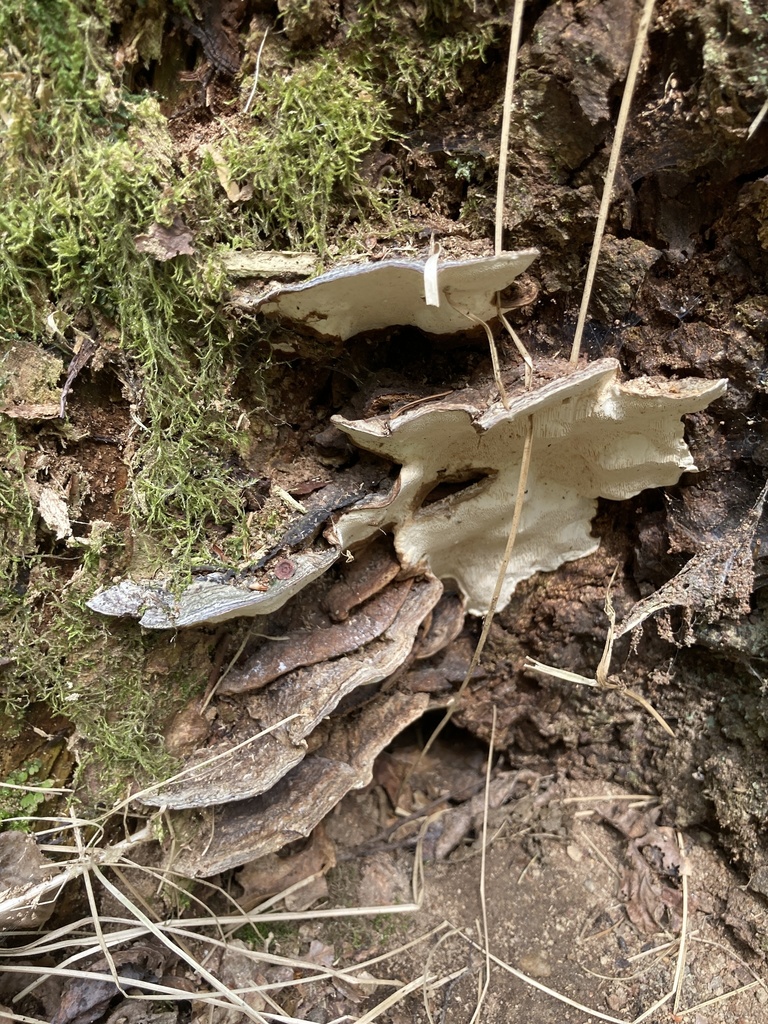
Conifer-base Polypore
Heterobasidion annosum
Heterobasidion annosum is a basidiomycete fungus in the family Bondarzewiaceae. It is considered to be the most economically important forest pathogen in the Northern Hemisphere. Heterobasidion annosum is widespread in forests in the United States and is responsible for the loss of one billion U.S. dollars annually. This fungus has been known by many different names. First described by Fries in 1821, it was known by the name Polyporus annosum. Later, it was found to be linked to conifer disease by Robert Hartig in 1874, and was renamed Fomes annosus by H. Karsten. Its current name of Heterobasidion annosum was given by Brefeld in 1888. Heterobasidion annosum causes one of the most destructive diseases of conifers. The disease caused by the fungus is named annosus root rot.
From the article Heterobasidion annosum on Wikipedia (CC BY-SA), quoted section by section
Description
The fruiting bodies of the fungus, which are also known as basidiocarps, are normally brackets which are whitish around the margins and dark brown on the uneven, knobbly upper surface. They can blacken in age. They can also take a resupinate form, consisting only of a white crust which corresponds to the underside of the bracket. Basidiocarps are up to about 40 cm in diameter and 3.5 cm thick. The fertile surface of the fruiting body is white, easily bruising brown, and has barely visible pores, with 3-4 per mm. The flesh, which has a strong fungus smell, is elastic when young but becomes woody when older. Sexual spores called basidiospores are created in the fertile layer on the lower surface of the basidiocarps, whilst conidiospores occur in the asexual stage and are produced on microscopic "conidiophores" which erupt through the surface of the host tree. Conidiospores and basidiospores are both produced by this fungus, the latter being more important for infecting the conifers. The species is inedible.
Range & habitat
The species is endemic to the United States. It was introduced into Italy during the Second World War, vectored in wooden crate material.
Wikipedia: “Range”
What it does
In the summertime, basidiospores, the primary infective propagules, are released. These basidiospores are carried long distances by wind currents. They infect trees (usually conifers) through damage such as freshly cut stumps. Once on the stump the fungus colonizes and moves into the root via mycelium. Heterobasidion annosum moves short distances from the roots of an infected stump through root grafts with other trees. It can also spread through insects that feed on roots. Since this fungus can not move very far through soil, it relies on tree roots to help it infect neighbouring trees. In these roots, it can grow 0.1–2.0 m per year. This results in a spread of the fungus and disease gaps in the forest. These disease gaps are produced when the trees die and fall, creating gaps in the forest canopy. These gaps affect the moisture and sunlight available, altering the habitats for plants and animals on the forest floor. Spiniger meineckellus, the name for the asexual stage of this fungus, is produced on stumps when the conditions are moist, and the conidiospores that are produced will be able to live in the soil for up to ten months. The role of conidiospores is unknown in the infection process and is not thought to be important.
Wikipedia: “Ecology and life cycle”
Where it lives
Recorded sightings
—
geo-referenced records in GBIF, from museums, herbaria and field observers.
Drag the globe to turn it. Dots are where records exist, not a range map; darker means more records.
In the stacks
Searching the stacks…
Every page naming Heterobasidion annosum in the Biodiversity Heritage Library →
This page is assembled live from iNaturalist, GBIF, Wikipedia, the Source Library and the Internet Archive. It is not yet part of the hand-edited codex. iNaturalist taxon 194485.