- Fungi Including Lichens
- ›Basidiomycete Fungi
- ›Higher Basidiomycetes
- ›Mushrooms, Bracket Fungi, Puffballs, and Allies
- ›Russulales
- ›Milkcaps, Brittlegills and Allies
- ›Lactarius
- ›Lactarius
- ›Deliciosi
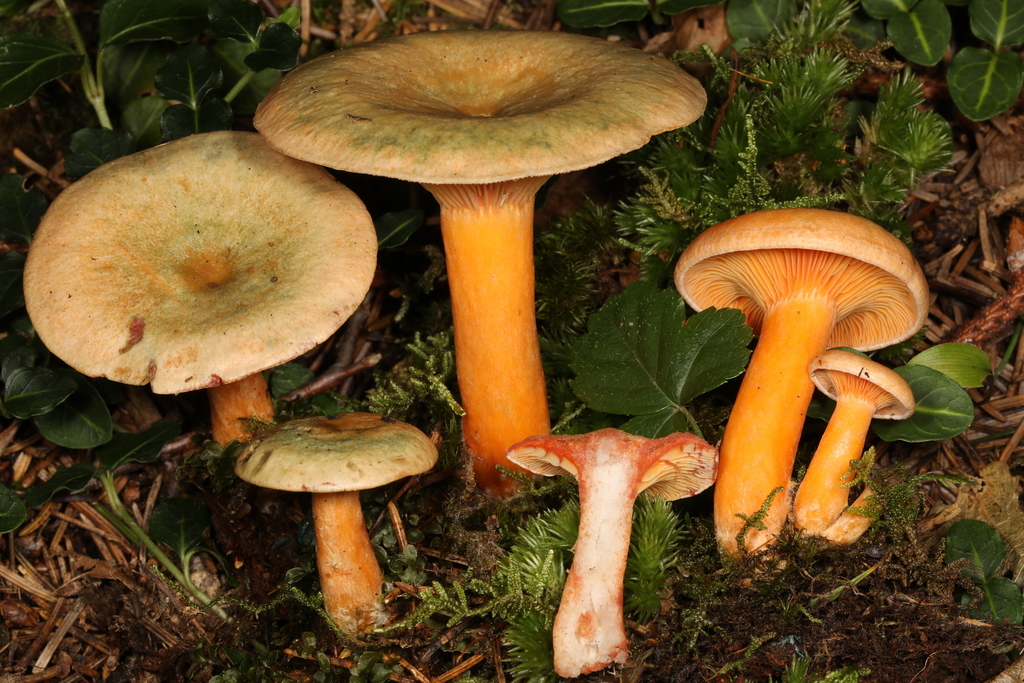
Orange-latex Milky
Lactarius deterrimus
Lactarius deterrimus, also known as false saffron milkcap or orange milkcap, is a species of fungus in the family Russulaceae. The fungus produces medium-sized fruit bodies (mushrooms) with orangish caps up to 12 centimetres (4+1⁄2 inches) wide that develop green spots in old age or if injured. Its orange-coloured latex stains maroon within 30 minutes.
Lactarius deterrimus is a mycorrhizal fungus that associates with Norway spruce and bearberry. The species is distributed in Europe, but has also found in parts of Asia. A visually similar species in the United States and Mexico is not closely related to the European species. The fruit bodies appear between late June and November, usually in spruce forests. Although the fungus is edible—like all Lactarius mushrooms from the section Deliciosi—its taste is often bitter, and it is not highly valued. The fruit bodies are used as source of food for the larvae of several insect species. Lactarius deterrimus can be distinguished from similar Lactarius species by difference in the mycorrhizal host or latex colour.
From the article Lactarius deterrimus on Wikipedia (CC BY-SA), quoted section by section
Range & habitat
Lactarius deterrimus is mainly distributed in Europe, but the fungus has also found in areas of Asia (Turkey, India, Pakistan). According to recent molecular biologic research, the similar North American species from the United States and Mexico are not closely related to the European species. In Europe, the fungus is especially common in Northern, North-East and Central Europe; in the UK, it may be found from July through to November. In the south and west it is common in mountainous areas. In the east, its range extends to Russia.
Wikipedia: “Distribution and habitat”
What it does
Lactarius deterrimus has traditionally been considered to have a strict mycorrhizal host specificity with Norway spruce. In 2006, it was reported that the fungus can also form arbutoid mycorrhiza with bearberry (Arctostaphylos uva-ursi). Arbutoid mycorrhizal associations are variants of ectomycorrhiza found in certain plants in the Ericaceae characterised by hyphal coils in epidermal cells. The mycorrhiza formed by L. deterrimus on both bearberry and Norway spruce show typical features such as a hyphal mantle and a Hartig net; the distinguishing characteristic between the mycorrhizal symbioses with the different hosts is that the hyphae penetrate the epidermal cells of bearberry, although there are also some differences in the form of the Hartig net, branching pattern, and colour. Although bearberry has been shown to form mycorrhiza with a wide range of fungi both in the field and in laboratory experiments, it had never previously been known to form mycorrhiza with fungi thought to be strictly host-specific. Bearberry may function as a nurse plant to help re-establish Norway spruce in deforested areas. The species is common in spruce-fir and spruce-moorland forests and in spruce forests and plantations. …
Wikipedia: “Ecology”
At the table
Lactarius deterrimus is an edible mushroom, but is much less appreciated than the similar L. deliciosus. The first tastes slightly bitter and is often infested by maggots. Like L. deliciosus, this fungus is mainly stir-fried in butter or oil; if it is cooked in water, the flesh becomes very soft. Young fruit bodies can be also pickled, or dried for later use. As the fungus is often heavily infested by maggots, skilled mushroom pickers prefer young fruit bodies. The urine discolours to red if a large amount of milk caps are eaten, but this is entirely harmless and is not evidence for an impairment to health. The red-coloured azulene compounds, ingested with the mushroom food, are more or less excreted with the urine.
Wikipedia: “Edibility”
Where it lives
Recorded sightings
—
geo-referenced records in GBIF, from museums, herbaria and field observers.
Drag the globe to turn it. Dots are where records exist, not a range map; darker means more records.
In the stacks
Searching the stacks…
Every page naming Lactarius deterrimus in the Biodiversity Heritage Library →
This page is assembled live from iNaturalist, GBIF, Wikipedia, the Source Library and the Internet Archive. It is not yet part of the hand-edited codex. iNaturalist taxon 194385.