- Fungi Including Lichens
- ›Ascomycete Fungi
- ›Sac Fungi and Lichens
- ›Common Lichens
- ›Shield Lichens, Sunburst Lichens, Rosette Lichens, and Allies
- ›shield lichens, rim lichens, and allies
- ›spindles and structured lichens
- ›Cladonia
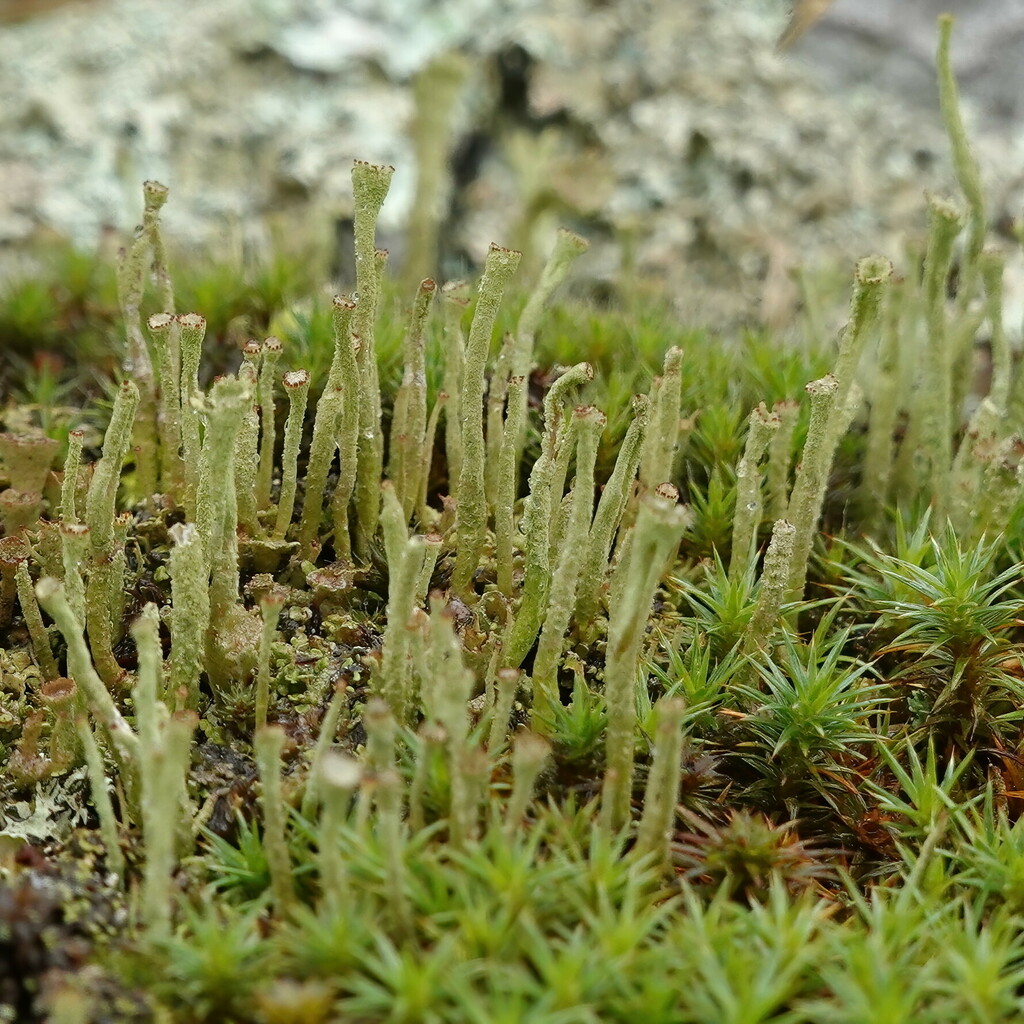
Wand Lichen
Cladonia rei
Cladonia rei, commonly known as the wand lichen, is a species of ground-dwelling, fruticose lichen in the family Cladoniaceae. It is a widely distributed species, having been reported from Africa, Asia, Australasia, Europe, and North America. It is identified by its slightly dirty-colored, rough-surfaced, slender podetia that grow up to 9 cm (3.5 in) tall. Diagnostic characters of the lichen include the continuously sorediate, green-and-brown-mottled, podetia that taper upward to a point, while chemically, it contains homosekikaic and sekikaic acids. Its reduced capacity to bioaccumulate toxic heavy metals from its surroundings, as well as its ability to switch photobiont partners, allows the lichen to colonize and survive highly polluted habitats. There are several other Cladonia species that are somewhat similar in appearance, but can be distinguished either by subtle differences in morphology, or by the secondary chemicals they contain.
From the article Cladonia rei on Wikipedia (CC BY-SA), quoted section by section
Description
Primary squamules are small and inconspicuous, often disappearing. Podetia are gray-green to olive, sometimes browned, slender, coarsely or finely sorediate on the upper half. They have dimensions in the range of 2–9 cm (13⁄16–3+9⁄16 in) tall by 1–2 mm (up to 3.5 mm) thick. They have with narrow, symmetrical, or, more frequently lopsided cups, proliferating at the margins to resemble a star or magic wand. Pale to dark brown apothecia are common on proliferations along the cup margins. It is prudent to take heed of Spier and Aptroot's thoughts: "There is much individual variation between the specimens, which can vary from nearly unbranched to cup-shaped, from slender (less than 1 mm thick) to robust (reaching 5 mm) and from low (average height below 2 cm) to high (height over 5 cm, clearly higher than the surrounding Cladonia species). The distribution of these forms over the chemotypes is on the whole largely similar and differentiating characteristics could not be found." Further, it is known that growth in contaminated sites can influence the growth and development of the Cladonia thalli, sometimes resulting in features that do not coincide with the normal taxonomic definition of the species. This phenomenon has been documented with Cladonia rei.
Chemistry. Chemical spot tests are undergone for identification. …
Range & habitat
Cladonia rei is a terricolous lichen that grows in soil, although more rarely it is found on rotting wood, and there are few records of it growing on other substrates, including rock, plastic, old straw, and mosses over rocks. It prefers open areas with low humus content and a substrate with a more or less neutral soil pH. often in dry and sunny places like grasslands, heaths and wastelands. Another favoured habitat is limestone cliffs and limestone meadows, although the lichen is also found in disturbed areas, such as road embankments, gravel pits, or house ruins. It is a pioneer species: able to quickly colonise bare ground, particularly in disturbed and anthropogenic habitats. In some cases, it can grow on impoverished soil with high heavy metal content. In Krompachy (Slovakia), the lichen, along with the moss Ceratodon purpureus, was found to be very abundant in bare acid soil near copper smelters, where all vascular plants were severely damaged or have disappeared. It is prevalent in temperate or somewhat arid regions, and does not occur in the Arctic or the Antarctic. The lichen was used as a case study for a large-scale biodiversity monitoring program in Alberta, Canada. …
Wikipedia: “Habitat and distribution”
What it does
Epicladonia sandstedei is a lichenicolous fungus that parasitises Cladonia rei. In a study of the oribatid mite communities associated with three Cladonia species in a heavily contaminated habitat, Cladonia rei was shown to provide a good habitat for mites. Because of the great variation in the growth forms of its podetia, densely covered with propagules such as corticated granules, squamules and microsquamules as well as numerous non-corticated, farinose-to-granular soredia, the surface area/volume ratio of the lichen is higher compared to other studied Cladonia species. The rugged surface texture provides more microhabitats for both mites and the particles of organic matter that are their diet. This contrasts with Cladonia cariosa and Cladonia pyxidata, which have a less diverse morphology, and a lower diversity of oribatid inhabitants. The photobiont partners of Cladonia rei are to some extent dependent upon the environment. Although both Asterochloris and Trebouxia can associate with the fungus, "the presence of Trebouxia was directly related to anthropogenic sites with technogenic substrates, and the proportion of lichen specimens with these algae clearly depended on the level of heavy-metal soil pollution and the habitat type. …
Wikipedia: “Ecology”
Where it lives
Recorded sightings
—
geo-referenced records in GBIF, from museums, herbaria and field observers.
Drag the globe to turn it. Dots are where records exist, not a range map; darker means more records.
In the stacks
Searching the stacks…
Every page naming Cladonia rei in the Biodiversity Heritage Library →
This page is assembled live from iNaturalist, GBIF, Wikipedia, the Source Library and the Internet Archive. It is not yet part of the hand-edited codex. iNaturalist taxon 180482.