- Fungi Including Lichens
- ›Ascomycete Fungi
- ›Sac Fungi and Lichens
- ›Common Lichens
- ›Shield Lichens, Sunburst Lichens, Rosette Lichens, and Allies
- ›shield lichens, rim lichens, and allies
- ›spindles and structured lichens
- ›Cladonia
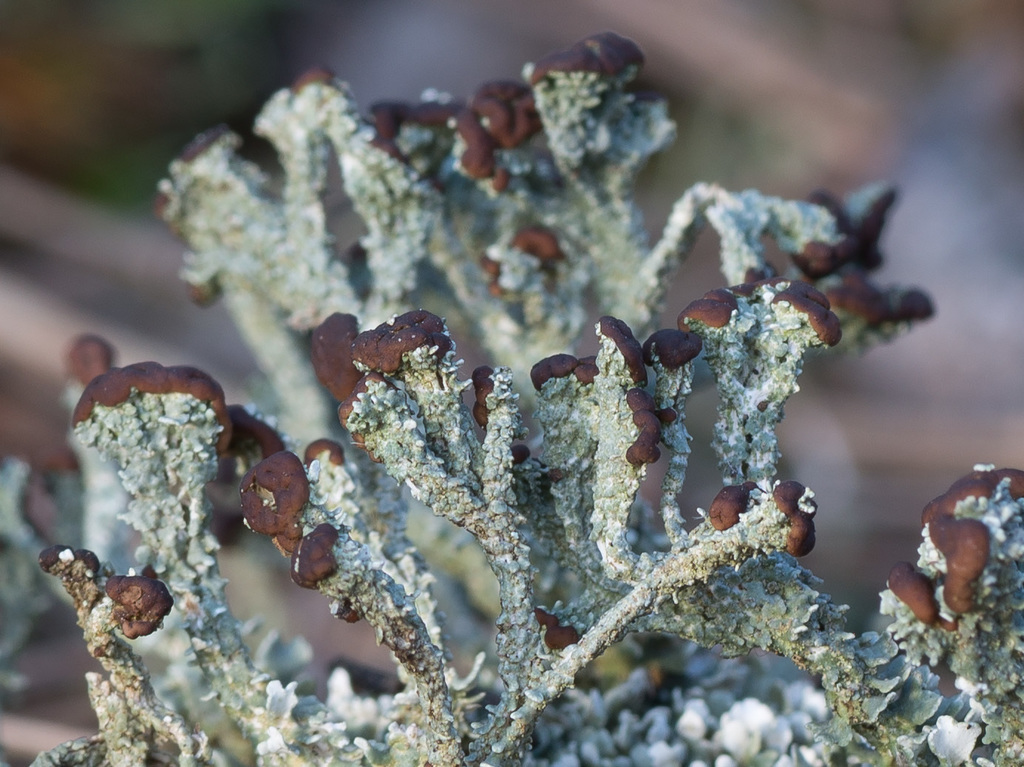
Split-peg Lichen
Cladonia cariosa
Cladonia cariosa is a species of fruticose lichen in the family Cladoniaceae. The species is characterised by its thick, tongue-shaped basal scales and upright grey-green stalks that lack the cup-like structures found in many related lichens, instead being topped with large chocolate-brown fruiting bodies. It has a cosmopolitan distribution and commonly grows on soil in both calcium-rich and calcium-poor sites across northern North America. The lichen is also known by the common names split-peg lichen and split-peg soldiers.
From the article Cladonia cariosa on Wikipedia (CC BY-SA), quoted section by section
Description
The primary thallus typically forms a low mat about 2–6(9) mm deep, made up of small to medium squamules about 1–3(6) by (0.5)1–1.5 mm. The upper surface is pale green to olive or tan, smooth to slightly roughened, sometimes lightly pruinose near the edges. The podetia are mostly 1–3 cm tall, simple to branched, and often have sides that are fissured and split; they usually bear terminal, convex to almost spherical, brown to dark-brown apothecia.
In the western North American material treated as C. cariosa in a strict sense, all specimens contained atranorin. Five chemotypes were detected: atranorin alone (most frequent), or atranorin with fumarprotocetraric acid, homosekikaic acid, norstictic acid, or porphyrilic acid. Rangiformic acid has been reported as an additional substance in some chemotypes, although the authors note that their newly sequenced specimens were not screened for fatty acids such as rangiformic acid because of the type of TLC plates used. Cladonia peziziformis is somewhat similar in appearance, but can be distinguished by differences in chemistry, the paler brown colour of its apothecia, and its greener podetia. Squamulose Cladonia colonies that lack podetia are often difficult to identify, because many diagnostic characters are on the podetia; when podetia are absent, chemical tests may be inconclusive and DNA sequencing may be needed. Within the C. …
Range & habitat
Cladonia cariosa is a widespread lichen with a cosmopolitan distribution. It grows directly on soil in calcium-rich and calcium-poor sites, and also in sun-exposed sandy soil. It is widely distributed in northern North America. In western North America it has been collected on soil in a range of settings, including roadcuts (both open and partially shaded), shale-derived soils, and sagebrush grassland soils. In Nepal, the lichen has been reported at 3,100 m elevation in a compilation of published records. Lichenozyma pisutiana is a yeast in the class Cystobasidiomycetes that has been found associating with Cladonia cariosa.
Wikipedia: “Habitat and distribution”
Where it lives
Recorded sightings
—
geo-referenced records in GBIF, from museums, herbaria and field observers.
Drag the globe to turn it. Dots are where records exist, not a range map; darker means more records.
In the stacks
Searching the stacks…
Every page naming Cladonia cariosa in the Biodiversity Heritage Library →
This page is assembled live from iNaturalist, GBIF, Wikipedia, the Source Library and the Internet Archive. It is not yet part of the hand-edited codex. iNaturalist taxon 179750.