- Fungi Including Lichens
- ›Basidiomycete Fungi
- ›Higher Basidiomycetes
- ›Mushrooms, Bracket Fungi, Puffballs, and Allies
- ›Agaricomycetidae
- ›Common Gilled Mushrooms and Allies
- ›Clavariineae
- ›antler and spindle fungi
- ›Clavulinopsis
- ›Donkella
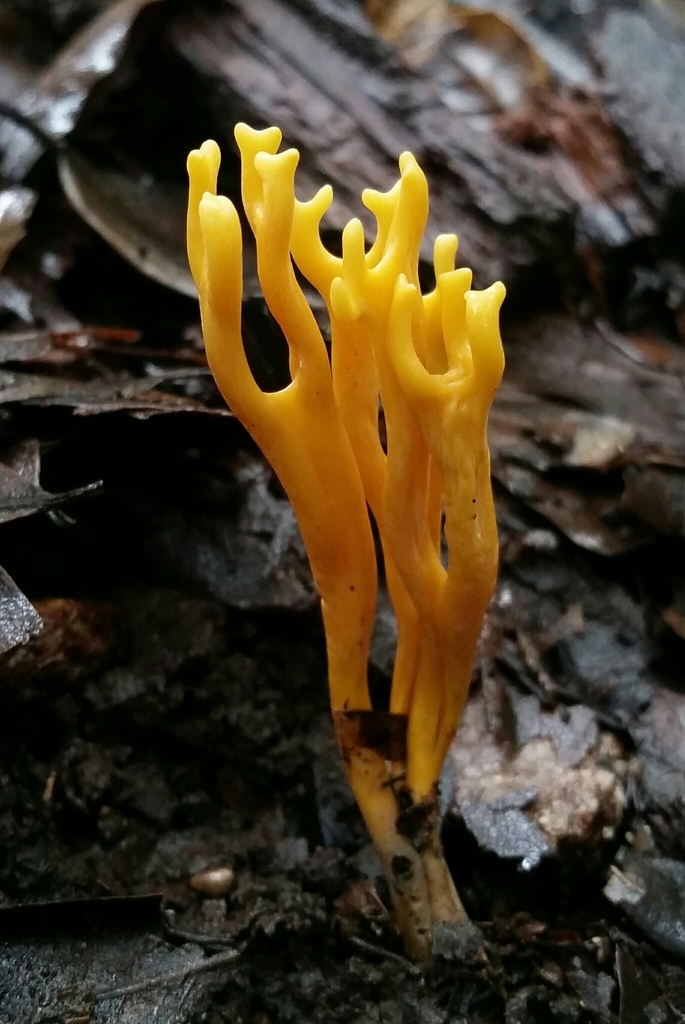
meadow coral fungus
Clavulinopsis corniculata
Clavulinopsis corniculata is a clavarioid fungus in the family Clavariaceae. In the UK, it has the recommended English name of meadow coral. It forms branched, cylindrical, ochre fruit bodies that grow on the ground in agriculturally unimproved grassland or in woodland litter. It was originally described from Germany and is part of a species complex as yet unresolved.
From the article Clavulinopsis corniculata on Wikipedia (CC BY-SA), quoted section by section
Description
The fruit body of is ochre to deep yellow, up to 8 centimetres (3 in) tall, typically branched two or three times, with a distinct, often paler stem. Microscopically, the basidiospores are hyaline, smooth, globose to subglobose, 4.5 to 6 by 4.5 to 5.5 μm, with a large apiculus.
Similar species. In Europe, Clavulinopsis umbrinella is a similarly shaped species in the same habitat, but is typically pale brown without yellowish tints. Some species of Ramaria sensu lato are yellow to ochre and similarly shaped. They typically occur in woodland and can be separated by their ochre (not white) spore print.
Range & habitat
The species was initially described from Europe, with a recent epitype from Slovakia. It is widely distributed throughout Europe, but has also been reported from North America, Central and South America, Africa, Asia, and Australia. The species occurs singly or in troops on the ground and is presumed to be saprotrophic. In America and Asia it grows in woodland, but in Europe it generally occurs in agriculturally unimproved, short-sward grassland (pastures and lawns), from July to November. Such waxcap grasslands are a declining and threatened habitat, but C. corniculata is one of the commoner species and is not generally considered of conservation concern.
Wikipedia: “Distribution and habitat”
At the table
Although too small to be of value, it is reported to be edible fresh, with the bitterness reduced through cooking and best mixed in as a garnish. It does not preserve well.
Wikipedia: “Uses”
Where it lives
Recorded sightings
—
geo-referenced records in GBIF, from museums, herbaria and field observers.
Drag the globe to turn it. Dots are where records exist, not a range map; darker means more records.
In the stacks
Searching the stacks…
Every page naming Clavulinopsis corniculata in the Biodiversity Heritage Library →
This page is assembled live from iNaturalist, GBIF, Wikipedia, the Source Library and the Internet Archive. It is not yet part of the hand-edited codex. iNaturalist taxon 179221.