- Fungi Including Lichens
- ›Ascomycete Fungi
- ›Sac Fungi and Lichens
- ›Common Lichens
- ›Shield Lichens, Sunburst Lichens, Rosette Lichens, and Allies
- ›Leprocaulales
- ›Leprocaulaceae
- ›Speerschneidera
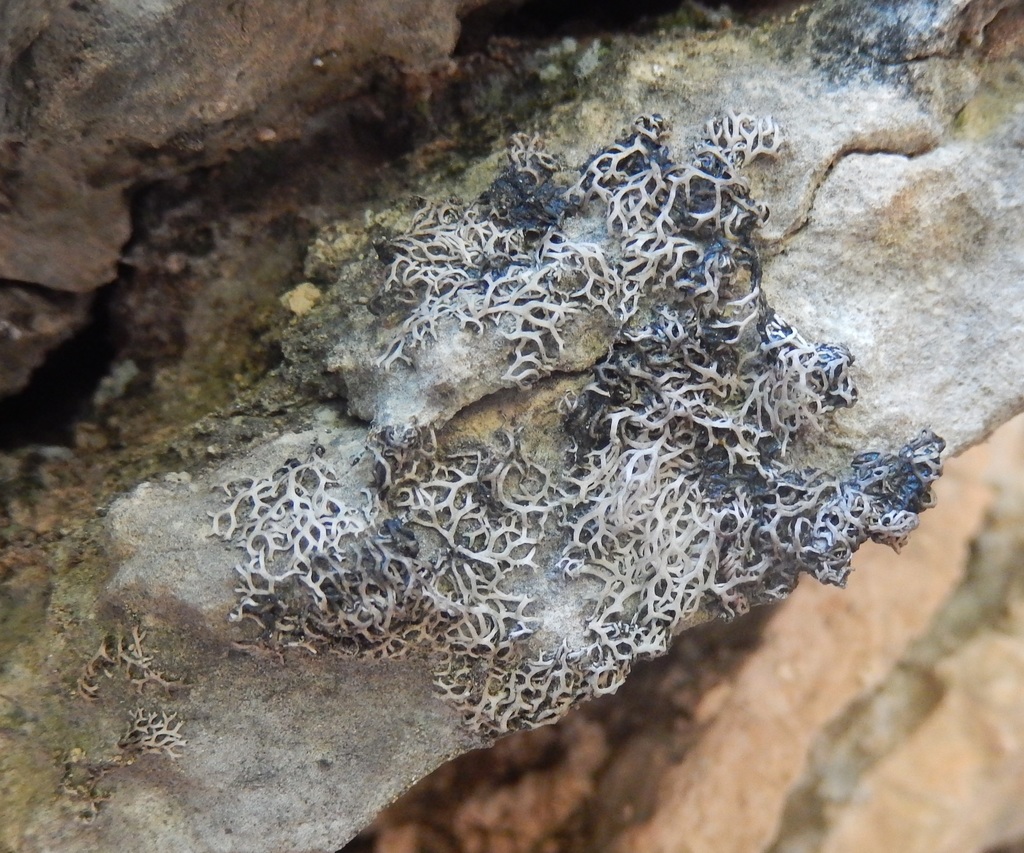
Speerschneidera euploca
Speerschneidera is a single-species fungal genus that contains the saxicolous (rock-dwelling) crustose lichen Speerschneidera euploca. It is known from scattered localities in the south-central United States and Mexico, where it grows on shaded calcareous outcrops. The genus has had an unstable family placement: it was traditionally placed in Leprocaulaceae, but a 2025 multi-gene phylogenetic study recovered it in Catillariaceae and treated Leprocaulaceae as a synonym.
From the article Speerschneidera on Wikipedia (CC BY-SA), quoted section by section
Description
The thallus of Speerschneidera forms regular, circular rosettes about 7–12 cm across. These are built from narrow lobes 0.2–0.5 mm thick that usually branch in two at short intervals; three-way branching is uncommon. The upper surface is smooth and grey to brownish-grey (turning grey-green when moist), while the underside is paler and has a fine, fibrillar texture. The thallus is attached to the rock at irregular intervals by adhesive strands. In cross section, much of the thallus is occupied by a strongly developed upper cortex of densely interwoven fungal tissue (scleroplectenchyma). This layer is typically 180–230 μm thick and makes up about one-half to four-fifths of the thallus thickness, while the lower cortex is thinner, at about 50–70 μm. The green algal partner is embedded in the medulla in clusters about 100 μm tall, interspersed with fungal hyphae. Josef Poelt interpreted the prominent, hyaline strand-like tissues in Speerschneidera as functioning mainly in water retention rather than acting purely as a mechanical support. Apothecia develop chiefly in the branch axils (less often near lobe tips or edges) and, as they mature, may appear centred on the narrow lobes. Mature apothecia are about 0.5–2.0 mm across with a flat to sometimes convex, reddish-brown disc, and they are built in the lecanoralean manner. …
Range & habitat
Speerschneidera euploca grows on calcareous rock, typically on shaded, steep, north-facing exposures, and is rarely collected and apparently uncommon. When dry it is easily overlooked because its color blends with limestone, but when wet it becomes bright green. In central Texas it was reported from juniper-shaded north-facing outcrops, growing alongside Dermatocarpon minimum and species of Collema and Verrucaria. Hafellner and Egan recorded it from the St. Louis area of Missouri south-west through Kansas, Oklahoma and Texas to a single locality in Jalisco, Mexico, with no records reported outside the United States and Mexico.
== References ==
Wikipedia: “Habitat and ecology”
Where it lives
Recorded sightings
—
geo-referenced records in GBIF, from museums, herbaria and field observers.
Drag the globe to turn it. Dots are where records exist, not a range map; darker means more records.
In the stacks
Searching the stacks…
Every page naming Speerschneidera euploca in the Biodiversity Heritage Library →
This page is assembled live from iNaturalist, GBIF, Wikipedia, the Source Library and the Internet Archive. It is not yet part of the hand-edited codex. iNaturalist taxon 174891.