- Fungi Including Lichens
- ›Ascomycete Fungi
- ›Sac Fungi and Lichens
- ›Arthoniomycetes
- ›Arthoniales
- ›Christmas lichens, comma lichens, and allies
- ›Diarthonis
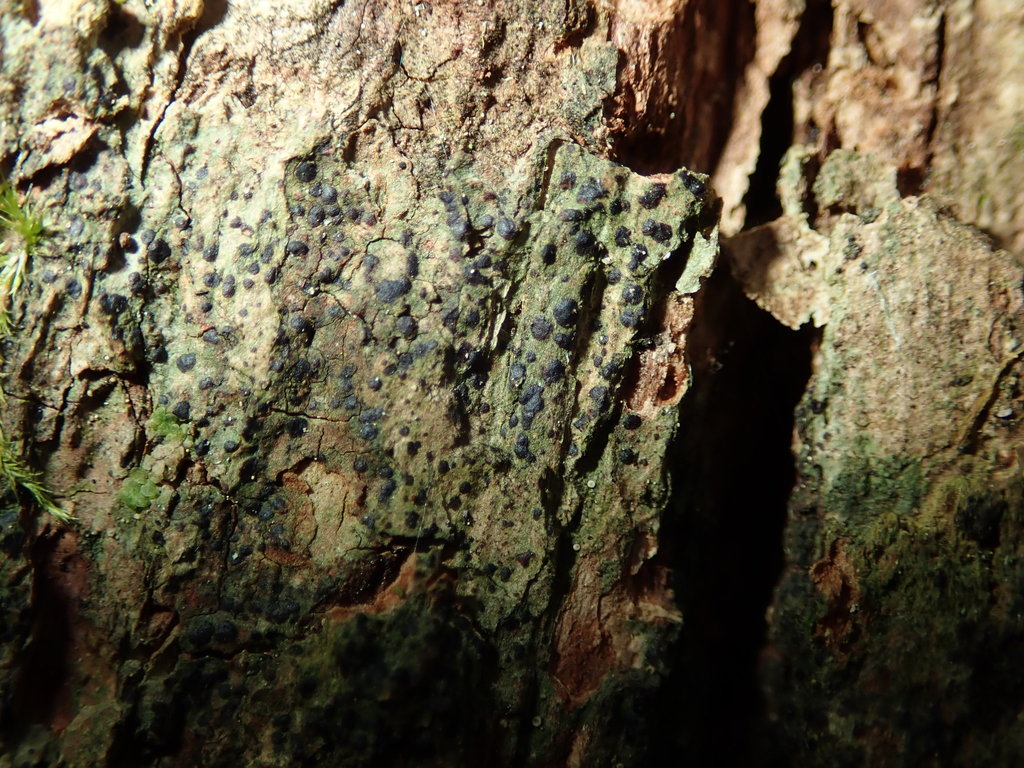
Diarthonis spadicea
Diarthonis is a fungal genus in the family Graphidaceae. Originally created in 1909 but long unused, the genus was revived in 2020 to accommodate D. spadicea when molecular studies showed this species fell outside the main Arthonia clade. The species grows as a thin, greyish to greenish crust beneath tree bark, producing small black disc-like reproductive structures (apothecia) that resemble drops of tar. It is considered an indicator of ecological continuity in old-growth broadleaved forests, particularly those dominated by English oak, and is listed as near-threatened in some regions.
From the article Diarthonis on Wikipedia (CC BY-SA), quoted section by section
Description
Diarthonis is characterised by its thin, greyish to grey-green body (thallus) that typically grows beneath the surface of tree bark, though occasionally appears on the surface. Its most distinctive features are the small, rounded reproductive structures (apothecia) that resemble drops of tar on the bark. These apothecia are reddish-brown to nearly black, often with a slight shine, and measure between 0.2 and 1.5 mm across. When viewed under a microscope, the apothecia show a uniform orange-brown colour that turns dull purple when treated with potassium hydroxide solution (K). The spores produced in these structures are colourless, divided into two cells by a single wall (septum), and roughly slipper-shaped, measuring 7–11 by 3–4 μm. The genus also produces smaller reproductive structures called pycnidia, which are brown with orange to reddish-brown walls that also turn pale purple with potassium hydroxide. These contain tiny, rod-shaped to narrowly elliptical spores (conidia). Chemical analysis has not detected any lichen products in the species.
Range & habitat
Diarthonis spadicea is considered an indicator species of good habitat quality and ecological continuity in broadleaved woodlands dominated by Quercus robur. Some authors consider it an old-growth indicator species. The species typically occurs in moist old forests that are well-lit but protected from direct sunlight. While it is often reported as being limited to the lowermost parts of tree boles or even roots, it has been found growing up to 2.5 metres high on trunks in some locations. In Italy, D. spadicea is listed as a near-threatened species in the national Red List of lichens. In Lombardy, there was only a single historical record from the mid-19th century in the hills around Como until recent surveys discovered new populations. In contrast, D. spadicea was listed as a least-concern species in the first Red List of Latvian lichen in 2024.
== References ==
Wikipedia: “Habitat, distribution, and ecology”
Where it lives
Recorded sightings
—
geo-referenced records in GBIF, from museums, herbaria and field observers.
Drag the globe to turn it. Dots are where records exist, not a range map; darker means more records.
In the stacks
Searching the stacks…
Every page naming Diarthonis spadicea in the Biodiversity Heritage Library →
This page is assembled live from iNaturalist, GBIF, Wikipedia, the Source Library and the Internet Archive. It is not yet part of the hand-edited codex. iNaturalist taxon 1648469.