- Fungi Including Lichens
- ›Basidiomycete Fungi
- ›Higher Basidiomycetes
- ›Mushrooms, Bracket Fungi, Puffballs, and Allies
- ›Russulales
- ›Milkcaps, Brittlegills and Allies
- ›Russula
- ›Russula
- ›Viscidinae
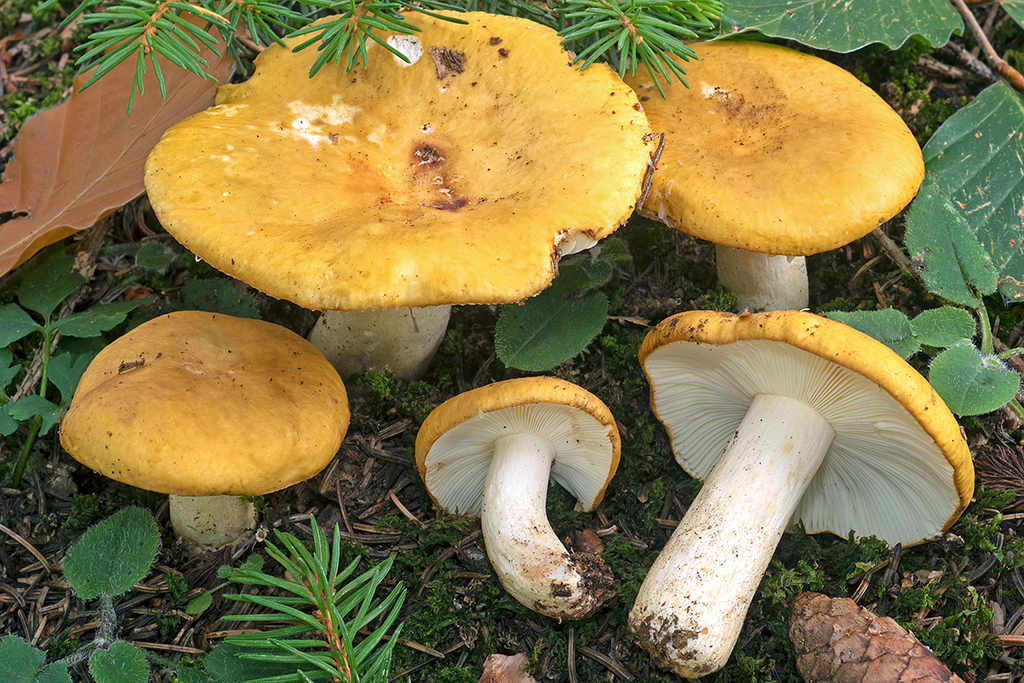
Ochre Brittlegill
Russula ochroleuca
Russula ochroleuca is a member of the genus Russula. A group that have become known as brittlegills. It has been commonly known as the common yellow russula for some years, and latterly the ochre brittlegill. It is widespread, and common in mixed woodland.
From the article Russula ochroleuca on Wikipedia (CC BY-SA), quoted section by section
Description
The cap is dull yellow and 5–12 cm (2–4.5 in) wide, initially convex, later flat, or slightly depressed. The cap margin becomes furrowed when mature, and it is two-thirds peeling. The gills are white to greyish white, and are adnexed. The stipe is 3–7 cm (1–3 in) long, 1–2 cm (0.5–1 in) wide, cylindrical, white or later greyish. The taste is mild to moderately hot. It could be confused with the similar-looking and much better tasting Russula claroflava.
Range & habitat
Russula ochroleuca grows in deciduous and coniferous forest, where it (at least in Northwestern Europe) is very common. In the USA it is fairly common under conifers; birch, and aspen in the Northern States.
Wikipedia: “Distribution and habitat”
Where it lives
Recorded sightings
—
geo-referenced records in GBIF, from museums, herbaria and field observers.
Drag the globe to turn it. Dots are where records exist, not a range map; darker means more records.
In the stacks
Searching the stacks…
Every page naming Russula ochroleuca in the Biodiversity Heritage Library →
This page is assembled live from iNaturalist, GBIF, Wikipedia, the Source Library and the Internet Archive. It is not yet part of the hand-edited codex. iNaturalist taxon 153459.