- Fungi Including Lichens
- ›Basidiomycete Fungi
- ›Higher Basidiomycetes
- ›Mushrooms, Bracket Fungi, Puffballs, and Allies
- ›Agaricomycetidae
- ›Common Gilled Mushrooms and Allies
- ›Agaricineae
- ›Strophariaceae
- ›Pholiota
- ›Pholiota
- ›Pholiota
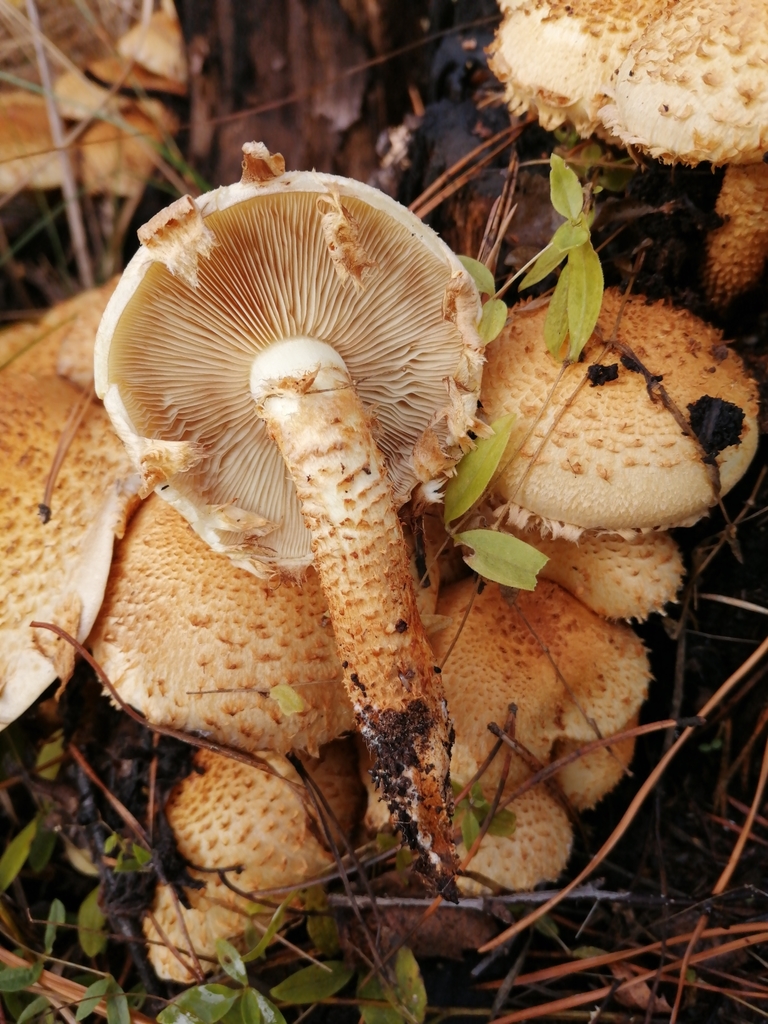
shaggy scalycap
Pholiota squarrosa
Pholiota squarrosa, commonly known as the shaggy scalycap, the shaggy Pholiota, or the scaly Pholiota, is a species of mushroom in the family Strophariaceae. Both the cap and the stem are covered in small, pointed scales that are pointed downward and backward. The crowded gills are yellowish, then later rust-brown. The mushroom has an odor that, depending on the author, has been described as resembling garlic, lemon, radish, onion, or skunk. It has a strong taste, resembling radishes. The very similar P. squarrosoides differs in having a paler cap that is sticky between the scales, and smaller spores.
Common in North America and Europe, it is a secondary parasite, in that it attacks trees that have already been weakened from prior injury or infection by bacteria or other fungi. It has a wide range of hosts among deciduous trees, although it can also infect conifers. It can also live as a saprobe, deriving nutrients from decomposing wood. Though edible to some, it may be toxic, especially if consumed in combination with alcohol. The mushroom contains unique chemicals thought to help it infect plants by neutralizing defensive responses employed by them.
From the article Pholiota squarrosa on Wikipedia (CC BY-SA), quoted section by section
Description
Like other Pholiota mushrooms, P. squarrosa has a scaly cap and stem. The cap ranges from 3 to 12 cm (1.2 to 4.7 in) in diameter, and depending on its age, can range in shape from bell-shaped to rounded to somewhat flattened. The cap color is yellowish-brown to tawny in older specimens. The scales on the cap are yellowish to tawny, and recurved. The stem is 4 to 12 cm (1.6 to 4.7 in) long by 0.5 to 1.5 cm (0.20 to 0.59 in) thick, and roughly equal in width throughout. The partial veil that covers the young gills forms a thick, woolly ring on the upper part of the stem. Above the level of the ring, the stem is bare, while below it is scaly like the cap. The gills are covered by a partial veil when young and have a greenish-brown color; mature gills are rusty brown. They are crowded closely together, attached to the stem (adnate), and usually notched (sinuate). The spore print is cinnamon or rusty brown. The spores are elliptic, smooth-walled, nonamyloid (not absorbing iodine when stained with Melzer's reagent), and measure 6.6–8 by 3.7–4.4 μm. The basidia (spore-bearing cells) are club-shaped, and four-spored, with dimensions of 16–25 by 5–7 μm. Fruit bodies have an odour described variously as resembling garlic, radish, lemon, onion, or skunk, and taste like radish.
Similar species. …
Range & habitat
The mushroom is typically found growing in clusters at the base of trees and stumps. Pholiota squarrosa is thought to be a white rot fungus, which use cellulose as a carbon source, and have the ability to degrade the lignin (present in wood) to carbon dioxide to access the cellulose molecule. The fungus can attack a wide variety of deciduous host trees, including sugar maple, red maple, yellow birch, paper birch, American beech, and white ash. It can also attack conifers, like spruce. The fungus is a secondary parasite, in that it attacks trees that have already been weakened from prior injury or infection by bacteria or other fungi. It also functions as a saprobe, and can obtain nutrients by breaking down organic matter in dead wood. P. squarrosa is found in North America and Europe. The North American distribution extends north to Canada, and south to Mexico, where its appearance is restricted to coniferous forests. In the Netherlands, P. squarrosa is one of many mushrooms that can regularly be found fruiting on ancient timber wharves. The fruit bodies are used as a primary food source by the red squirrel Sciurus vulgaris, and have a higher protein content than the other mushrooms typically consumed by this species. Decaying fruit bodies are also used as a food source by fruit flies of the genus Drosophila.
Wikipedia: “Ecology, habitat and distribution”
At the table
Although some sources report P. squarrosa as edible, the mushroom has caused several cases of poisoning. The afflicted individuals had consumed alcohol with the mushroom, then experienced vomiting and diarrhoea about ten hours later. The toxic effect may be due to the combination of eating the mushrooms and taking alcohol, although the extended time delay between consumption and symptoms suggests the mechanism of toxicity is different than the antabuse effect experienced from Coprinopsis atramentaria with alcohol.
Wikipedia: “Edibility”
Where it lives
Recorded sightings
—
geo-referenced records in GBIF, from museums, herbaria and field observers.
Drag the globe to turn it. Dots are where records exist, not a range map; darker means more records.
In the stacks
Searching the stacks…
Every page naming Pholiota squarrosa in the Biodiversity Heritage Library →
This page is assembled live from iNaturalist, GBIF, Wikipedia, the Source Library and the Internet Archive. It is not yet part of the hand-edited codex. iNaturalist taxon 153445.