- Fungi Including Lichens
- ›Ascomycete Fungi
- ›Sac Fungi and Lichens
- ›Operculate Ascomycetes
- ›Pezizales
- ›Caloscyphaceae
- ›Caloscypha
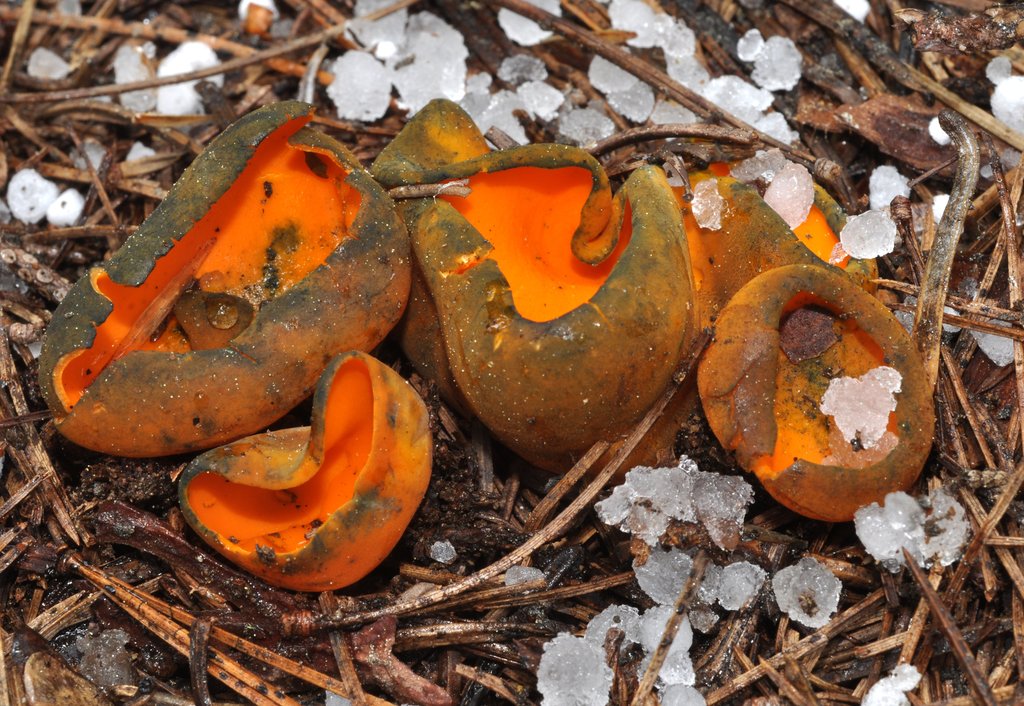
Spring Orange Peel Fungus
Caloscypha fulgens
Caloscypha is a fungal genus in the family Caloscyphaceae (order Pezizales). A monotypic genus, it contains the single species Caloscypha fulgens, commonly known as the snowbank orange peel fungus, spring orange peel fungus, the golden cup, or the dazzling cup. It is a cup fungus, typically up to 4 centimetres (1+5⁄8 in) in diameter, with a bright to pale orange interior and orange; specimens that are old or bruised often have an olive-green discoloration, especially around the edges.
In North America, C. fulgens is usually found on the ground in forest litter near conifers. Fruiting occurs in early spring following snow melt. The asexual (imperfect), or conidial stage of C. fulgens is the plant pathogenic species Geniculodendron pyriforme, known to infect dormant seeds of the Sitka spruce.
From the article Caloscypha on Wikipedia (CC BY-SA), quoted section by section
Description
The fruiting body of C. fulgens is roughly cup-shaped, although the cup may be somewhat flattened, lopsided or split; the size is up to 6 centimetres (2+3⁄8 inches) in diameter. The inner surface of the cup is orange-yellow, while the external surface is pale yellow. Either the margin around the rim or the entire outer surface may be stained olive-green. The green or bluish staining that occurs upon injury or with age is unique within the order Pezizales. The stem, if present, is rather short. The spore deposit is white. A single specimen of an albino form, 2 cm (3⁄4 in) in diameter, was discovered in Northern Idaho; it was found to be lacking the pigment responsible for staining the outer surface olive-green. The spores are translucent (hyaline), roughly spherical, thin-walled and smooth, with dimensions of 6–8 μm in diameter. The asci, the spore-bearing cells, are cylindrical and 80–100 by 7–8 μm; the paraphyses are thin and filamentous and contain orange granules. This fungus is considered nonpoisonous but inedible.
Similar species. C. fulgens bears some resemblance to the orange-peel fungus (Aleuria aurantia); however, A. aurantia does not have the characteristic bluing reaction upon bruising or with age, and it fruits later in the season (usually in autumn). It also bears similarities to Otidea species (e.g. O. onotica) which do not stain blue.
Range & habitat
This species is usually found in the spring, often on duff under conifers shortly after the snow melts. In North America, where it has been noted to occur only between March and July, it is widespread in the Rocky Mountains and the Pacific Northwest. C. fulgens has been collected in Britain, and possibly arrived there from imported infected seeds. It has also been collected from Japan, Sweden, The Netherlands, and Turkey.
Wikipedia: “Distribution and habitat”
In human culture
The specific epithet means "bright colored", while the genus name Caloscypha means "beautiful cup". The distinctive orange-yellow color of the fungus has earned it the common names "spring orange peel fungus", the "golden cup", and the "dazzling cup".
Wikipedia: “Etymology”
Where it lives
Recorded sightings
—
geo-referenced records in GBIF, from museums, herbaria and field observers.
Drag the globe to turn it. Dots are where records exist, not a range map; darker means more records.
In the stacks
Searching the stacks…
Every page naming Caloscypha fulgens in the Biodiversity Heritage Library →
This page is assembled live from iNaturalist, GBIF, Wikipedia, the Source Library and the Internet Archive. It is not yet part of the hand-edited codex. iNaturalist taxon 153035.