- Fungi Including Lichens
- ›Basidiomycete Fungi
- ›Higher Basidiomycetes
- ›Mushrooms, Bracket Fungi, Puffballs, and Allies
- ›Agaricomycetidae
- ›Common Gilled Mushrooms and Allies
- ›Hygrophorineae
- ›Waxcaps and Allies
- ›Cuphophylloideae
- ›Cuphophyllus
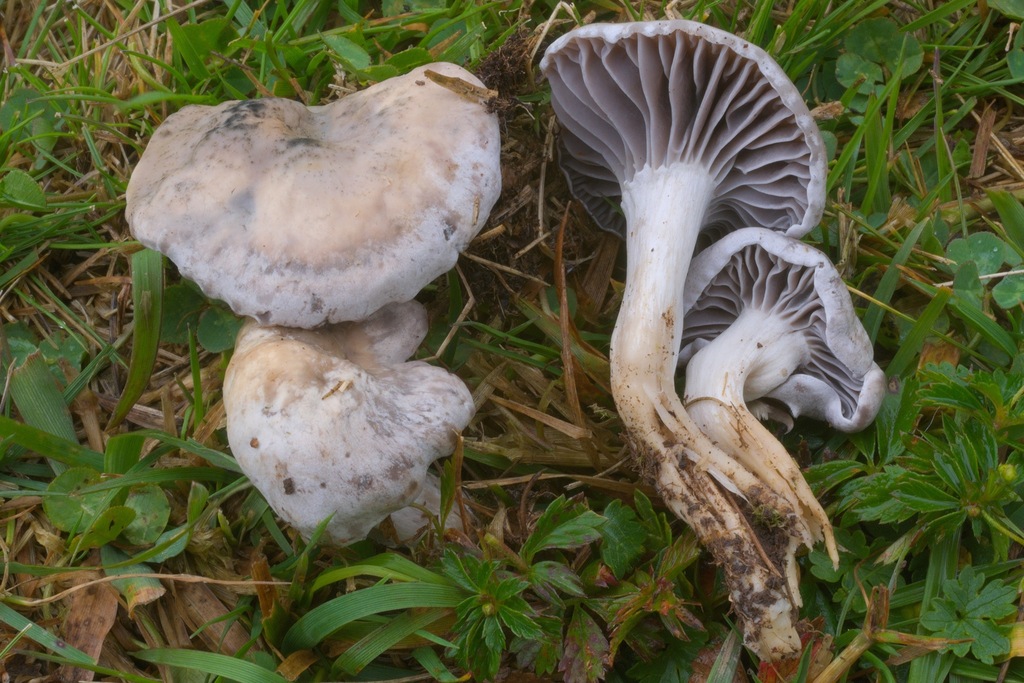
Felted Waxcap
Cuphophyllus atlanticus
Cuphophyllus atlanticus is a species of agaric (gilled mushroom) in the family Hygrophoraceae. Until recently (2021), the species was considered to be conspecific with the North American Cuphophyllus canescens, but DNA sequencing has shown that it is distinct. As C. canescens, it has been given the recommended English name of felted waxcap in the United Kingdom. Cuphophyllus atlanticus has a European and North American distribution, occurring in Europe mainly in agriculturally unimproved grassland. Threats to its habitat have resulted in C. canescens (including C. atlanticus) being assessed as globally "vulnerable" on the IUCN Red List of Threatened Species.
From the article Cuphophyllus atlanticus on Wikipedia (CC BY-SA), quoted section by section
Description
Basidiocarps are agaricoid, up to 40mm (1.5 in) tall, the cap broadly convex to flat when expanded, up to 40mm (1.5 in) across. The cap surface is smooth, dry, slightly felted, grey to bluish grey. The lamellae (gills) are thick, decurrent (running down the stipe), pale grey. The stipe (stem) is smooth, white to pale grey, lacking a ring. The spore print is white, the spores (under a microscope) smooth, inamyloid, subglobose, c. 5.5 to 6 by 4.5 to 5 μm.
Similar species. In Europe, the felted waxcap is distinguished from other grey species of Cuphophyllus by its dry, slightly felted cap that is never viscid or greasy. In North America, C. canescens is very similar, but is said to have drab or brownish tints in the cap and (microscopically) smaller, more globose spores measuring 4 to 5 μm across.
Range & habitat
In Europe, DNA studies have confirmed the presence of the felted waxcap in Norway, Sweden, and Scotland. This is the same northerly distribution previously noted for "C. canescens" in Europe. In North America, C. atlanticus has been confirmed from the United States (North Carolina) and Canada. Recent research suggests waxcaps are neither mycorrhizal nor saprotrophic but may be associated with mosses.
Wikipedia: “Distribution and habitat”
Where it lives
Recorded sightings
—
geo-referenced records in GBIF, from museums, herbaria and field observers.
Drag the globe to turn it. Dots are where records exist, not a range map; darker means more records.
In the stacks
Searching the stacks…
Every page naming Cuphophyllus atlanticus in the Biodiversity Heritage Library →
This page is assembled live from iNaturalist, GBIF, Wikipedia, the Source Library and the Internet Archive. It is not yet part of the hand-edited codex. iNaturalist taxon 1503496.