- Fungi Including Lichens
- ›Basidiomycete Fungi
- ›Higher Basidiomycetes
- ›Mushrooms, Bracket Fungi, Puffballs, and Allies
- ›Agaricomycetidae
- ›boletes and allies
- ›Suillineae
- ›Suillaceae
- ›Suillus
- ›Larigni
- ›Suillus grevillei
Larch Bolete
Suillus grevillei
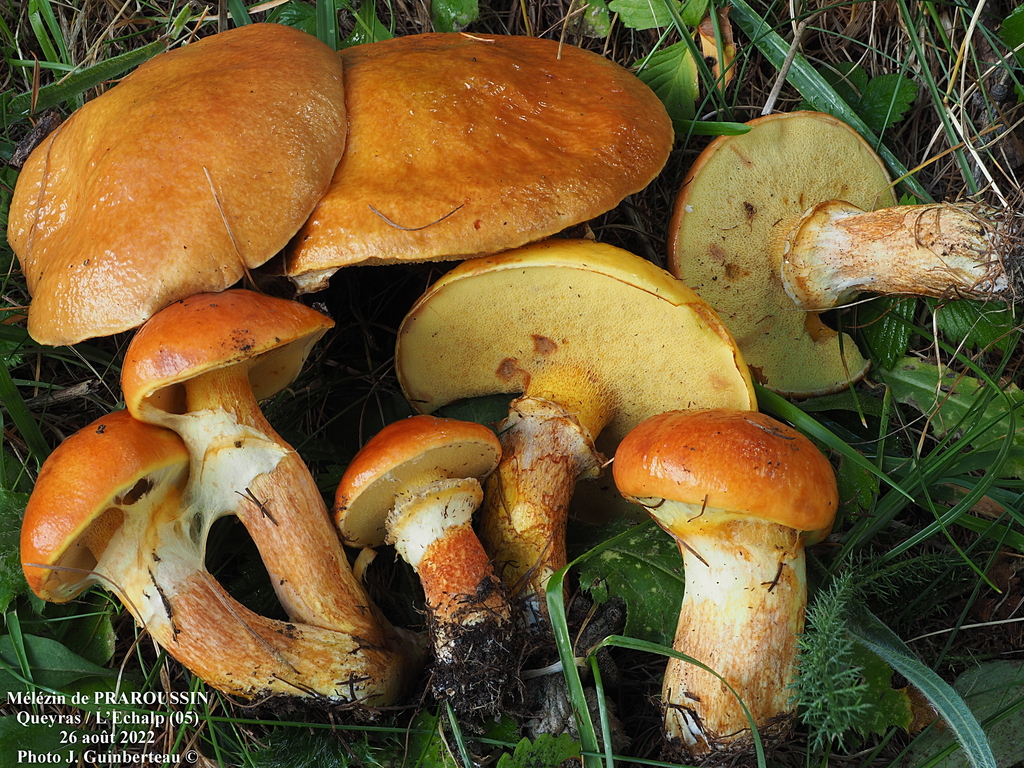
Suillus grevillei, commonly known as tamarack jack, Greville's bolete, or larch bolete, is a mycorrhizal mushroom with a tight, brilliantly coloured cap, shiny and wet looking with its mucous slime layer. The hymenium easily separates from the flesh of the cap, with a central stalk that is quite slender. The species has a ring or a tight-fitting annular zone.
From the article Suillus grevillei on Wikipedia (CC BY-SA), quoted section by section
Description
Suillus grevillei is a mushroom with a 5–10 cm (2–4 in) cap colored from citrus yellow to burnt orange, that is at first hemispherical, then bell-shaped, and finally flattened. It has a sticky skin, often with veil remnants on the edge, short tubes of yellow (possibly staining brownish) which descend down to the bottom of its cylindrical stalk (6–10 x 1–2 cm), which is yellowish above the ring area with streaks of reddish brown below. The flesh is yellow, staining brown. Taste mild to slightly astringent to bitterish; odor none to somewhat metallic.
Range & habitat
It grows only under larch trees. Widespread in North America and Europe (July–November). In Asia, it has been recorded from Taiwan.
Wikipedia: “Habitat and distribution”
At the table
Suillus grevillei can be cooked as an edible mushroom, though one without culinary interest, if the slimy cuticle is removed from the cap.
Wikipedia: “Edibility”
Where it lives
Recorded sightings
—
geo-referenced records in GBIF, from museums, herbaria and field observers.
Drag the globe to turn it. Dots are where records exist, not a range map; darker means more records.
In the stacks
Searching the stacks…
Every page naming Suillus grevillei in the Biodiversity Heritage Library →
This page is assembled live from iNaturalist, GBIF, Wikipedia, the Source Library and the Internet Archive. It is not yet part of the hand-edited codex. iNaturalist taxon 147277.