- Fungi Including Lichens
- ›Basidiomycete Fungi
- ›Higher Basidiomycetes
- ›Mushrooms, Bracket Fungi, Puffballs, and Allies
- ›Cantharellales
- ›Hydnaceae
- ›Cantharellus
- ›Cantharellus
- ›Sublaeves
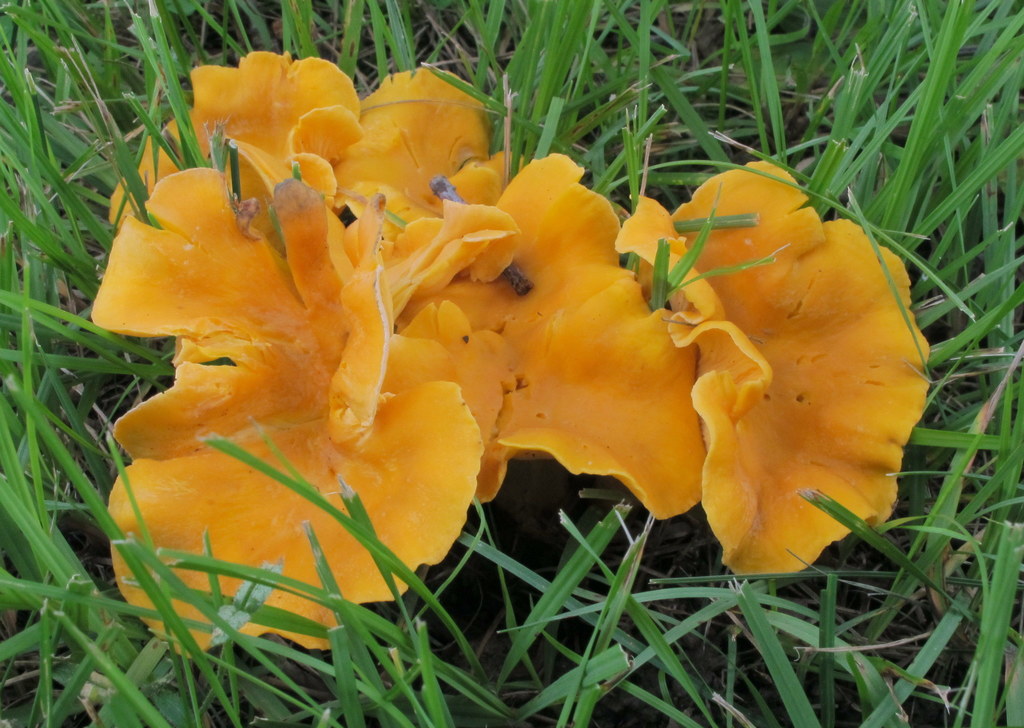
Smooth Chanterelle
Cantharellus lateritius
Cantharellus lateritius, commonly known as the smooth chanterelle, is a species of edible fungus in the mushroom family Cantharellaceae. The species has a complex taxonomic history, and has undergone several name changes since its first description by American mycologist Lewis David de Schweinitz in 1822. The fruit bodies of the fungus are brightly colored yellow to orange, and usually highly conspicuous against the soil in which they are found. At maturity, the mushroom resembles a filled funnel with the spore-bearing surface along the sloping outer sides. The texture of the fertile undersurface (hymenium) of the caps is a distinguishing characteristic of the species: unlike the well-known golden chanterelle, the hymenium of C. lateritius is much smoother.
Chemical analysis has revealed the presence of several carotenoid compounds in the fruit bodies. Found in Asia, Africa, and North America, the species forms ectomycorrhizal relationships.
From the article Cantharellus lateritius on Wikipedia (CC BY-SA), quoted section by section
Description
The caps of the C. lateritius fruiting bodies typically range between 2 and 12 cm (3⁄4 and 4+3⁄4 in) in diameter, with a flattened to somewhat funnel-shaped top surface and a wavy margin. The cap surface is dry, slightly tomentose (covered with a layer of fine hairs), and a deep and bright orange-yellow color, with older specimens fading to more yellow in age; the distinctive margins of the cap are a paler yellow, and typically curve downward in young specimens. Fruiting bodies can reach a height of 12 cm (4+3⁄4 in). The hymenophore (the spore-bearing surface) is initially smooth and without wrinkles, but gradually develops channels or ridges, and what appear to be very shallow gills that are vein-like, and less than 1 mm wide. The color is pale yellow, and is continuous with the surface of the stem. The stem is rather plump and stout, 1.5 to 10 cm (1⁄2 to 4 in) long and 0.5 to 2 cm (1⁄4 to 3⁄4 in) thick, more or less cylindrical, tapering downwards towards the (sometimes white) base. Internally, the stems are either stuffed (filled with cotton-like mycelia) or solid. Rarely, fruiting bodies may be clumped together with stems conjoined at the base; in these cases there are usually no more than three fused stems. …
Range & habitat
Cantharellus lateritius is distributed in North America, Africa, Malaysia, and the Himalayas (specifically, the Almora hills in Uttar Pradesh). In North America, it appears from June to September, with its range in the United States extending northward to Michigan and New England. Typically found growing solitary, in groups or in clusters under hardwood trees, the fungus produces fruit bodies in the summer and autumn. In the New England area of the United States, mycologist Howard Bigelow has noted it to grow on road shoulders in grass near oaks; it also has a predilection for growing on sloping creek banks. In Malaysia, it is found growing on the soil in forests, mostly under species of Shorea (rainforest trees in the family Dipterocarpaceae). C. lateritius has been reported from the Western Ghats, Kerala, India, forming ectomycorrhizal association with endemic tree species like Vateria indica, Hopea parviflora, Diospyros malabarica, and Myristica malabarica in semi-evergreen to evergreen forests.
Wikipedia: “Distribution and habitat”
At the table
Like all species in the genus Cantharellus, C. lateritius is edible, and often considered choice. The odor resembles apricots, and the taste is mild, or "moderately to faintly acrid". In the opinion of McFarland and Mueller, authors of a field guide to edible fungi of Illinois, compared to the well-known C. cibarius, C. lateritius is "in general ... somewhat disappointing when compared with their delicious relatives".
Wikipedia: “Edibility”
Where it lives
Recorded sightings
—
geo-referenced records in GBIF, from museums, herbaria and field observers.
Drag the globe to turn it. Dots are where records exist, not a range map; darker means more records.
In the stacks
Searching the stacks…
Every page naming Cantharellus lateritius in the Biodiversity Heritage Library →
This page is assembled live from iNaturalist, GBIF, Wikipedia, the Source Library and the Internet Archive. It is not yet part of the hand-edited codex. iNaturalist taxon 143270.