- Fungi Including Lichens
- ›Basidiomycete Fungi
- ›Higher Basidiomycetes
- ›Mushrooms, Bracket Fungi, Puffballs, and Allies
- ›Agaricomycetidae
- ›Common Gilled Mushrooms and Allies
- ›Marasmiineae
- ›Omphalotaceae
- ›Collybiopsis
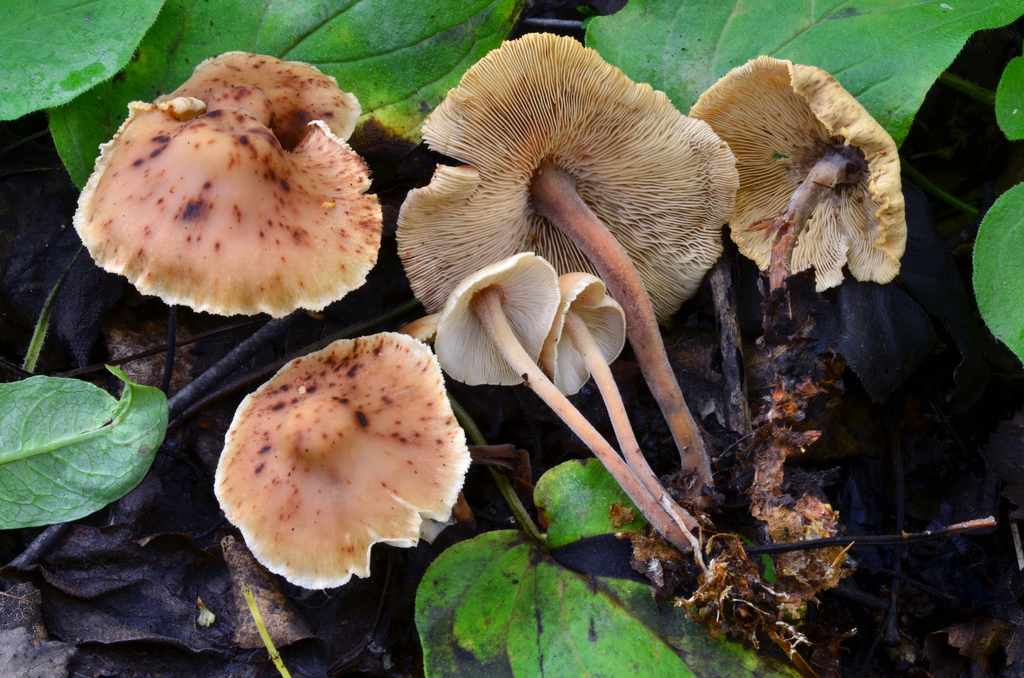
clustered toughshank
Collybiopsis confluens
Collybiopsis confluens, commonly known as the clustered toughshank, is a type of mushroom from the Omphalotaceae family. The fruiting body appears from summer until autumn in deciduous and coniferous forests. Collybiopsis confluens is not an edible mushroom.
From the article Collybiopsis confluens on Wikipedia (CC BY-SA), quoted section by section
Range & habitat
Collybiopsis confluens is widely spread throughout Pakistan and the Holarctic realm. In the Holoartic realm, the distribution area reaches from the meridian to the subarctic climate zone. The species has been documented in North Asia (Caucasus, Eastern Siberia, Kamchatka, China, Korea, Japan), North America (USA, Canada), and Europe. In Europe the mushroom is distributed from Spain in the South to Macedonia in the South-East. In western Europe they can be found in France, Great Britain, in the Benelux countries and northwards to the Hebrides. They appear throughout all of middle Europe, east Europe, Ukraine, Belarus and Russia. They can also be found throughout all of Fennoscandia. In the north, its distribution area reaches Sweden and Finland, to beyond the arctic circle.
Wikipedia: “Distribution”
What it does
This species appears in almost every native forest, as well as in common forest communities. They mainly contain adult copper beeches. The fruiting body appears from July to November mostly in rows of clusters or fairy circles from 1 to 5 meters in diameter. As a substrate, deciduous and coniferous trees serve very well, however they grow most frequently on copper beech wood. The mushrooms appear from lowland to high mountain land.
Wikipedia: “Ecology”
In human culture
The Latin epithet confluens means "to flow together" or "to flow into each other".
Wikipedia: “Etymology”
Where it lives
Recorded sightings
—
geo-referenced records in GBIF, from museums, herbaria and field observers.
Drag the globe to turn it. Dots are where records exist, not a range map; darker means more records.
In the stacks
Searching the stacks…
Every page naming Collybiopsis confluens in the Biodiversity Heritage Library →
This page is assembled live from iNaturalist, GBIF, Wikipedia, the Source Library and the Internet Archive. It is not yet part of the hand-edited codex. iNaturalist taxon 1275338.