- Fungi Including Lichens
- ›Basidiomycete Fungi
- ›Higher Basidiomycetes
- ›Mushrooms, Bracket Fungi, Puffballs, and Allies
- ›Hymenochaetales
- ›Hymenochaetaceae
- ›Trichaptum
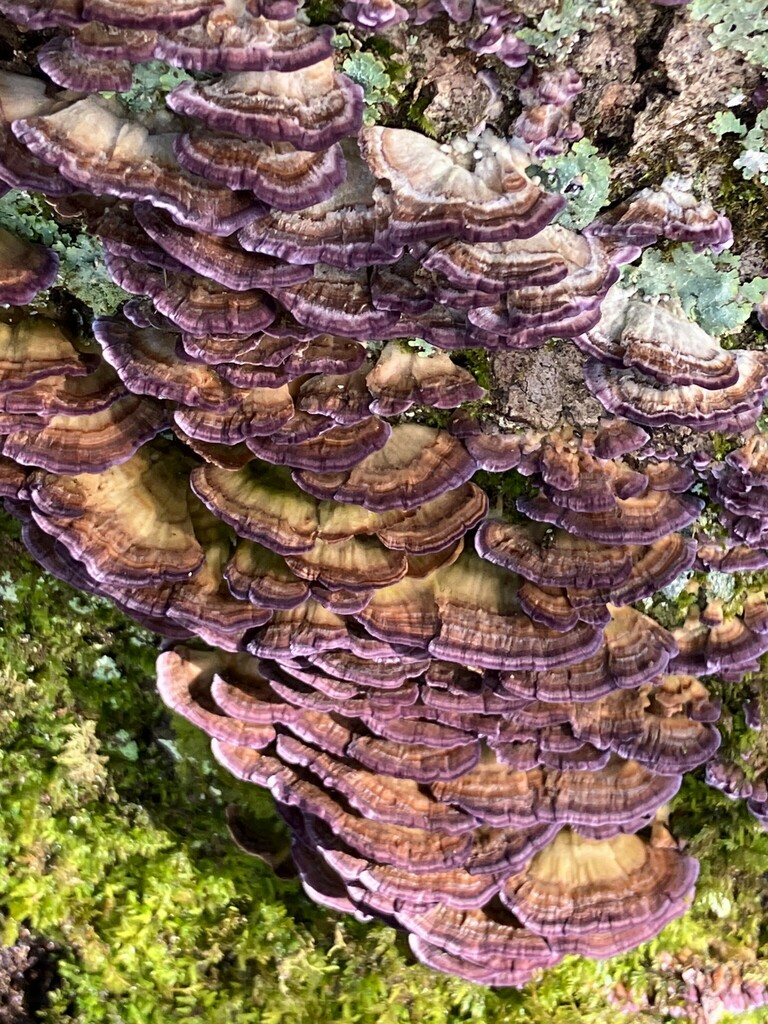
violet-toothed polypore
Trichaptum biforme
Trichaptum biforme, commonly known as the violet-pored bracket fungus, purple tooth, or violet-toothed polypore, is a species of poroid fungus in the order Hymenochaetales.
From the article Trichaptum biforme on Wikipedia (CC BY-SA), quoted section by section
Description
Growing to 1–7.5 centimetres (1⁄2–3 in) in width, it is initially violet before fading into zones of white to brown, retaining violet at the margin for a time.
Similar species. It is sometimes confused with Trichaptum abietinum, which grows almost exclusively on conifers, as do T. byssogenum and T. fuscoviolaceum. Skeletocutis lilacina is also similar.
Range & habitat
T.biforme is a saprobe that decomposes hardwood stumps and logs. Widely distributed, it occurs on at least 65 tree hosts. It rarely grows on conifers, but has been recorded from pine (Pinus) deadwood. T.biforme was once recorded in association with the little-known pleasing fungus beetle Haematochiton elateroides, but it is suspected that the beetles were not feeding on this tough and leathery fungus, but simply hibernating in the dead log on which it grew.
Wikipedia: “Distribution and ecology”
Where it lives
Recorded sightings
—
geo-referenced records in GBIF, from museums, herbaria and field observers.
Drag the globe to turn it. Dots are where records exist, not a range map; darker means more records.
In the stacks
Searching the stacks…
Every page naming Trichaptum biforme in the Biodiversity Heritage Library →
This page is assembled live from iNaturalist, GBIF, Wikipedia, the Source Library and the Internet Archive. It is not yet part of the hand-edited codex. iNaturalist taxon 125705.