- Fungi Including Lichens
- ›Basidiomycete Fungi
- ›Higher Basidiomycetes
- ›Mushrooms, Bracket Fungi, Puffballs, and Allies
- ›Agaricomycetidae
- ›Common Gilled Mushrooms and Allies
- ›Agaricineae
- ›Webcaps
- ›Cortinarius
- ›Paramyxacium
- ›Rozites
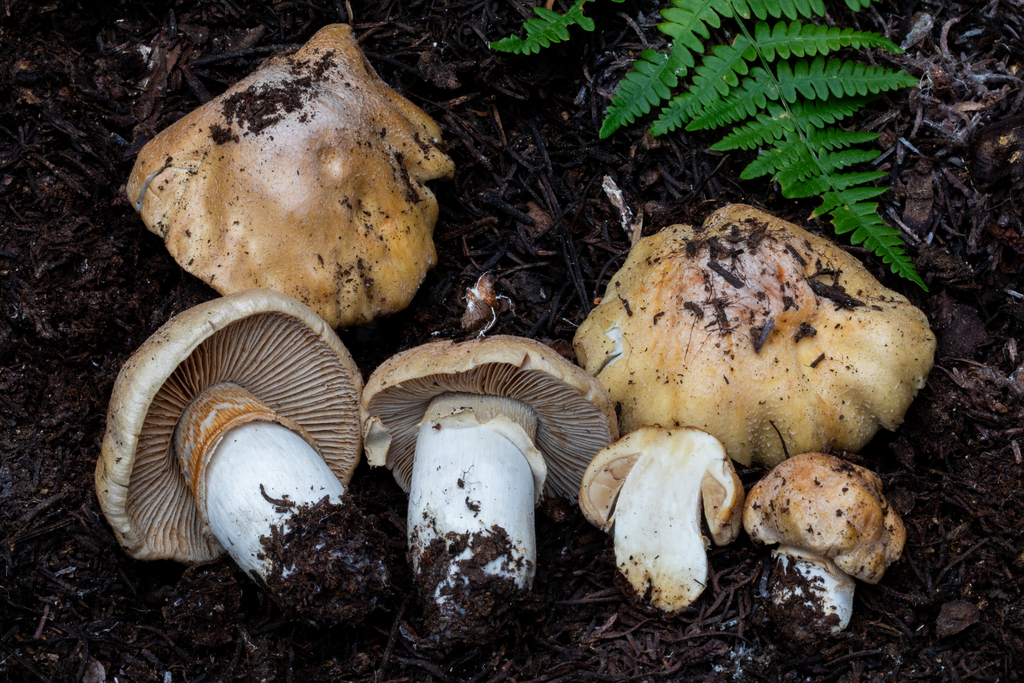
Wrinkled Cortinarius
Cortinarius caperatus
Cortinarius caperatus, commonly known as the wrinkled cort or gypsy mushroom, is a species of fungi of the genus Cortinarius. It was known as Rozites caperata for many years before genetic studies revealed that it belonged to the genus Cortinarius. The Latin specific name, caperatus, means wrinkled and refers to the distinctive texture of the cap. The ochre-coloured cap is up to 10 cm (4 in) across and has a fibrous surface. The clay-colored gills are attached to the stipe under the cap, and the stipe is whitish with a whitish ring. The flesh has a mild smell and flavor. It can resemble a number of other species, including the poisonous Inosperma erubescens in central Europe in summer.
Fruiting bodies of C. caperatus appear in northern parts of Europe and North America in addition to temperate Asia. They can be found in coniferous and beech woods in autumn as well as heathlands in late summer and autumn. The mushrooms have been found to bioaccumulate mercury and radioactive isotopes of caesium and can also be infested by maggots. It is otherwise a highly regarded edible species amongst European mushroom foragers.
From the article Cortinarius caperatus on Wikipedia (CC BY-SA), quoted section by section
Description
C. caperatus has a buff to brownish-ochre cap 5–12 centimetres (2–4+3⁄4 in) diameter, which is covered with whitish fibres. The surface has a wrinkled and furrowed texture. It may have a lilac tinge when young. It is convex initially before expanding and flattening with a boss (umbo) in the centre. The stipe is 4–12 cm (1+1⁄2–4+3⁄4 in) long and 1–2.2 cm (1⁄2–3⁄4 in) thick; it is slightly swollen at the base, and whitish to beige with a noteworthy whitish ring, which is initially attached to the cap. The partial veil is a key identifying feature of the mushroom. The spores give an ochre-brown spore print. The warty almond-shaped spores measure 10–13 μm long by 8–9 μm wide. The flesh is cream-coloured and the flavor mild.
Similar species. Similar-looking North American species include Agrocybe praecox, which lacks the wrinkled cap and is found in cultivated areas, and Phaeolepiota aurea, which has a powdery-granular surface. Members of the Cortinarius subgenus Telamonia have thin rings and C. corrugatus has none, with a wrinkled cap. In central Europe, old specimens could be mistaken for the highly poisonous Inosperma erubescens in summer, and young mushrooms for the inedible Cortinarius traganus, although the latter is readily distinguished by its unpleasant odour.
Range & habitat
C. caperatus is found across northern Europe, mainly in Scandinavia, where it is common, although it is uncommon in Denmark and Iceland. In the British Isles it is uncommon outside the Scottish Highlands and the New Forest. It has been classified as vulnerable in Germany and Great Britain and endangered in the Netherlands. C. caperatus had become less common in the vicinity of Salzburg in Austria between 1937 and 1988, thought due to picking. It is widely found in northern parts of North America, as far south as Mendocino County on the west coast. It is uncommon in California. C. caperatus is a rare component of subarctic areas of western Greenland. The fungus also grows in temperate Asia, having been recorded growing with bilberry near oriental beech (Fagus orientalis) and fir near Pamukova in the Marmara Region of Turkey. It is also found in boggy areas of the taiga (boreal pine forest) in western Siberia. Fruiting bodies sprout from August to October in conifer and beech woods, as well as heather (often close by sphagnum) in Scotland. It is mycorrhizal but non-selective in its hosts. Mushrooms appear from September to November in North America, and July and August in Alaska. It prefers acidic and sandy soils and avoids chalky ones, and may be found in the same habitats as bay bolete (Imleria badia), brown roll-rim (Paxillus involutus), and chanterelles. …
Wikipedia: “Distribution and habitat”
At the table
C. caperatus is a highly regarded edible mushroom with a mild to good flavour. It is said to mix well with stronger-flavoured fungi such as chanterelles, boletes, brittlegills or milk-caps. The mushroom can have a faintly bitter taste if eaten raw, but a pleasant nutty flavour when cooked. It can readily be dried for later use, such as adding to soups and stews. It is sold commercially in Finland, and is a popular target of foragers in many parts of Europe. Mycologist David Arora recommends discarding the tough stipes.
Wikipedia: “Edibility”
Where it lives
Recorded sightings
—
geo-referenced records in GBIF, from museums, herbaria and field observers.
Drag the globe to turn it. Dots are where records exist, not a range map; darker means more records.
In the stacks
Searching the stacks…
Every page naming Cortinarius caperatus in the Biodiversity Heritage Library →
This page is assembled live from iNaturalist, GBIF, Wikipedia, the Source Library and the Internet Archive. It is not yet part of the hand-edited codex. iNaturalist taxon 125364.