- Fungi Including Lichens
- ›Basidiomycete Fungi
- ›Higher Basidiomycetes
- ›Mushrooms, Bracket Fungi, Puffballs, and Allies
- ›Agaricomycetidae
- ›Common Gilled Mushrooms and Allies
- ›Agaricineae
- ›Tubariaceae
- ›Tubaria
- ›Confragosae
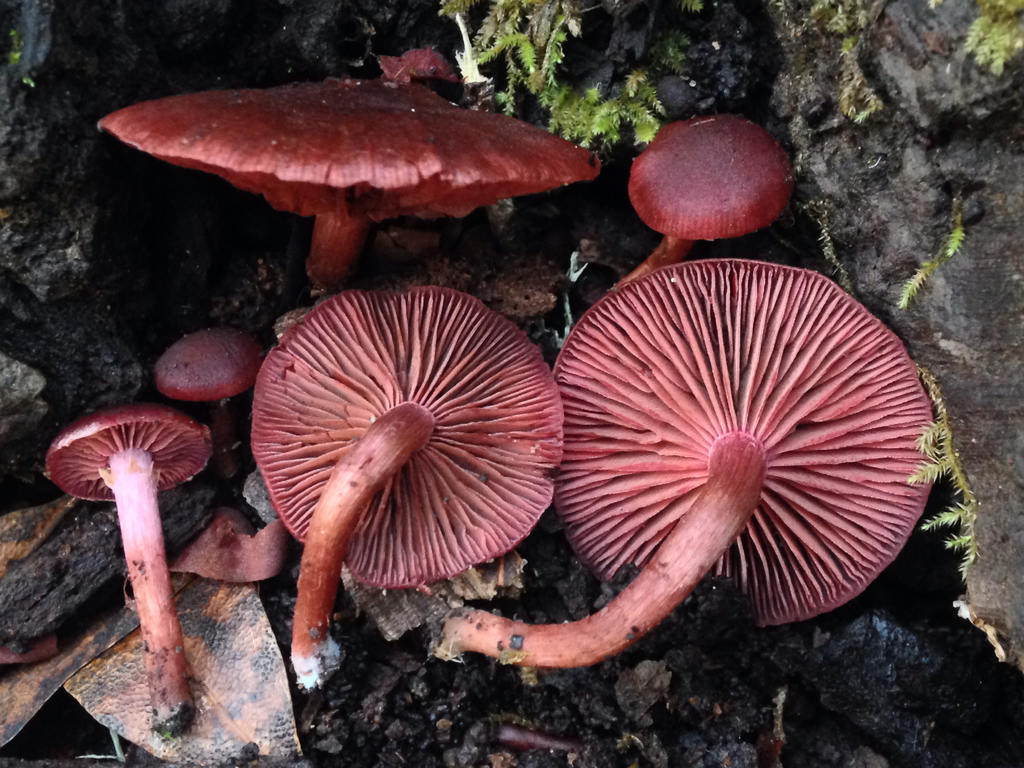
Maroon Madrone Tubaria
Tubaria punicea
Tubaria punicea is a rare species of agaric fungus in the family Tubariaceae. It is found on the west coast of North America, where it grows on the bases and in hollows of madrone (genus Arbutus).
From the article Tubaria punicea on Wikipedia (CC BY-SA), quoted section by section
Description
Fruit bodies have caps that are initially hemispherical to convex, but later become flattened, sometimes developing a low, broad umbo; the cap diameter is 1–5 cm (0.4–2.0 in). Its surface is dry, and its color vinaceous, with lighter margins. The cap margin is curved downward, and has faint radial grooves. It may be irregular in instances where fruit bodies have grown together in clusters. The gills have an adnate to somewhat decurrent attachment to the stipe. They are somewhat closely spaced. Initially deep vinaceous, they become brownish with a reddish tinge after the spores mature. The stipe measures 2–9 cm (0.8–3.5 in) long by 2.6–6 mm (0.1–0.2 in) thick, and the same width throughout its length, or slightly thicker at the base. It has a fibrillose surface texture, and, in mature specimens, faint longitudinal grooves. It is wine-red with a whitish base. Young individuals have a silky white partial veil that later becomes fibrillose (as if made of threadlike fibers) and vinaceous in color. The flesh is reddish brown and lacks any discernible odor. The spore print is cinnamon brown. Due to its rarity, the edibility of the mushroom has not been definitively established, but one report suggests that it is "harmless", with a flavor of "bland beef". Spores are typically 7.2–7.8 by 4.6–5.1 μm with a shape ranging from somewhat phaseoliform (bean-shaped) to elliptical to egg-shaped. …
Range & habitat
Tubaria punicea is a saprobic species, and grows on the rotting wood of Arbutus. Fruit bodies are commonly encountered in the hollowed bases of large trees. Usual habitats include mixed forests containing Pseudotsuga, Arbutus, or Quercus. A rare species, the fungus is distributed on the west coast of North America from British Columbia, Canada, to Marin County, California.
Wikipedia: “Habitat and distribution”
Where it lives
Recorded sightings
—
geo-referenced records in GBIF, from museums, herbaria and field observers.
Drag the globe to turn it. Dots are where records exist, not a range map; darker means more records.
In the stacks
Searching the stacks…
Every page naming Tubaria punicea in the Biodiversity Heritage Library →
This page is assembled live from iNaturalist, GBIF, Wikipedia, the Source Library and the Internet Archive. It is not yet part of the hand-edited codex. iNaturalist taxon 120971.