- Fungi Including Lichens
- ›Basidiomycete Fungi
- ›Higher Basidiomycetes
- ›Mushrooms, Bracket Fungi, Puffballs, and Allies
- ›Agaricomycetidae
- ›Common Gilled Mushrooms and Allies
- ›Marasmiineae
- ›Physalacriaceae
- ›Armillaria
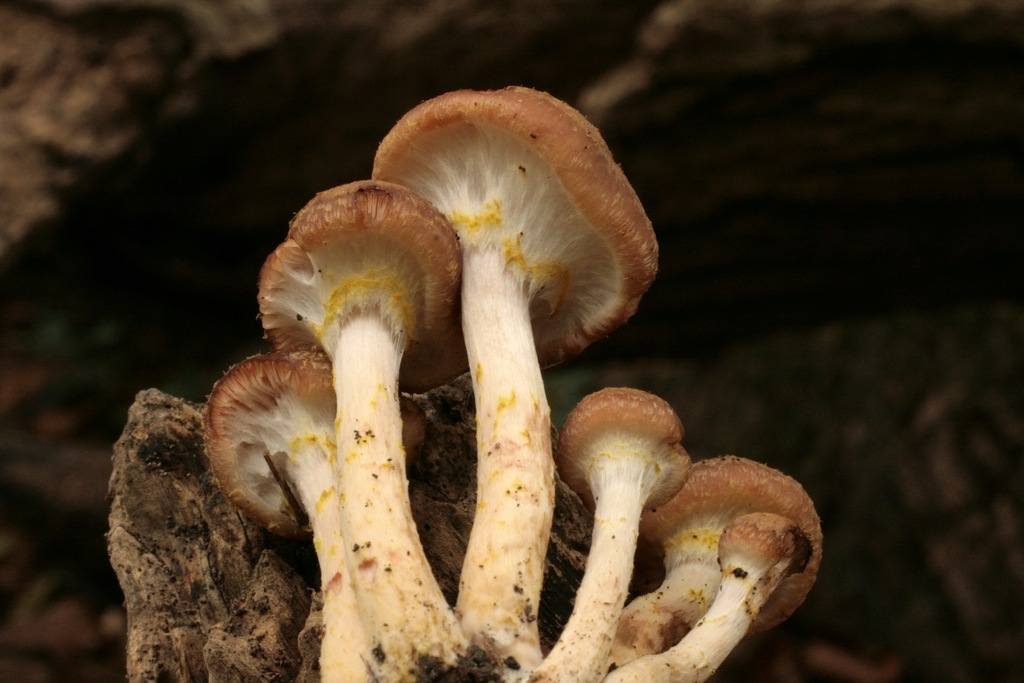
Bulbous Honey Fungus
Armillaria gallica
Armillaria gallica (synonymous with A. bulbosa and A. lutea) is a species of honey mushroom in the family Physalacriaceae of the order Agaricales. The species is a common and ecologically important wood-decay fungus that can live as a saprobe, or as an opportunistic parasite in weakened tree hosts to cause root or butt rot. It is found in temperate regions of Asia, North America, and Europe. The species forms fruit bodies singly or in groups in soil or rotting wood. The fungus has been inadvertently introduced to South Africa. Armillaria gallica has had a confusing taxonomy, due in part to historical difficulties encountered in distinguishing between similar Armillaria species. The fungus received international attention in the early 1990s when an individual colony living in a Michigan forest was reported to cover an area of 15 hectares (37 acres), weigh at least 9.5 tonnes (9,500 kg; 21,000 lb), and be 1,500 years old. This individual is popularly known as the "humongous fungus", and is a tourist attraction and inspiration for an annual mushroom-themed festival in Crystal Falls. Recent studies have revised the fungus's age to 2,500 years and its size to about 400 tonnes (400,000 kg; 880,000 lb), four times the original estimate.
Armillaria gallica is a largely subterranean fungus, and it produces fruit bodies that are up to about 10 cm (3.9 in) in diameter, yellow-brown, and covered with small scales. On the underside of the caps are gills that are white to creamy or pale orange.
From the article Armillaria gallica on Wikipedia (CC BY-SA), quoted section by section
Description
The fruit bodies of Armillaria gallica have caps that are 2.5–9.5 cm (1.0–3.7 in) broad, and depending on their age, may range in shape from conical to convex to flattened. The caps are brownish-yellow to brown when moist, often with a darker-colored center; the color tends to fade upon drying. The cap surface is covered with slender fibers (same color as the cap) that are erect, or sloping upwards. When the fruit bodies are young, the underside of the caps have a cottony layer of tissue stretching from the edge of the cap to the stem—a partial veil—which serves to protect the developing gills. As the cap grows in size the membrane is eventually pulled away from the cap to expose the gills. The gills have an adnate (squarely attached) to somewhat decurrent (extending down the length of the stem) attachment to the stem. They are initially white, but age to a creamy or pale orange covered with rust-colored spots. The stem is 4–10 cm (1.6–3.9 in) long and 0.6–1.8 cm (0.24–0.71 in) thick, and almost club-shaped with the base up to 1.3–2.7 cm (0.5–1.1 in) thick. Above the level of the ring, the stem is pale orange to brown, while below it is whitish or pale pink, becoming grayish-brown at the base. The ring is positioned about 0.4–0.9 cm (0.16–0.35 in) below the level of the cap, and may be covered with yellowish to pale-brownish woolly cottony mycelia. …
Range & habitat
Armillaria gallica can normally be found on the ground, but sometimes on stumps and logs. Mushrooms that appear to be terrestrial are attached to plant roots underneath the surface. It is widely distributed and has been collected in North America, Europe, and Asia (China, Iran, and Japan). The species has also been found in the Western Cape Province of South Africa, where it is thought to have been introduced from potted plants imported from Europe during the early colonization of Cape Town. In Scandinavia, it is absent in areas with very cold climates, like Finland or Norway, but it is found in southern Sweden. It is thought to be the most prevalent low altitude species of Armillaria in Great Britain and France. The upper limits of its altitude vary by region. In the French Massif Central, it is found up to 1,100 m (3,600 ft), while in Bavaria, which has a more continental climate, the upper limit of distribution reaches 600 m (2,000 ft). In Serbian forests, it is the most common Armillaria between elevations of 70 to 1,450 m (230 to 4,760 ft). Field studies suggest that A. gallica prefers sites that are low in organic matter and have high soil pHs. In North America, it is common east of the Rocky Mountains, but rare in the Pacific Northwest. …
Wikipedia: “Habitat and distribution”
What it does
The life cycle of A. gallica includes two diploidization–haploidization events. The first of these is the usual process of cell fusion (forming a diploid) followed by meiosis during the formation of haploid basidiospores. The second event is more cryptic and occurs before fruit body formation. In most basidiomycetous fungi, the hyphae of compatible mating types will fuse to form a two-nucleate, or dikaryotic stage; this stage is not observed in Armillaria species, which have cells that are mostly monokaryotic and diploid. Genetic analyses suggest that the dikaryotic mycelia undergo an extra haploidization event prior to fruit body formation to create a genetic mosaic. These regular and repeating haploidization events result in increased genetic diversity, which helps the fungus to adapt to unfavorable changes in environmental conditions, such as drought. The growth rate of A. gallica rhizomorphs is between 0.3 and 0.6 m (1.0 and 2.0 ft) per year. Population genetic studies of the fungus conducted in the 1990s demonstrated that genetic individuals grow mitotically from a single point of origin to eventually occupy territories that may include many adjacent root systems over large areas (several hectares) of forest floor. Based on the low mutation rates observed in large, long-lived individuals, A. gallica appears to have an especially stable genome. …
Wikipedia: “Life cycle and growth”
Where it lives
Recorded sightings
—
geo-referenced records in GBIF, from museums, herbaria and field observers.
Drag the globe to turn it. Dots are where records exist, not a range map; darker means more records.
In the stacks
Searching the stacks…
Every page naming Armillaria gallica in the Biodiversity Heritage Library →
This page is assembled live from iNaturalist, GBIF, Wikipedia, the Source Library and the Internet Archive. It is not yet part of the hand-edited codex. iNaturalist taxon 118401.