- Fungi Including Lichens
- ›Basidiomycete Fungi
- ›Higher Basidiomycetes
- ›Mushrooms, Bracket Fungi, Puffballs, and Allies
- ›Agaricomycetidae
- ›Common Gilled Mushrooms and Allies
- ›Agaricineae
- ›Hymenogastraceae
- ›Agrocybe
- ›Agrocybe praecox
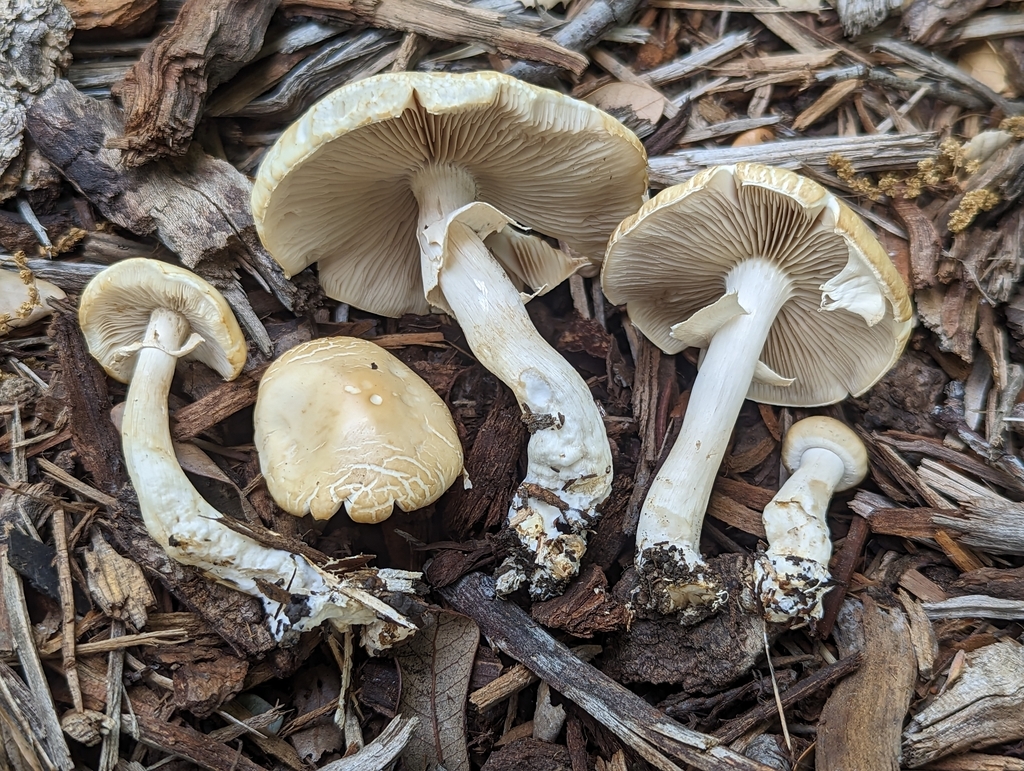
Spring Fieldcap
Agrocybe praecox
Agrocybe praecox, commonly known as the spring agrocybe, early agrocybe, or spring fieldcap, is a species of fungus. According to modern analysis, it is one of a cluster of closely similar species, known as the A. praecox complex.
It appears early in the year in woods, gardens, and fields in Eurasia, North Africa, and North America. It is of debatable culinary interest.
From the article Agrocybe praecox on Wikipedia (CC BY-SA), quoted section by section
Description
Agrocybe praecox belongs to a group of species which are difficult to distinguish consistently. The cap is up to 10 centimeters (4 inches) wide, bun-shaped and brownish then convex and lightening to tannish (beige when dry and yellowish-brown when moist), and smooth. Veil remnants are often visible around the rim. The gills are initially pale grayish, later brown. The stem is pale, 4 to 12 cm (1+1⁄2 to 4+3⁄4 in) long and up to about 2 cm thick, with a fragile ring. They often have white mycelial cords at the base. The odor and taste are floury. The taste may be bitter. The spores are 8–10 x 5–7 μm, elliptical, and brown en masse.
Similar species. The following species are closely related to A. praecox, according to Index Fungorum and other sources.
Another similar species is A. smithii.
Range & habitat
It can grow alone or gregarious in grass, compost, or on wood debris in woods and gardens. Like other Agrocybes, it is a saprophyte. It has a widespread distribution in North America (spring to summer), Europe, Asia, and North Africa. Also it has been reported from Mongolia, Siberia, Sri Lanka, South Korea, Japan, New Zealand, Argentina and Colombia.
Wikipedia: “Habitat and distribution”
At the table
The species is not flavorful but is sometimes considered edible, but because it belongs to a group, it may overlap with some inedible taxa. According to one French source, due to its bitterness and soft consistency, it is best left aside. One site says that it is edible but needs to be well cooked. Roger Phillips lists it as inedible.
== References ==
Wikipedia: “Uses”
Where it lives
Recorded sightings
—
geo-referenced records in GBIF, from museums, herbaria and field observers.
Drag the globe to turn it. Dots are where records exist, not a range map; darker means more records.
In the stacks
Searching the stacks…
Every page naming Agrocybe praecox in the Biodiversity Heritage Library →
This page is assembled live from iNaturalist, GBIF, Wikipedia, the Source Library and the Internet Archive. It is not yet part of the hand-edited codex. iNaturalist taxon 118391.