- Fungi Including Lichens
- ›Basidiomycete Fungi
- ›Higher Basidiomycetes
- ›Mushrooms, Bracket Fungi, Puffballs, and Allies
- ›Agaricomycetidae
- ›Common Gilled Mushrooms and Allies
- ›Agaricineae
- ›Field Mushrooms and Allies
- ›Agariceae
- ›Agaricus
- ›Agaricus
- ›Agaricus
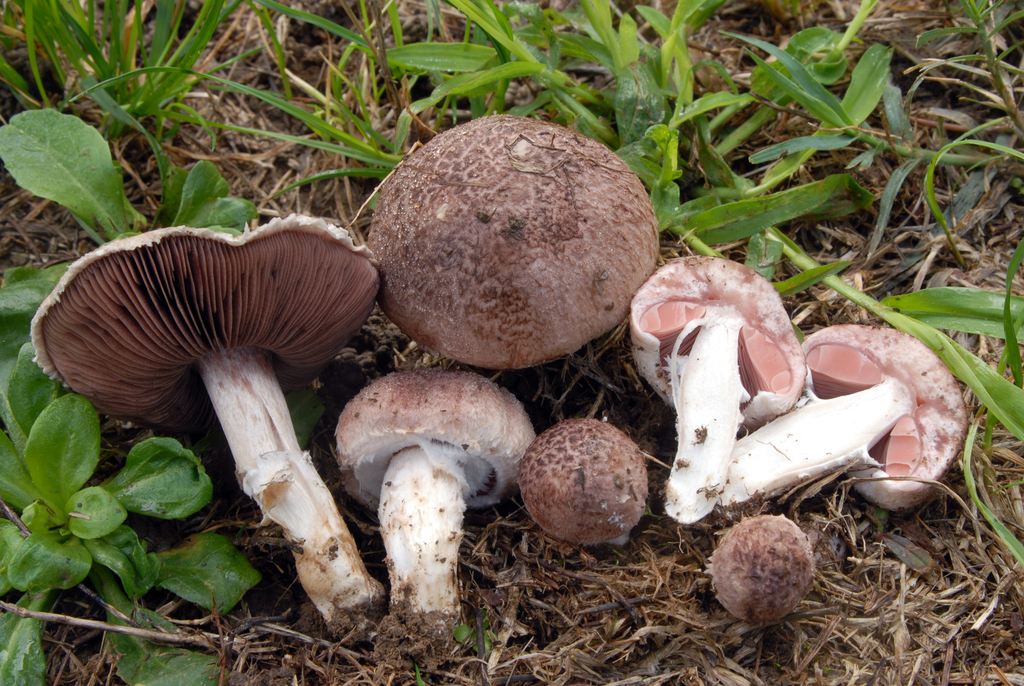
Agaricus cupreobrunneus
Agaricus cupreobrunneus, commonly known as the copper mushrooom or brown field mushroom, is an edible mushroom of the genus Agaricus.
From the article Agaricus cupreobrunneus on Wikipedia (CC BY-SA), quoted section by section
Description
The brown cap is 3–10 centimetres (1–4 inches) wide with flattened reddish-brown fibrils. The white stalk is 2–7 cm (1–3 in) tall and 1–2 cm wide. The spores are dark brown, elliptical, and smooth.
Similar species. A. cupreobrunneus is similar in general appearance to a number of other Agaricus species, especially to A. campestris. It also bears strong similarities to A. argenteus, A. augustus, A. hondensis, A. porphyrocephalus, and A. rutilescens. The only potential lookalikes of A. cupreobrunneus that are poisonous are yellow- or red-staining, or occur in much different habitats.
Range & habitat
Agaricus cupreobrunneus tends to fruit in disturbed areas and grassy places, such as lawns, pastures, and roadsides. It can fruit by itself, gregariously, or in fairy rings.
Wikipedia: “Distribution and habitat”
At the table
A. cupreobrunneus is edible and good. Its taste is comparable to that of A. campestris, but it is comparatively lacking in texture. A. cupreobrunneus is not currently cultivated on a widespread basis, but is commonly eaten by collectors in the areas in which it grows. It does not contain the carcinogen agaritine, which appears in many other members of the genus Agaricus.
Wikipedia: “Edibility”
Where it lives
Recorded sightings
—
geo-referenced records in GBIF, from museums, herbaria and field observers.
Drag the globe to turn it. Dots are where records exist, not a range map; darker means more records.
In the stacks
Searching the stacks…
Every page naming Agaricus cupreobrunneus in the Biodiversity Heritage Library →
This page is assembled live from iNaturalist, GBIF, Wikipedia, the Source Library and the Internet Archive. It is not yet part of the hand-edited codex. iNaturalist taxon 118384.