- Fungi Including Lichens
- ›Basidiomycete Fungi
- ›Higher Basidiomycetes
- ›Mushrooms, Bracket Fungi, Puffballs, and Allies
- ›Agaricomycetidae
- ›Common Gilled Mushrooms and Allies
- ›Marasmiineae
- ›Omphalotaceae
- ›Rhodocollybia
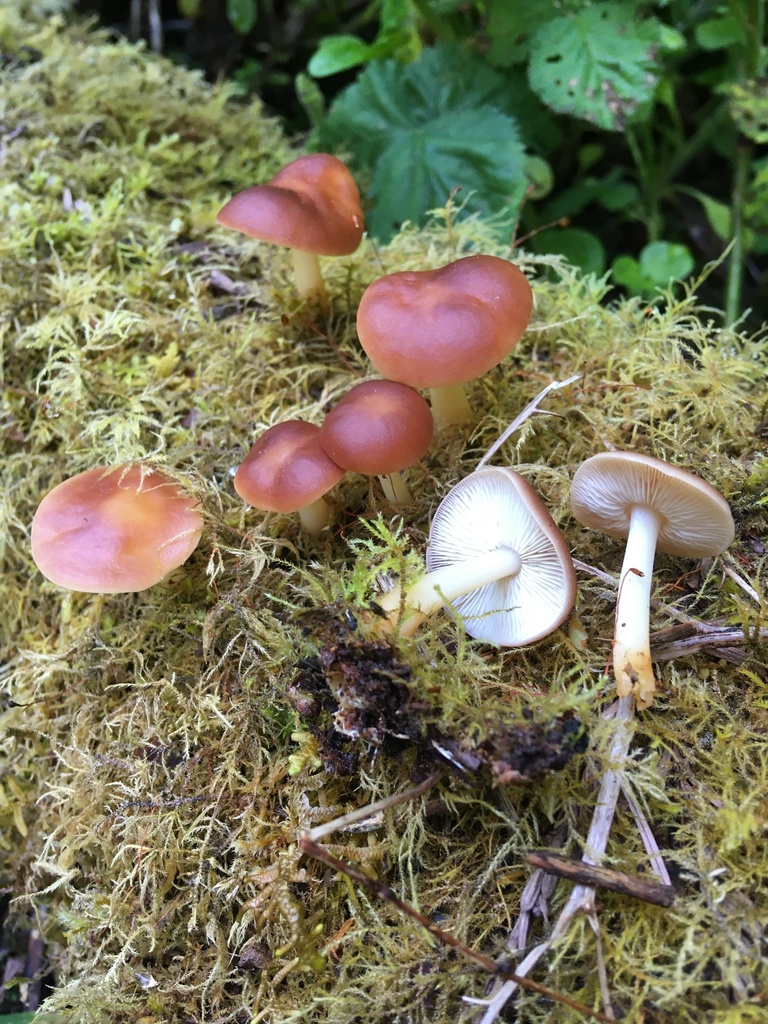
Buttery Collybia
Rhodocollybia butyracea
Rhodocollybia butyracea, commonly known as the buttery collybia, is a species of fungus in the family Omphalotaceae. It has a number of subspecies.
From the article Rhodocollybia butyracea on Wikipedia (CC BY-SA), quoted section by section
Description
The cap is 2 to 10 centimetres (3⁄4 to 4 in) across. It is convex and becomes broadly convex or almost flat. When fresh, this species is smooth and moist. It has a reddish-brown colour fading to cinnamon. The gills are either free from the stem, or narrowly attached. They range from close to crowded and are whitish. Occasionally, they develop a pinkish tone as they age, and often form fine, jagged edges. The stem is up to 10 cm long and 1 cm thick. It is normally somewhat club-shaped. It can either be moist or dry. The flesh of this species is white. There is no distinctive odor or taste. The spores are pale yellowish, pale pinkish, or white.
Similar species. It can resemble R. badiialba, R. prolixa, and Gymnopus dryophilus.
What it does
This species is saprobic. It decomposes litter from conifers, usually that of the genus Pinus, and occasionally hardwoods.
Wikipedia: “Ecology”
Where it lives
Recorded sightings
—
geo-referenced records in GBIF, from museums, herbaria and field observers.
Drag the globe to turn it. Dots are where records exist, not a range map; darker means more records.
In the stacks
Searching the stacks…
Every page naming Rhodocollybia butyracea in the Biodiversity Heritage Library →
This page is assembled live from iNaturalist, GBIF, Wikipedia, the Source Library and the Internet Archive. It is not yet part of the hand-edited codex. iNaturalist taxon 118166.