- Fungi Including Lichens
- ›Basidiomycete Fungi
- ›Higher Basidiomycetes
- ›Mushrooms, Bracket Fungi, Puffballs, and Allies
- ›Agaricomycetidae
- ›boletes and allies
- ›Suillineae
- ›Suillaceae
- ›Suillus
- ›Douglasia
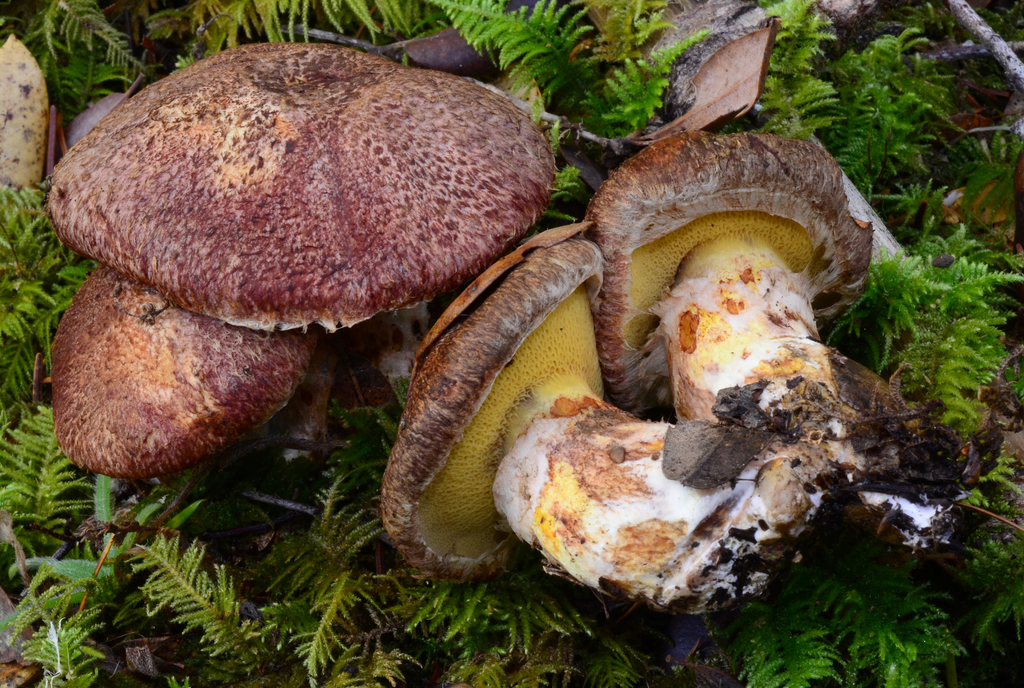
Western Painted Suillus
Suillus lakei
Suillus lakei, commonly known as the matte Jack, Lake's bolete, or the western painted Suillus, is a species of fungus in the family Suillaceae. It is characterized by the distinctive reddish-brown tufted fibers or small scales on the cap, and the presence of a woolly veil on the stem. The caps can reach diameters of up to 15 cm (6 in), while the stems are between 6 and 12 cm (2+1⁄4 and 4+3⁄4 in) long and usually 1–3 cm (1⁄2–1+1⁄4 in) thick. On the underside of the cap is a layer of spongy yellow to yellow-brown angular pores; these pores are covered with a whitish partial veil when young.
A mycorrhizal fungus, S. lakei grows in association with Douglas-fir. It is native to northwestern North America, but has been introduced to Europe as well as South America and New Zealand. The mushroom is edible, but opinions vary as to its quality.
From the article Suillus lakei on Wikipedia (CC BY-SA), quoted section by section
Description
The cap of S. lakei is up to 15 cm (6 in) in diameter and initially convex, but flattens out somewhat in maturity. The cap is fleshy, dry, yellowish to reddish-brown but fades with age. It is covered with pressed-down hairs or minute tufted scales in the center, with the yellowish flesh visible between the scales. Heavy rain can wash the fibrils off the cap surface, leaving a sticky, glutinous layer behind. Older specimens may be nearly smooth in age. Remnants of the partial veil sometimes hang from the edge of the cap. The cap margin is initially curved or rolled inwards, but unrolls as it grows and in maturity may be curled upward.
The tubes that comprise the pore surface on the underside of the cap are 5–12 mm (1⁄4–1⁄2 in) deep; the angular pores are up to 2.5 mm wide and radially arranged. The pores range in color from yellow to brownish-yellow to ochre, and stain brownish or reddish-brown when bruised. They are covered by a partial veil in young specimens. The flesh is thick, yellow, and either unchanged in color when bruised or broken, or turns pinkish-red. The stem is 6 to 12 cm (2+3⁄8 to 4+3⁄4 in) long and usually 1–3 cm (3⁄8–1+1⁄8 in) thick, yellow, sometimes with reddish streaks (particularly below the ring zone), and solid and yellow within. The species usually lacks the glandular dots on the stem that are characteristic of some Suillus species. …
Range & habitat
Suillus lakei is indigenous to the Rocky Mountains and western parts of North America. Its range extends south into Mexico. Fruit bodies grow solitarily or in groups on the ground in young conifer stands or grassy parkland. Fruiting occurs in the late summer and autumn, later on the West Coast. Suillus lakei forms ectomycorrhizae with Douglas-fir (Pseudotsuga menziesii), and its distribution coincides with this tree. It is one of the most common bolete species found in northwestern Montana and Idaho. In a study of host specificity in pure culture in the laboratory, S. lakei failed to form healthy ectomycorrhizas with Eucalyptus roots; the hyphae were covered in mucilage-like deposits and appeared to be collapsed. It has also been noted to prefer poor, exposed soil such as that found on road banks and campgrounds. It can often be found with the mushroom Gomphidius subroseus, another species that associates with Douglas-fir. Both Douglas-fir and S. lakei are non-native introduced species in Europe. The fungus has been found in several central and south European countries following the intentional introduction of Douglas-fir. These include Bosnia and Herzegovina, Bulgaria, Czech Republic, Germany, Hungary, Italy, and Slovakia. It is considered endangered in the Czech Republic. …
Wikipedia: “Habitat and distribution”
At the table
Suillus lakei is edible, although opinions vary considerably as to its quality. It has been called choice, mediocre, and of poor taste and texture. Laboratory tests indicate that the fruit bodies have antimicrobial activity, and contain alkaloids and tannins.
Wikipedia: “Edibility”
Where it lives
Recorded sightings
—
geo-referenced records in GBIF, from museums, herbaria and field observers.
Drag the globe to turn it. Dots are where records exist, not a range map; darker means more records.
In the stacks
Searching the stacks…
Every page naming Suillus lakei in the Biodiversity Heritage Library →
This page is assembled live from iNaturalist, GBIF, Wikipedia, the Source Library and the Internet Archive. It is not yet part of the hand-edited codex. iNaturalist taxon 118159.