- Fungi Including Lichens
- ›Ascomycete Fungi
- ›Sac Fungi and Lichens
- ›Operculate Ascomycetes
- ›Pezizales
- ›Pyronemataceae
- ›Geopora
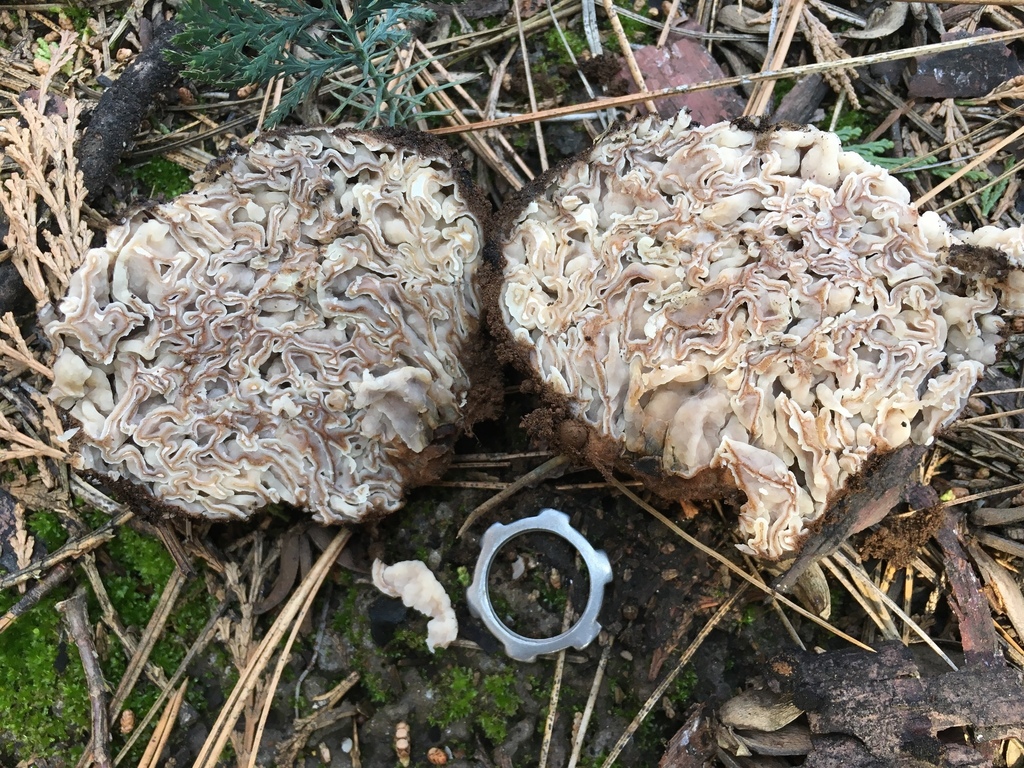
Geopora cooperi
Geopora cooperi, commonly known as the pine truffle or the fuzzy truffle, is a species of fungus in the family Pyronemataceae. It has a fuzzy brown outer surface and an inner surface of whitish, convoluted folds of tissue. Widely distributed in the Northern Hemisphere, the species has been recorded from Asia, Europe, and North America.
From the article Geopora cooperi on Wikipedia (CC BY-SA), quoted section by section
Description
The roughly spherical fruit bodies grow underground. Ranging from 2 to 8 cm (3⁄4 to 3+1⁄8 in) in diameter, they are yellow-brown to darker brown with a fuzzy, furrowed external surface. The inside of the fruit body, the whitish gleba, comprises deeply folded and convoluted tissue with some internal open spaces between them. Young pine truffles ooze a whitish juice when they are cut. The odor of the internal flesh is usually mild, but David Arora has noted the existence of a form in the Western United States that smells similar to fermented cider. The smooth, elliptical or roughly spherical spores measure 18–27 by 13–21 μm and have an oil droplet. The asci (spore-bearing cells) are typically eight-spored. They are arranged as a palisade of cells forming a hymenium that covers the inner surfaces of the internal folds.
Range & habitat
Fruit bodies grow singly or in groups under the soil surface near conifer and Eucalyptus trees. In the field, they can sometimes be detected by the mound of soil they push up as they grow. In western North America, it is found from Mexico to as far north as Alaska. Specimens from the latter location have been found under aspen and willow trees. Geopora cooperi is a snowbank mushroom, as it commonly occurs after snow has melted. The fungus has also been recorded in China, western Asia (Turkey), Pakistan, and Europe. In Turkey, it is considered critically endangered.
Wikipedia: “Habitat and distribution”
Where it lives
Recorded sightings
—
geo-referenced records in GBIF, from museums, herbaria and field observers.
Drag the globe to turn it. Dots are where records exist, not a range map; darker means more records.
In the stacks
Searching the stacks…
Every page naming Geopora cooperi in the Biodiversity Heritage Library →
This page is assembled live from iNaturalist, GBIF, Wikipedia, the Source Library and the Internet Archive. It is not yet part of the hand-edited codex. iNaturalist taxon 118136.